
eToro Copy Trading: How It Works, What It Costs, and Whether It's Worth It


Most people know eToro for commission-free stock trading and its social feed. But the feature that genuinely sets the platform apart is CopyTrader, the built-in copy trading system that lets you automatically mirror the portfolio and trades of experienced investors in real time.
We have been testing eToro's copy trading ourselves, and for investors who do not want to spend hours researching individual stocks or building their own portfolios, it is one of the most practical alternatives available today. Think of it as delegating your investment decisions to someone with a public track record, while keeping full control over your money at all times.
In this guide, we break down exactly how eToro copy trading works, what it actually costs (spoiler: less than you might think compared to ETFs), how to choose the right Popular Investor to follow, and what to watch out for.
How eToro Copy Trading Works
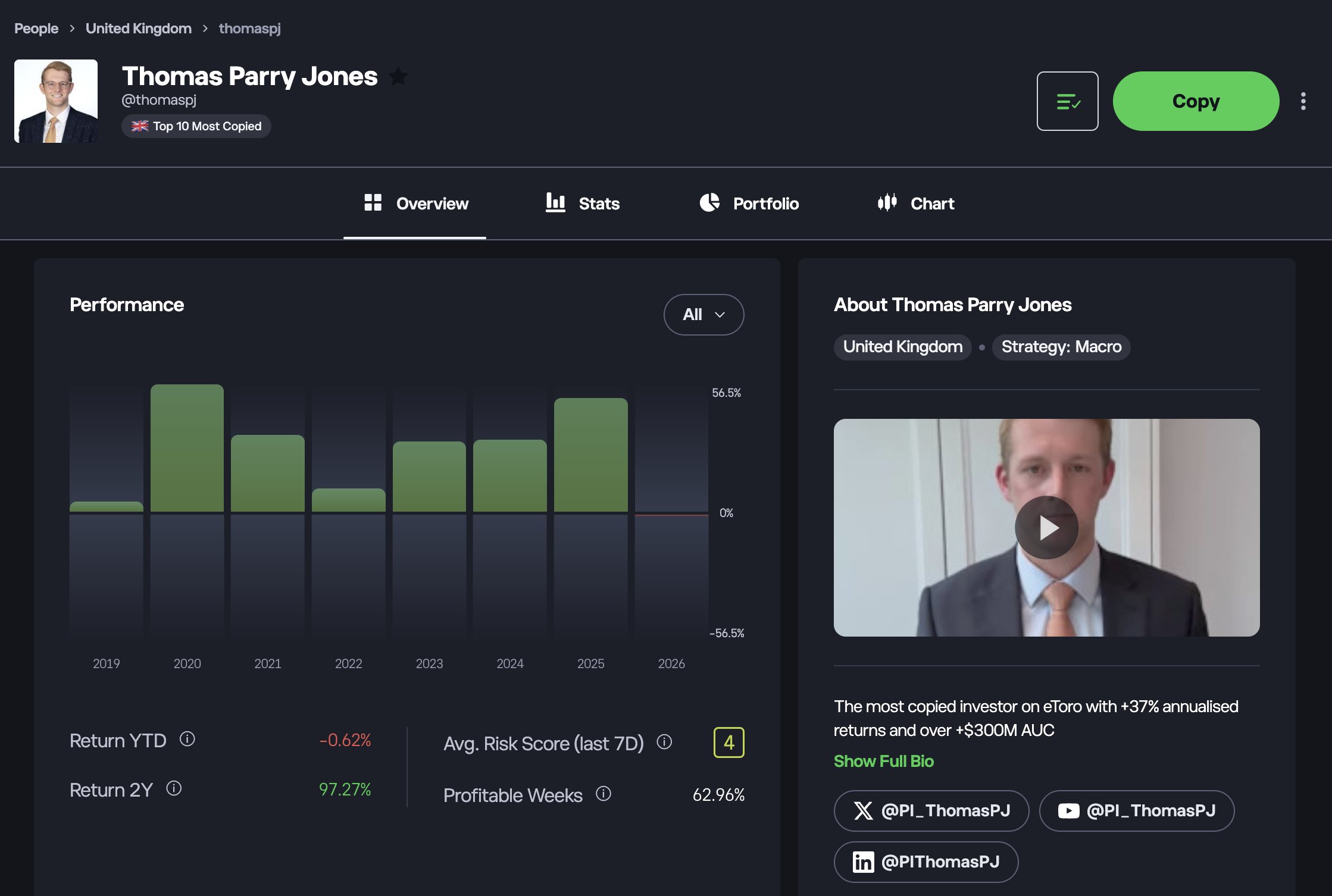
The concept is straightforward. On eToro, thousands of traders and investors operate publicly visible portfolios. These are called Popular Investors, and each one has a detailed profile showing their strategy, risk score, performance history (month by month, year by year), and every single position they hold. Nothing is hidden.
When you decide to copy someone, you allocate a specific amount, starting from $200. From that moment, every trade they make is automatically replicated in your account, proportionally to the amount you have invested. If the trader allocates 10% of their portfolio to Amazon, 10% of your copy allocation goes to Amazon too.
You have two options when you start copying:
- Copy Open Trades: Replicate the investor's entire existing portfolio at current market prices, giving you immediate exposure to their strategy.
- New trades only: Start fresh and only mirror trades they make going forward.
All positions are mirrored in real time and in proportion to your allocated amount. If the investor you are copying has $100,000 in their portfolio and you allocate $1,000, a $10,000 position they open becomes a $100 position in your account. The system handles this automatically.
Full Transparency into Every Investor
This is where eToro genuinely stands out. Before you commit a single dollar, you can examine a Popular Investor's entire track record. The platform shows you:
- Performance by month and by year, going back multiple years
- Risk score (1-10 scale, updated daily)
- Every position in their current portfolio, with allocation percentages and P/L
- Number of copiers and assets under copy
- Their written bio, strategy description, and social media links
- A social feed where they post market updates and explain their thinking

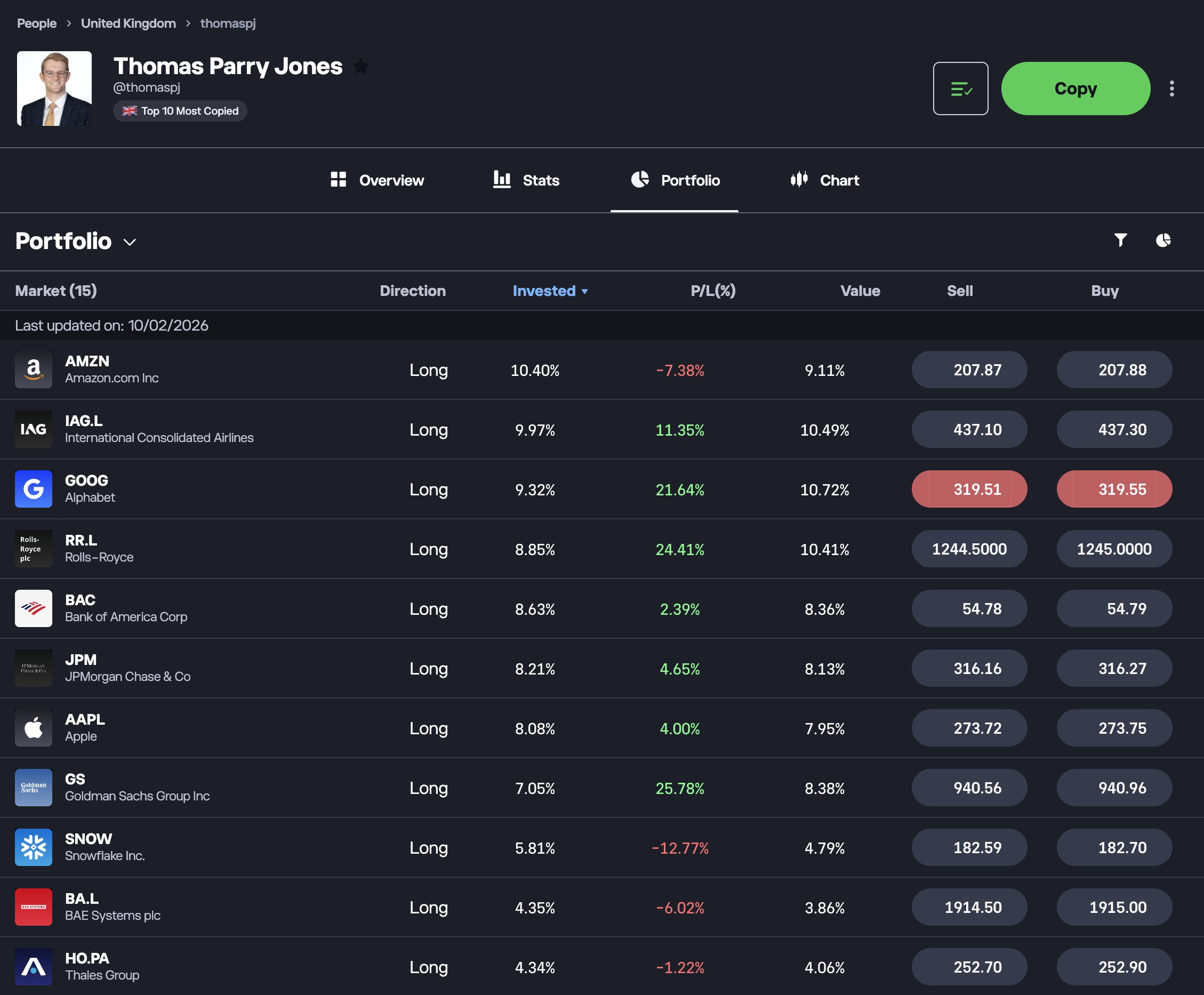
Some of these Popular Investors have been on the platform for over a decade, consistently outperforming the market. The level of transparency is comparable to what you would see in a fund prospectus, but updated in real time and completely free to browse.
You Stay in Control
Unlike handing money to a fund manager, you retain full control at all times. You can:
- Pause copying to stop new trades from being replicated while keeping existing positions open
- Stop copying entirely and choose to either sell all positions or keep them in your portfolio to manage yourself
- Set a Copy Stop Loss (CSL) to automatically close the copy if your losses reach a threshold you define
- Add or withdraw funds from a copy at any time
- Copy multiple investors simultaneously (up to 100) to diversify across different strategies
This flexibility is a significant advantage over traditional managed funds, where your money is typically locked in and you have no say in individual positions.
What Copy Trading Actually Costs (and How It Compares to ETFs)
This is one of the strongest selling points, and one that often gets overlooked. eToro charges zero additional fees for copy trading. There is no management fee, no performance fee, and no subscription cost. The only costs that apply are the same ones you would pay if you bought the same stocks manually on the platform.
Now here is where it gets interesting when you compare this to ETF investing, which many people consider the default passive investment strategy.
When you invest in an ETF, you pay the fund provider's management fee (the expense ratio, typically 0.03% to 0.50% per year) plus, in many cases, a commission to your broker every time you buy or sell. These costs compound over time. A 0.20% annual fee on a $10,000 investment adds up to roughly $200 over ten years, not counting broker commissions.
With eToro copy trading, there is no management fee and no commission on the copied trades themselves. The only costs are the standard market spreads, which apply to any trade on any platform. This makes copy trading a genuinely cost-effective way to access actively managed strategies, something that would traditionally require paying a fund manager 1-2% per year.
For a full breakdown of all eToro fees, including spreads, withdrawal fees, and currency conversion costs, see our complete eToro fees guide.
How to Choose the Right Popular Investor
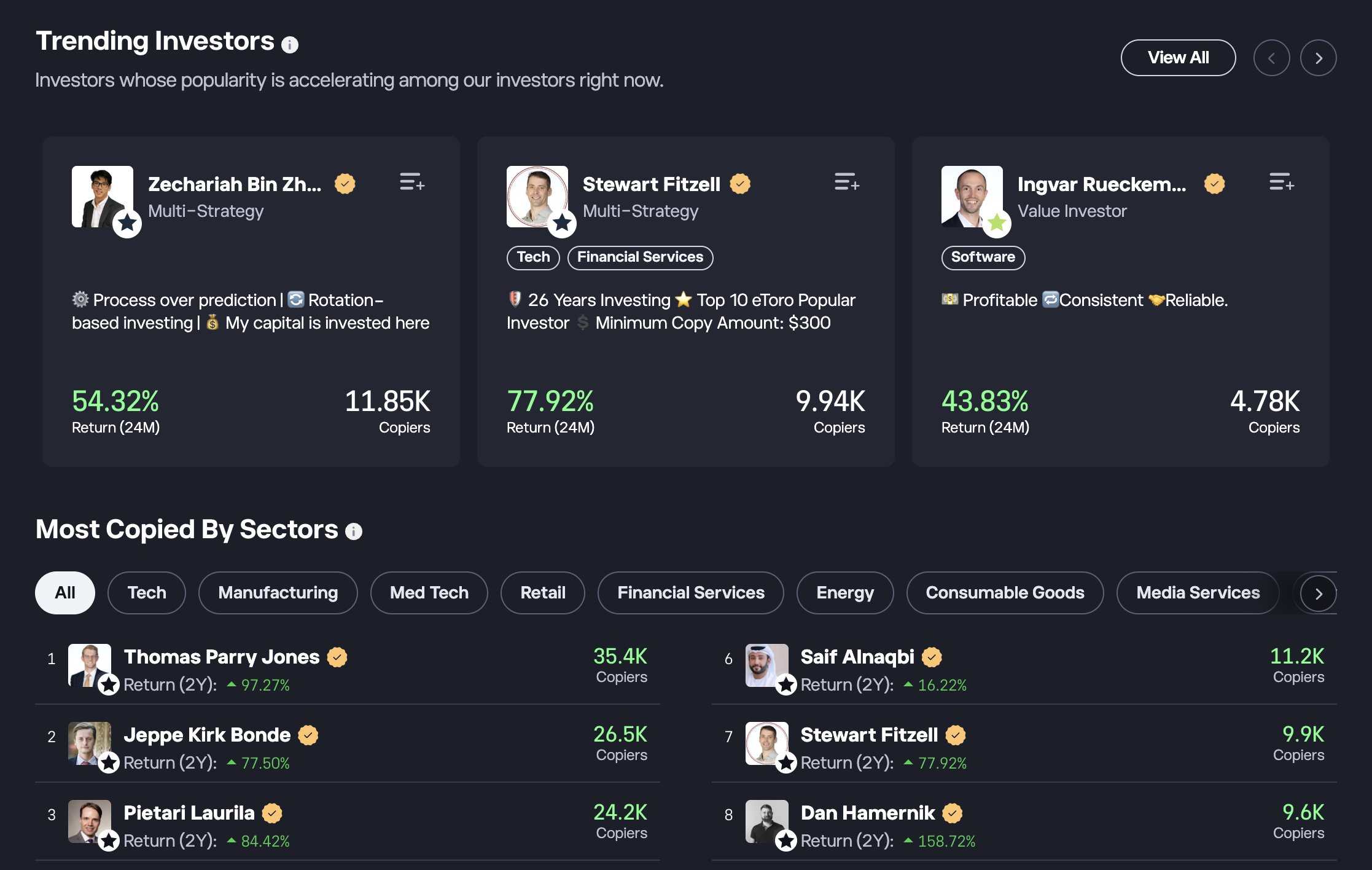
The quality of your copy trading experience depends almost entirely on who you choose to copy. eToro provides extensive filtering tools and data to help you make an informed decision, but here is what we recommend focusing on:
Look at Multi-Year Performance
A single great year does not mean much. Look for investors with at least 2-3 years of consistent performance. eToro shows monthly returns going back several years, so you can see how they performed during both bull and bear markets. An investor who returned 30% in a good year but lost 40% in a downturn has a very different profile from someone who returned 15% consistently.
Understand the Risk Score
Every Popular Investor has a daily risk score from 1 (lowest) to 10 (highest). A score of 4-6 is moderate. Be cautious with anyone consistently above 7, as higher risk scores typically mean concentrated positions or leveraged trades. The risk score is not just a number on a screen, it directly reflects the volatility and concentration of their portfolio.
Read Their Strategy and Feed
The best Popular Investors do not just trade silently. They explain their thinking, post regular market updates, and describe their approach in their bio. This is valuable for two reasons: it helps you understand whether their strategy aligns with your goals, and it gives you insight into how they react during market stress.

Diversify Across Multiple Investors
Do not put all your copy trading allocation into a single investor. Experienced users on forums consistently recommend copying 5-10 traders across different asset classes and strategies. This way, if one investor has a bad stretch, your overall portfolio is cushioned by the others. With the $200 minimum per copy, a diversified copy trading portfolio realistically starts at around $1,000-$2,000.
One Important Rule: Do Not Interfere
This comes up repeatedly in community discussions. Users who manually close individual positions within a copy, overriding the trader's decisions, consistently report worse results than those who let the copy run without interference. If you trust an investor enough to copy them, trust their process. If you disagree with their approach, stop the copy entirely rather than trying to second-guess individual trades.
What to Keep in Mind
We are positive about eToro copy trading, but no honest review skips the caveats. Here are the things you should be aware of before getting started.
Past performance is not a guarantee. An investor who returned 50% last year could lose 20% this year. That is the nature of active investing, and it applies equally to professional fund managers, ETFs during a market crash, or anyone else. The difference with copy trading is that you can see the track record in full detail before you commit, and you can exit at any time.
Small copy amounts can miss trades. When you copy with $200, the proportional allocation means that some of the investor's smaller positions may fall below the $1 minimum per trade. This means your copy may not perfectly replicate every position. If you want a more accurate mirror, allocating $500 or more per investor gives better results.
Standard trading costs still apply. While copy trading itself is free, the same spreads and fees that apply to manual trades on eToro also apply to copied positions. For stock positions held long-term, these are minimal. For details, see our eToro fees breakdown.
Positions stay on eToro. Securities purchased through copy trading cannot be transferred to another broker. This is an eToro platform limitation that applies to all trades, not just copies. If you decide to leave eToro, you would need to sell your positions and transfer the cash.
How to Get Started with eToro Copy Trading
It is worth noting that eToro also offers recurring investments for building positions in individual stocks over time, and eToro Club membership for additional benefits. These features complement copy trading well. You can combine strategies: copy one or more Popular Investors for your passive allocation, while using the rest of your eToro balance to buy individual stocks, ETFs, or crypto as you see fit. You can also explore commodities like eToro gold trading, which is available 24/7.
For details on eToro's regulation and security track record, see our Is eToro Safe? analysis. The platform is now a publicly traded company on Nasdaq (ticker: ETOR) following its May 2025 IPO, adding another layer of regulatory scrutiny and transparency.
Who Is eToro Copy Trading Best For?
Based on our testing and research, eToro copy trading is best suited for:
- Investors who lack the time or interest for research. If you want market exposure through individual stocks but do not have hours to analyse earnings reports and chart patterns, delegating to a proven investor is a practical solution.
- People looking for an alternative to ETFs. Copy trading offers the potential for active, human-driven strategies without ETF management fees. It is not a replacement for index investing, but it can be a complement.
- Beginners who want to learn by observing. Watching how experienced investors allocate their portfolios, react to market moves, and explain their reasoning is a powerful educational tool.
- Investors who want flexibility. Unlike locking your money into a fund, you can start and stop copying at any time, split your allocation across multiple investors, and maintain your own separate positions alongside your copies.
It is less ideal for experienced investors who prefer full control over every trade, or for anyone looking for guaranteed returns (which, of course, do not exist in any form of investing).
New to eToro? You may qualify for a welcome bonus of up to $500 when you sign up and fund your account.
Frequently Asked Questions
Is eToro copy trading actually profitable?
It can be, but results vary entirely based on which investors you copy and when you start. Some Popular Investors have delivered consistent annual returns above 30% over multiple years. Others have had losing periods. The key is careful selection, diversification across multiple investors, and a long-term time horizon. No investment strategy, whether copy trading, ETFs, or individual stock picking, guarantees profits.
What is the minimum amount needed to start copy trading?
The minimum to copy a single investor is $200, with a $1 minimum per individual copied position. For effective diversification across 5-10 investors, we recommend starting with at least $1,000-$2,000. Copying with very small amounts (the $200 minimum) may result in some of the investor's smaller positions not being replicated due to the $1 per-trade minimum.
Do I get charged extra fees for copy trading?
No. eToro does not charge any management fee, performance fee, or subscription for copy trading. The only costs are the same market spreads and standard fees (such as currency conversion or withdrawal fees) that apply to any trade on the platform. For a complete fee breakdown, see our eToro fees guide.
What happens if the investor I am copying closes their account?
If a Popular Investor stops trading, your existing copied positions remain open in your account. You can choose to keep them and manage them yourself, or close them. The copy relationship simply ends, and no new trades are replicated.
Can I manually close individual positions within a copy?
Technically yes, but we do not recommend it. Community experience consistently shows that manually overriding the copied investor's decisions leads to worse results. If you disagree with their strategy, it is better to stop the copy entirely rather than selectively closing positions.
Is copy trading better than investing in ETFs?
They serve different purposes. ETFs provide broad, low-cost diversification with decades of track record data. Copy trading offers actively managed strategies with the potential for outperformance, but with higher variability. Many investors combine both: ETFs for their core allocation and copy trading for a portion where they want more active exposure. The fee advantage of copy trading (no management fee) is notable compared to ETFs, where you pay both the fund's expense ratio and often a broker commission.
How many investors should I copy at once?
We recommend 5-10 for meaningful diversification. Choose investors with different strategies (growth, value, dividend), different geographic focuses, and different risk profiles. This reduces your dependence on any single person's decisions and smooths out your overall returns.
Risk Disclaimer: Trading involves significant risk and may not be suitable for all investors. The value of investments can go down as well as up, and you may lose some or all of your initial investment. Past performance is not indicative of future results. Copy Trading does not amount to investment advice. Your capital is at risk. Terms and conditions apply.eToro is a multi-asset investment platform. The value of your investments may go up or down. Your capital is at risk.
Copy Trading does not amount to investment advice. The value of your investments may go up or down. Your capital is at risk. Past performance is not an indication of future results.
CFDs are complex instruments and come with a high risk of losing money rapidly due to leverage. 51% of retail investor accounts lose money when trading CFDs with this provider. You should consider whether you understand how CFDs work, and whether you can afford to take the high risk of losing your money.
This content contains affiliate links. We may earn a commission if you sign up through them, at no extra cost to you.
.png)

