Trading 212 Review 2026: Features, Fees & Pros & Cons

Trading 212 Review 2026: Commission-Free Investing Done Right
Trading 212 has quietly become one of the most successful investment platforms for retail investors worldwide. While newer fintech brokers compete for attention with flashy marketing, Trading 212 has focused on building a genuinely excellent product that speaks for itself. With over 4.5 million funded accounts and €30 billion in client assets, the numbers tell the story.
We have used Trading 212 for several years now, and it remains one of our top recommendations for investors in the UK, Europe, the UAE, and many other regions. For beginners and intermediate investors especially, Trading 212 is genuinely a joy to use. The interface is clean, intuitive, and makes investing feel approachable rather than intimidating. The combination of zero commissions, extremely low FX fees, competitive interest on cash, and features like Pies makes it an excellent choice for building long-term wealth. But it is not perfect, and we will cover the drawbacks honestly too.
New users can claim a free fractional share worth up to £100/€100 when opening an account through our link (Sponsored Link). Terms apply.
Get Your Free Fractional Share (up to £100/€100)
What is Trading 212?
Trading 212 is a UK-based online broker offering commission-free trading on stocks, ETFs, and CFDs. Founded in 2004 in Bulgaria before relocating its headquarters to London, the company pioneered zero-commission stock trading in Europe before it became the industry standard.
That includes newly listed US shares. Here is our step-by-step guide on how to buy SpaceX stock (SPCX).
The platform is regulated by the UK's Financial Conduct Authority (FCA), Germany's BaFin, and Australia's ASIC. UK clients benefit from FSCS protection up to £85,000 for investments and £120,000 for cash deposits (the latter increased from £85,000 in December 2025), subject to the scheme's eligibility conditions.
We recently enjoyed Trading 212's 2025 rebrand, which gives the app a more modern and sleek appearance. The updated interface makes navigation even smoother, particularly for beginners just getting started with investing. It is easily one of the most user-friendly brokers we have tested, and using the app genuinely feels effortless.
Trading 212 Fees: The Full Picture
One of Trading 212's biggest selling points is its fee structure. The platform charges zero commission on stock and ETF trades, with no platform fees, no ISA fees, and no inactivity fees. Other fees may apply, including a 0.15% currency conversion fee on trades in a currency other than your account currency. See Trading 212's terms and fees.
The main cost to be aware of is the 0.15% FX conversion fee when trading assets in a different currency than your account's base currency. However, Trading 212's multi-currency account feature allows you to hold balances in 13 different currencies (GBP, USD, EUR, CHF, and more), effectively avoiding FX fees if you deposit in the same currency as your trades.
Compared to traditional brokers like Hargreaves Lansdown (which charges up to 1% FX fees) or even eToro (0.5% FX fee), Trading 212's 0.15% rate is extremely competitive.
Interest on Uninvested Cash
Trading 212 pays above-industry-standard interest on uninvested cash held in your account. The rates track central bank rates closely and are among the best offered by any retail broker in both the UK and Europe.
For UK investors, Trading 212 consistently ranks among the best high-yield savings options in the UK. European investors benefit similarly, with EUR rates competitive with the best high-yield accounts in Europe.
Interest is paid daily and there is no minimum balance required. Your cash remains fully accessible, and you can withdraw or invest it at any time without penalties. This is a significant benefit for investors who keep some cash on the side for buying opportunities.
Trading 212 generates these returns by investing idle cash into Qualifying Money Market Funds (QMMFs), time deposits, and current accounts with regulated financial institutions. The rates are tied to central bank rates, so they may change when the Bank of England or ECB adjusts its base rate.
For more details on how this works, read our guide on Trading 212 stock lending and earning interest.
When investing, your capital is at risk. If you enable interest, Trading 212 will hold your cash in qualifying money market funds and banks. Otherwise, your cash will be held only in banks. Interest applies on cash in an investment account. Terms apply.
Trading 212 Pies and AutoInvest
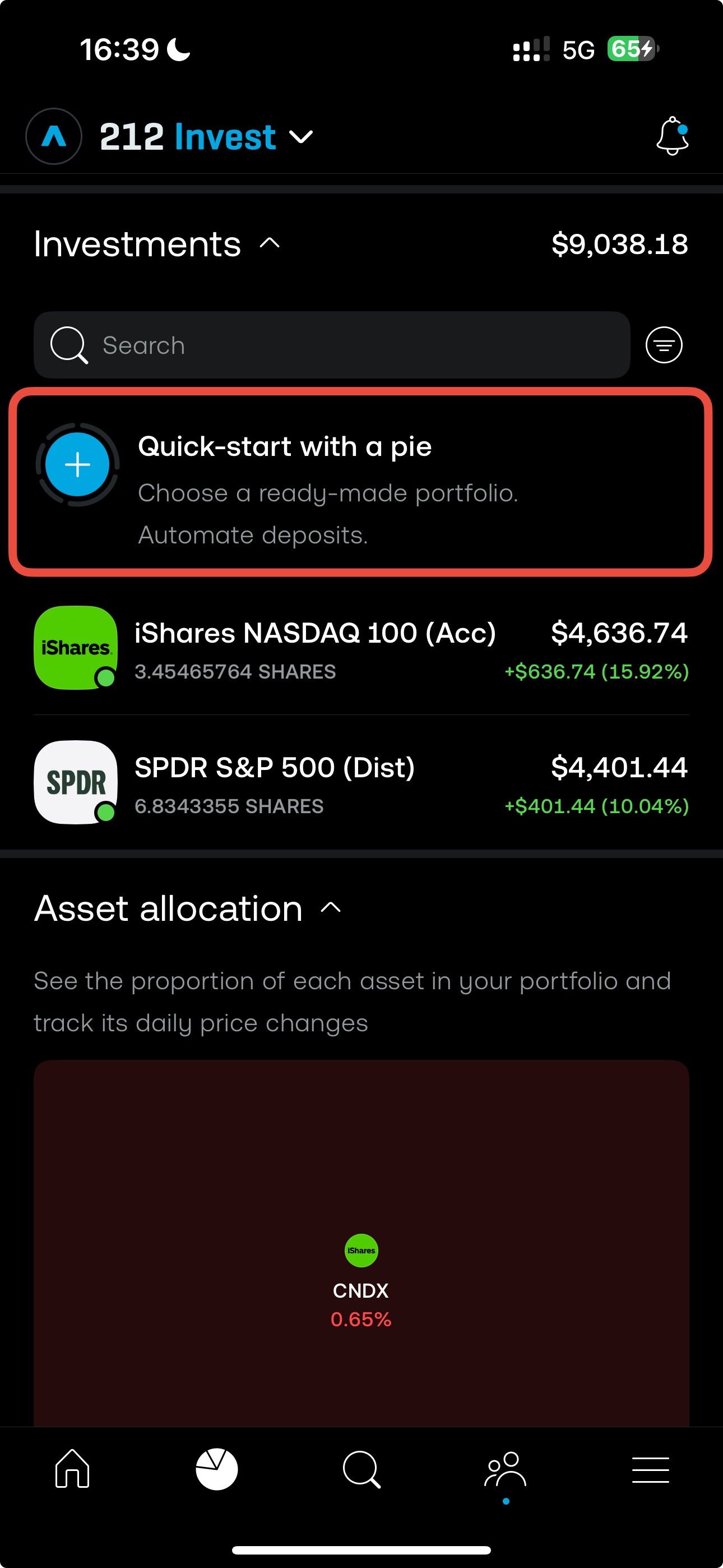
One of Trading 212's standout features is the Pies system, which allows you to create custom portfolios and automate your investments through dollar-cost averaging.
With AutoInvest, you can set up recurring deposits that automatically buy your chosen assets according to your predefined allocation. This is perfect for long-term investors who want to consistently build wealth without manually placing trades each month. You can also copy community Pies created by other investors if you want inspiration or a ready-made portfolio structure.

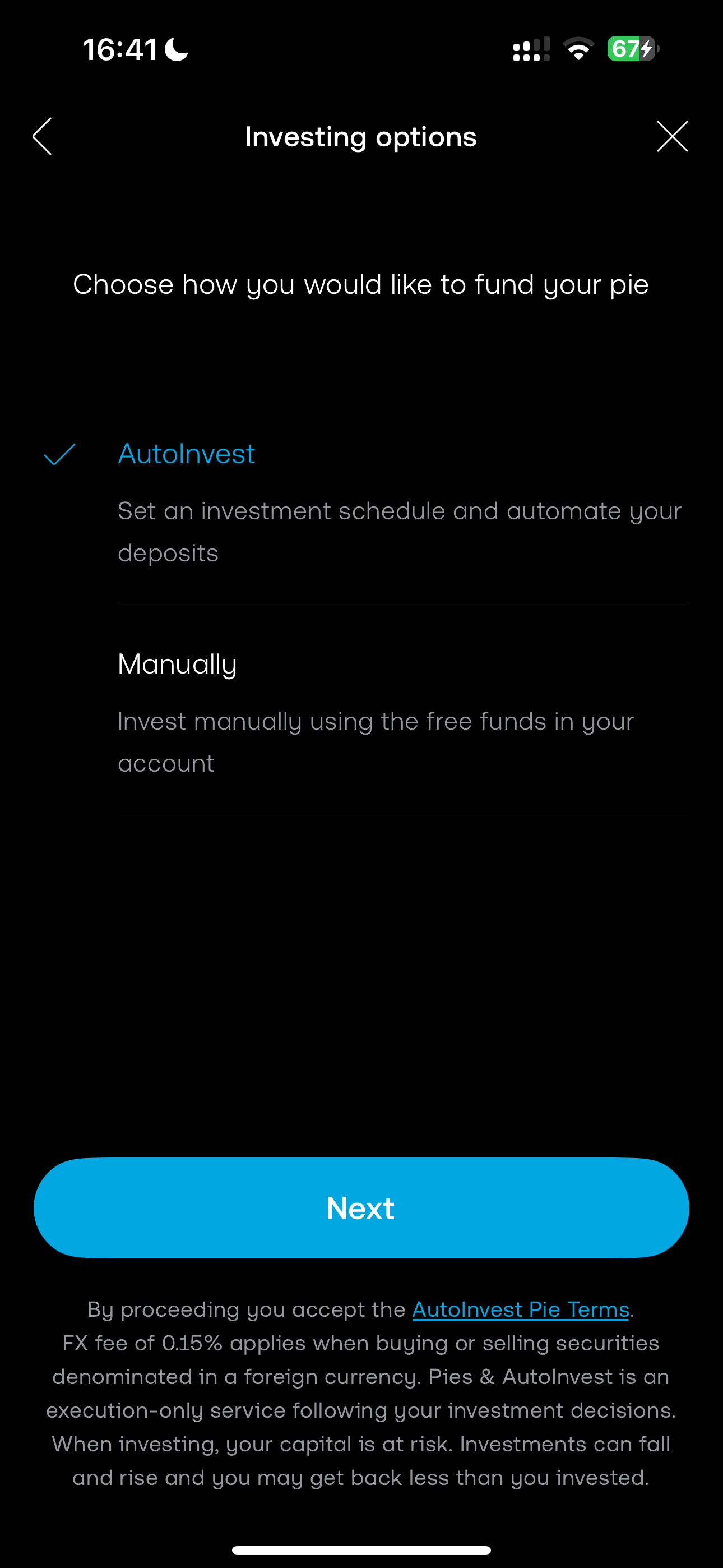
We have a detailed breakdown in our Trading 212 Pies guide if you want to learn how to set this up effectively.
Pies & AutoInvest is an execution-only service. Not investment advice or portfolio management. Automatic investing refers to executing scheduled deposits. You are responsible for all investment and rebalancing decisions.
Portfolio Transfers
A major improvement in 2025 was the full rollout of portfolio transfers. You can now transfer your investments into Trading 212 from other brokers (or out of Trading 212) completely free of charge.
Both ISA and Invest accounts support transfers, though there are some limitations:
- Only whole shares can be transferred (fractional shares must be sold first)
- ISA transfers must be for the full account if transferring stocks
- Transfers between Invest and ISA accounts are not supported
The process is paperless and typically completes within 30 calendar days. This removes a significant barrier that previously locked investors into the platform.
Trading 212 Pros and Cons
Is Trading 212 Safe?
Safety is a common concern for investors considering newer platforms, and it is a valid question to ask. Trading 212 is regulated by multiple financial authorities including the FCA in the UK, which provides strong consumer protections.
Key safety features include:
- FCA regulation (UK) and BaFin (Germany), ASIC (Australia)
- FSCS protection up to £85,000 for investments, £120,000 for cash deposits
- Client funds held separately from company funds under CASS 6 and CASS 7 rules
- Custodians include The Bank of New York Mellon and Interactive Brokers
- Two-factor authentication available
- Annual external audits by Buzzacott
For a deeper analysis including what happens if Trading 212 were to fail, see our full article on whether Trading 212 is safe.
No broker removes investment risk. As with any investment, your capital is at risk and you may get back less than invested. FSCS eligibility conditions apply.
Trading 212 Card
Trading 212 offers a debit card linked to your Invest account. Card transactions carry a 0% FX fee, and ATM withdrawals are free up to £400 per month in the UK and €400 per month outside the UK, with a 1% fee above that. Cashback starts at 0%. You earn 1.5% only while Cashback Reinvest is activated with a Pie selected and at least one qualifying weekly, bi-weekly, or monthly paid subscription is active on the card. Cashback is credited monthly and invested automatically into that Pie rather than paid as spendable cash, capped at £15 per month on GBP accounts and €15 per month on EUR accounts. Full conditions are on the Trading 212 Cashback Programme page. Card distributed by Trading 212, issued and provided by Paynetics (UK). Available with an Invest Account. Other fees may apply.
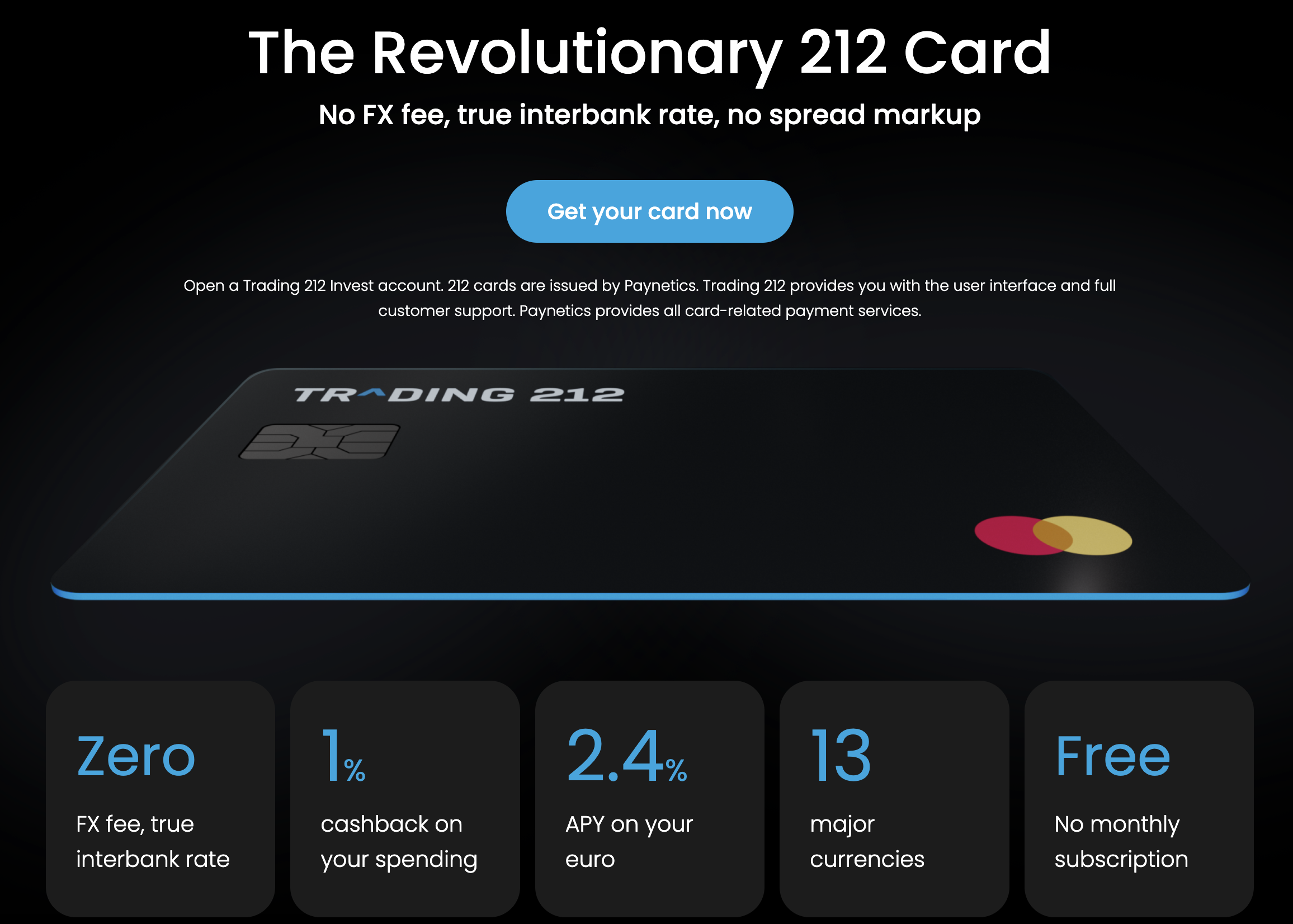
The card is directly linked to your Trading 212 account, making it easy to spend from your investment returns or uninvested cash. Availability varies by country, primarily available in the UK and select European markets.
Read our full Trading 212 Card review for more details on eligibility and benefits.
UK Investors: ISA and SIPP
For UK investors, Trading 212 offers a Stocks and Shares ISA with no fees. This allows you to invest up to £20,000 per tax year and pay no capital gains tax or dividend tax on your returns. They also offer a Cash ISA with rates that track the Bank of England base rate.
However, Trading 212 does not currently offer a SIPP (Self-Invested Personal Pension). While there have been hints about a potential SIPP launch, as of early 2026 it has not materialized. If pension investing is important to you, alternatives like Interactive Brokers or Freetrade offer SIPP options.
How to Open a Trading 212 Account
Trading 212 vs Interactive Brokers
A common question we receive is how Trading 212 compares to Interactive Brokers. The short answer: for beginners, Trading 212 is the better choice. For advanced traders, Interactive Brokers offers more tools and market access.
Trading 212 wins on: Simplicity, zero commissions, user experience, and interest on cash. It is probably one of the easiest investing apps to use, making it ideal for those just starting out or who prefer a streamlined experience.
Interactive Brokers wins on: Research tools, market access (including options and futures), advanced order types, API trading, and the ability to open a SIPP. The learning curve is steeper, but the capabilities are far greater.
We cover this comparison in depth in our Trading 212 vs Interactive Brokers article.
Invest vs CFD Account
Trading 212 offers an Invest account for buying real shares, and an ISA for UK investors. There is also a separate CFD account, which is not the focus of this review. For long-term investing, we recommend the Invest or ISA account.
CFDs are complex instruments and come with a high risk of losing money rapidly due to leverage. 76% of retail investor accounts lose money when trading CFDs with this provider. You should consider whether you understand how CFDs work and whether you can afford to take the high risk of losing your money.
For more details on the differences, see our Trading 212 Invest vs CFD guide.
What We Don't Recommend Trading 212 For
Being honest about limitations:
Advanced traders: If you need sophisticated charting, API access, options trading, or complex order types, Trading 212's simplicity becomes a limitation. Interactive Brokers would serve you better.
Pension investing: No SIPP means you cannot use Trading 212 for tax-advantaged pension contributions. Look at Interactive Brokers or Freetrade for SIPP options.
CFD trading: While Trading 212 offers CFDs, the spreads are not competitive with specialist platforms. If CFD trading is your focus, there are better options.
Alternatives to Consider
While Trading 212 is an excellent choice for most beginner and intermediate investors, it may not be right for everyone. Here are some alternatives worth considering:
- Interactive Brokers - Better for advanced traders who need research tools, global market access, and a SIPP
- eToro - Similar ease of use with social trading features and Smart Portfolios. New users can get up to $500 in free assets
- Lightyear - Another commission-free option with competitive FX rates. Claim up to £100 in free stock with our promo code
For UAE-based investors, check our guide on Trading 212 in the UAE.
Not sure which broker is right for you? Try our Broker Match Tool to get a personalized recommendation, or browse our complete broker reviews.
Our Verdict
Trading 212 remains one of our top recommendations for investors in the UK, Europe, the Middle East, and beyond. For beginners and intermediate investors especially, it is genuinely one of the easiest and most enjoyable brokers to use. The app is intuitive, the fees are minimal, and features like Pies make long-term wealth building straightforward.
The platform has executed remarkably well, reaching 4.5 million funded accounts and over €30 billion in client assets. They continue to add features and improve the platform consistently, with the 212 Card and improved portfolio transfers being recent examples.
The platform is especially well-suited for:
- Beginner and intermediate investors who want a simple, intuitive interface
- UK investors looking for a fee-free Stocks and Shares ISA
- European investors wanting competitive EUR cash interest rates
- UAE and Middle East investors seeking a reliable, well-regulated broker
- Anyone who wants to automate their investing with Pies and AutoInvest
The main drawbacks are the lack of a SIPP for pension investing and limited research tools for advanced traders. If those are priorities, consider alternatives like Interactive Brokers.
FAQ
Is Trading 212 safe to use?
Yes. Trading 212 is regulated by the FCA (UK), BaFin (Germany), and ASIC (Australia). UK clients receive FSCS protection up to £85,000 for investments and £120,000 for cash deposits. Client funds are held in segregated accounts with custodians including The Bank of New York Mellon.
Does Trading 212 charge any fees?
Trading 212 offers commission-free stock and ETF trading with no platform fees, no ISA fees, and no inactivity fees. The main cost is a 0.15% FX conversion fee when trading assets in a different currency, though this can be avoided using the multi-currency feature.
Can I transfer my portfolio out of Trading 212?
Yes. Trading 212 now supports free portfolio transfers both in and out. The process is paperless and typically completes within 30 days. Note that only whole shares can be transferred.
Does Trading 212 pay interest on cash?
Yes. Trading 212 pays above-average interest on uninvested cash in GBP, EUR, USD and 10 other currencies. Interest is paid daily with no minimum balance required. Rates track central bank rates closely. See our UK high-yield comparison and EU high-yield comparison for current rates.
Does Trading 212 offer an ISA?
Yes. Trading 212 offers both a Stocks and Shares ISA and a Cash ISA, both completely fee-free. The annual ISA allowance is £20,000 for the 2025/26 tax year. See how Trading 212 compares in our best Cash ISAs in the UK ranking.
Does Trading 212 offer a SIPP?
No. Trading 212 does not currently offer a SIPP pension account. If pension investing is important to you, consider alternatives like Interactive Brokers or Freetrade.
How does Trading 212 compare to eToro?
Trading 212 offers lower fees overall (0.15% FX vs 0.5%, no withdrawal fees, no inactivity fees) and interest on cash. eToro offers CopyTrader for social trading and Smart Portfolios for thematic investing. For cost-conscious investors, Trading 212 has the edge. For those interested in social features, eToro may be preferable. Read our full eToro vs Trading 212 comparison for the detailed verdict.
Risk Disclaimer
When investing, your capital is at risk and you may get back less than invested. Past performance doesn't guarantee future results.
Trading 212 offers commission-free investing; other fees may apply, including a 0.15% currency conversion fee. See Trading 212's terms and fees. To get free fractional shares worth up to €100/£100, you can open an account with Trading 212 through the links on this page (Sponsored Link). Terms apply. Higher-value shares are awarded less frequently.
Pies & AutoInvest is an execution-only service. Not investment advice or portfolio management. Automatic investing refers to executing scheduled deposits. You are responsible for all investment and rebalancing decisions.
If you enable interest on cash, Trading 212 will hold your cash in qualifying money market funds and banks. Otherwise, your cash will be held only in banks. Interest applies on cash in an investment account. Terms apply.
The 212 Card is distributed by Trading 212 and issued and provided by Paynetics (UK). Available with an Invest Account.
CFDs are complex instruments and come with a high risk of losing money rapidly due to leverage. 76% of retail investor accounts lose money when trading CFDs with this provider. You should consider whether you understand how CFDs work and whether you can afford to take the high risk of losing your money.
This content is sponsored: MatchMyBroker may receive compensation from Trading 212 for accounts opened through links on this page. This is not investment advice. Do your own research.