Fiscal AI Review 2026: AI-Powered Investment Research Tested



Most investors hit the same wall, too many earnings calls, too many filings, too many spreadsheets, and not enough hours. Fiscal AI is built specifically to solve that. After spending real time inside the platform across the Free, Pro and Max tiers, plus a look at their newer API and MCP integrations, here is the honest take on whether it earns a spot in your research stack.
This is a comprehensive review of Fiscal AI in 2026, covering the AI Copilot, institutional-grade data, screener, expert-tracking features, the full updated pricing tiers, and the new API & MCP product that lets you pipe Fiscal.ai data straight into Claude or ChatGPT, and the new Fiscal.ai app for OpenAI's Codex and ChatGPT that launched in June 2026 (covered below).
What Is Fiscal AI
Fiscal AI is a research terminal for fundamental investors. It combines institutional-quality financial data with a specialised AI assistant and a clean, modern dashboard system. The platform launched in 2023 as an offshoot of Stratosphere.io and rebranded from FinChat to Fiscal.ai in mid-2025 alongside a Series A funding round.
Today the company is backed by Social Leverage (the same VC that backed Robinhood and eToro), holds SOC2 Type II accreditation, and serves both retail investors and institutional clients including Morgan Stanley, Raymond James, Manulife, Franklin Templeton, Allianz, EY and PwC. The founding team includes Braden Dennis (CEO and co-host of The Canadian Investor Podcast), Ryan White (CTO), Adrian Iwanicki (COO) and Kevin Bojan (CPO).
Before we get into the features, one thing worth knowing up front. Because we partner with Fiscal AI, MatchMyBroker readers get an exclusive discount that is not shown on the public pricing page.
Use our link or enter code MMB at checkout for 15% off every payment for your first 11 months, on Pro or Max, monthly or annual.
Core Features That Make Fiscal AI Stand Out
1. Fiscal AI Copilot, Your AI Financial Analyst
At the heart of Fiscal AI is the Copilot, an AI assistant trained specifically on financial data. Unlike a general chatbot, it understands accounting terminology, can parse multi-quarter trends, and cites its sources back to the underlying filing or transcript every time it answers.
In testing, the most useful workflows were summarising hour-long earnings calls into a tight bullet list, asking pointed questions about specific risk factors in 10-Ks, and generating side-by-side comparisons between competing companies. The example below shows the Copilot turning NVIDIA's Q4 2026 earnings call into a structured AI Summary panel on the right, complete with business performance analysis and the key financial highlights, while you skim the full transcript on the left.
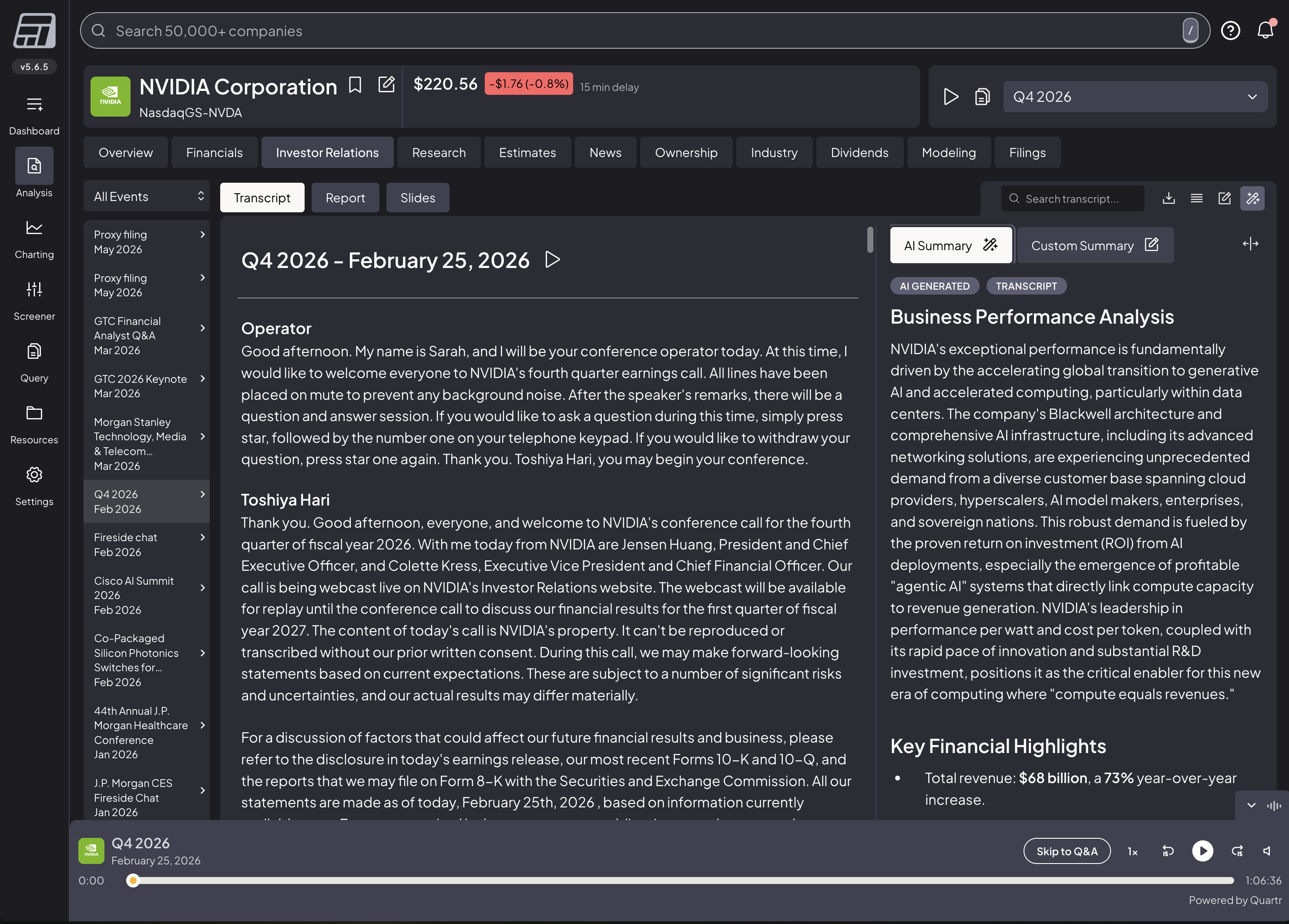
The AI Summary panel turns a 60-minute earnings call into a structured brief in seconds, with every number tied back to the transcript.
What you do not get is hallucinated answers. Because Fiscal's AI is bounded to the verified data set behind it, the Copilot will tell you when it does not have the answer rather than making one up. That trust angle is the main reason serious analysts use it instead of plugging questions into ChatGPT.
2. Institutional-Grade Financial Data
Fiscal AI covers 100,000+ public stocks, ETFs and funds globally, with financials sourced from S&P Market Intelligence. The standout layer is the proprietary Segments & KPIs data set, business-line revenue and operating metrics across 2,500+ companies that you usually only get on a Bloomberg or Capital IQ terminal.
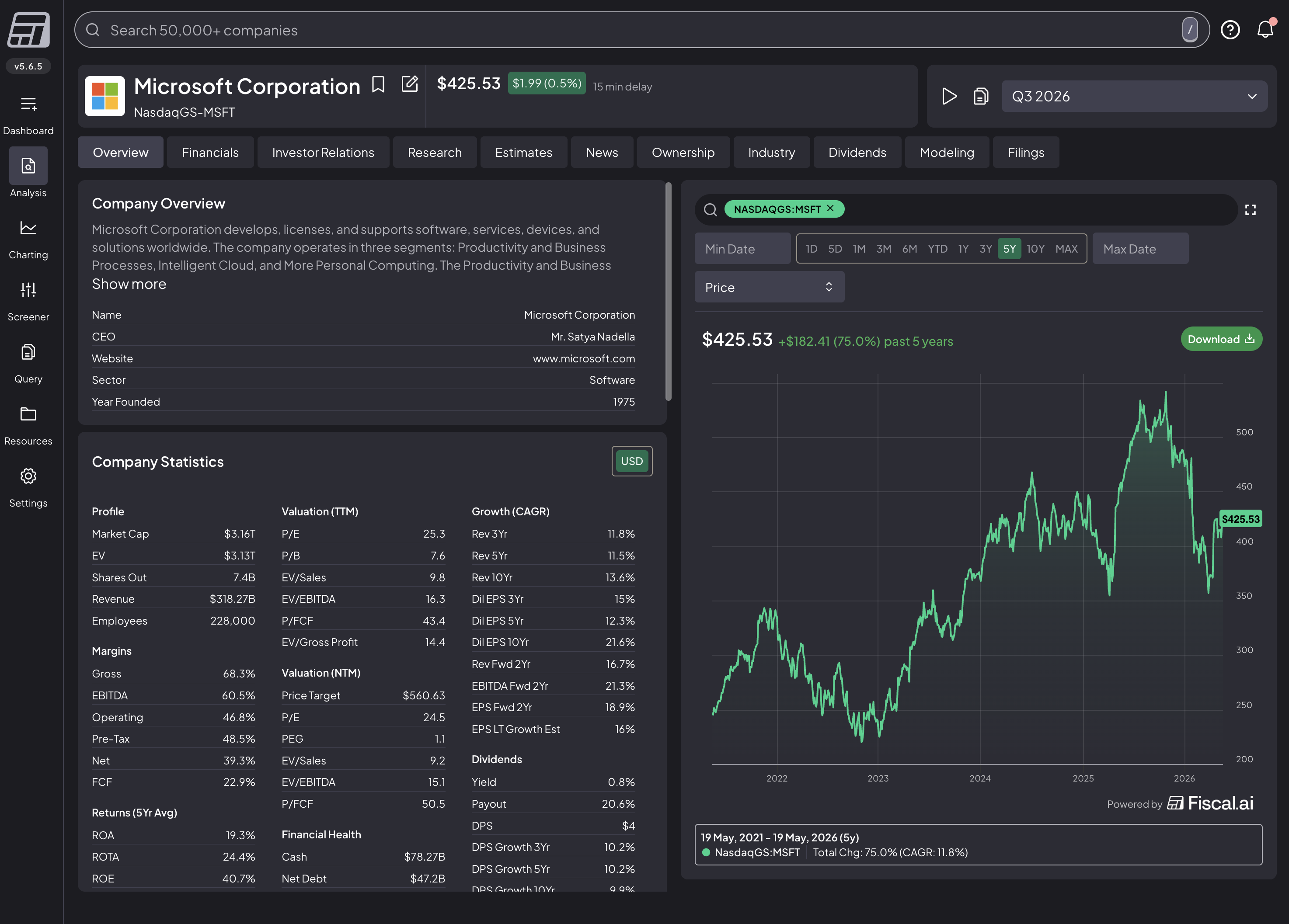
A typical company overview page (Microsoft shown), with company stats, valuation multiples, growth profile, and a 5-year price chart side by side.
The data history depth scales with your plan, 10 years of annual financials on Free, 15 years on Pro, and 20+ years on Max. KPI history runs 2 / 10 / 15+ years respectively. Pro and Max also unlock the curated equity research feed (Morningstar AI), analyst estimate revisions, and price targets.
3. Powerful Research Tools, Including AI-Powered Screening
Beyond the AI and the data, Fiscal AI is a full research workflow. The stock screener filters companies across hundreds of financial metrics, but the standout feature is the AI filter, you can describe what you are looking for in plain English and the screener builds the criteria for you.
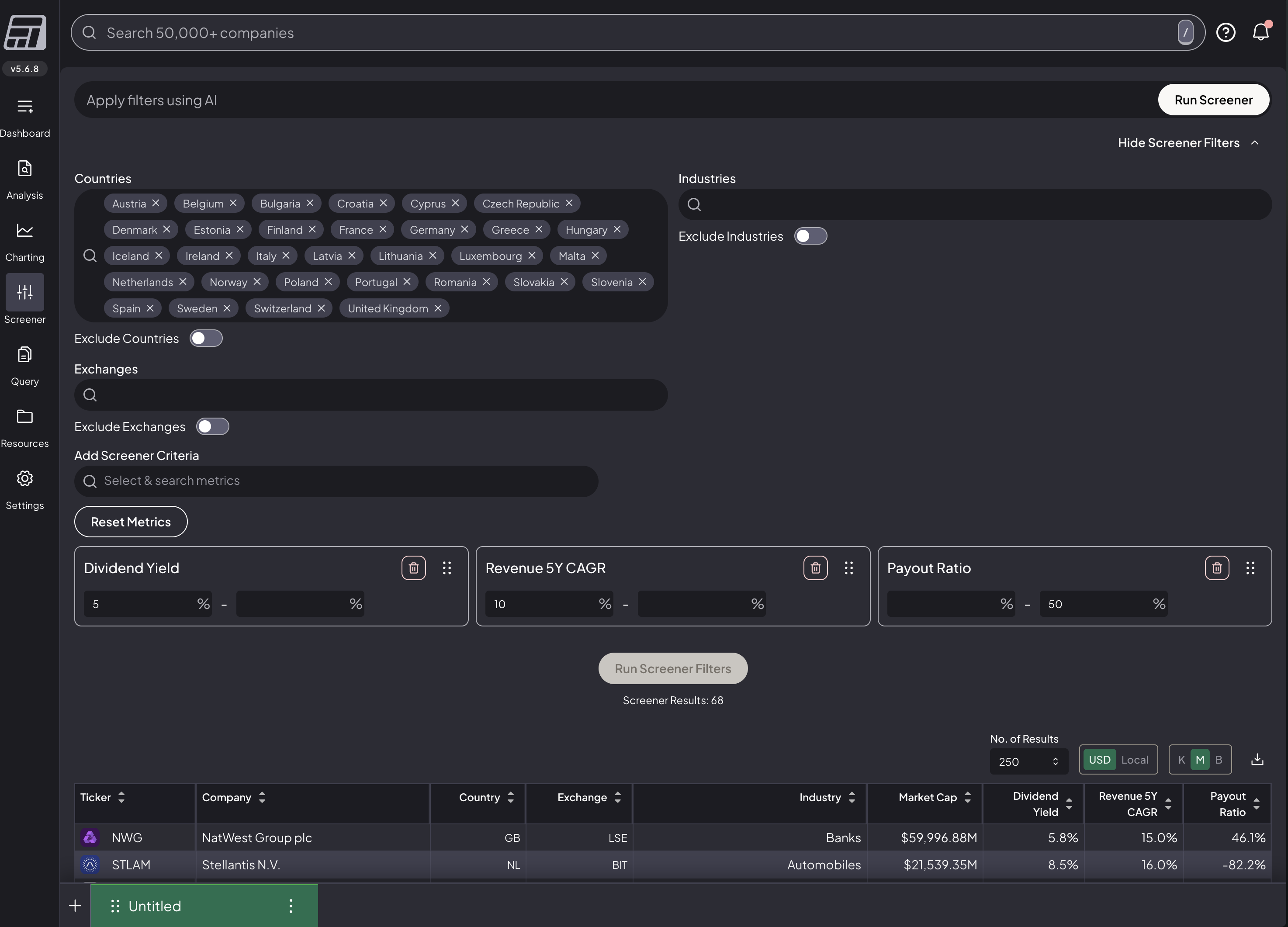
The screener combines a natural-language AI input with structured criteria like dividend yield, revenue growth and payout ratio.
Other workflow pieces worth knowing about:
- Customisable Dashboards, 1 dashboard on Free, 10 on Pro, unlimited on Max
- DCF Modeling, available on every plan including Free
- Document Access, transcripts, slides, press releases and filings in a single search interface
- Comparisons & Valuation, peer benchmarking against industry comparables
- Custom Metrics, build your own ratios and KPIs (Pro and Max)
4. Segments and KPIs That Other Platforms Miss
This is the feature that originally set FinChat apart and is still Fiscal AI's sharpest edge in 2026. Instead of just reporting consolidated revenue, Fiscal AI breaks every covered company down into the segments and KPIs that management actually talks about on earnings calls.
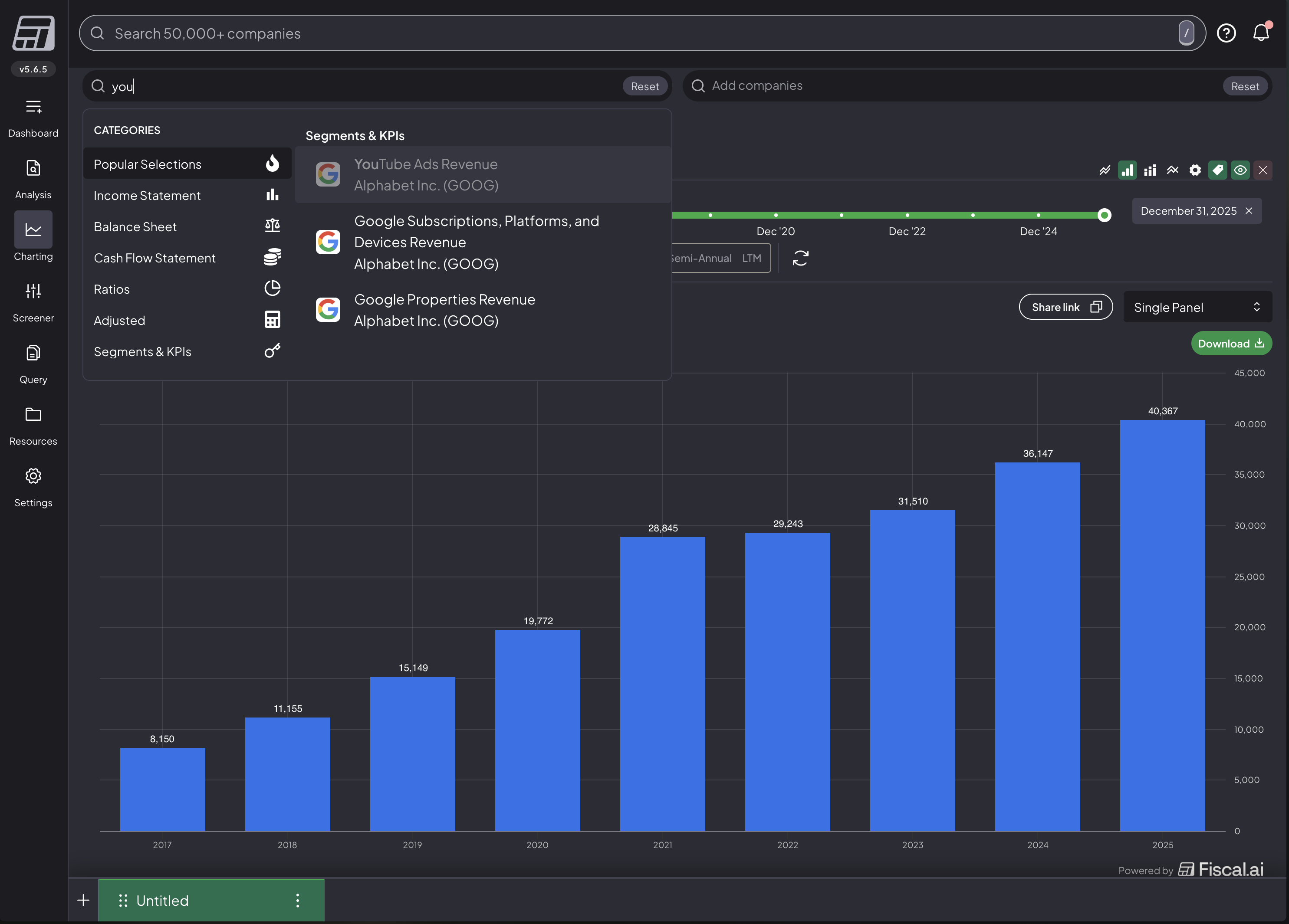
Drilling into Alphabet to chart YouTube Ads revenue specifically. The same workflow exists for AWS at Amazon, Datacenter at NVIDIA, Cloud at Microsoft, and thousands of others.
For growth investors, this is the difference between “Alphabet's revenue grew 12%” and “YouTube Ads grew 23% while Search grew 9%, and YouTube is now driving the marginal dollar.” You can build these chart segments straight into a custom dashboard in seconds.
5. Expert Tracking and Super Investor Holdings
Fiscal AI also bundles in a 13F-backed expert tracking module. The Super Investors view lets you browse the live portfolios of Warren Buffett, Charlie Munger, Bill Ackman, Mohnish Pabrai, Joel Greenblatt, Ray Dalio, Michael Burry, and dozens more, with market value, position count, and turnover all in one screen.
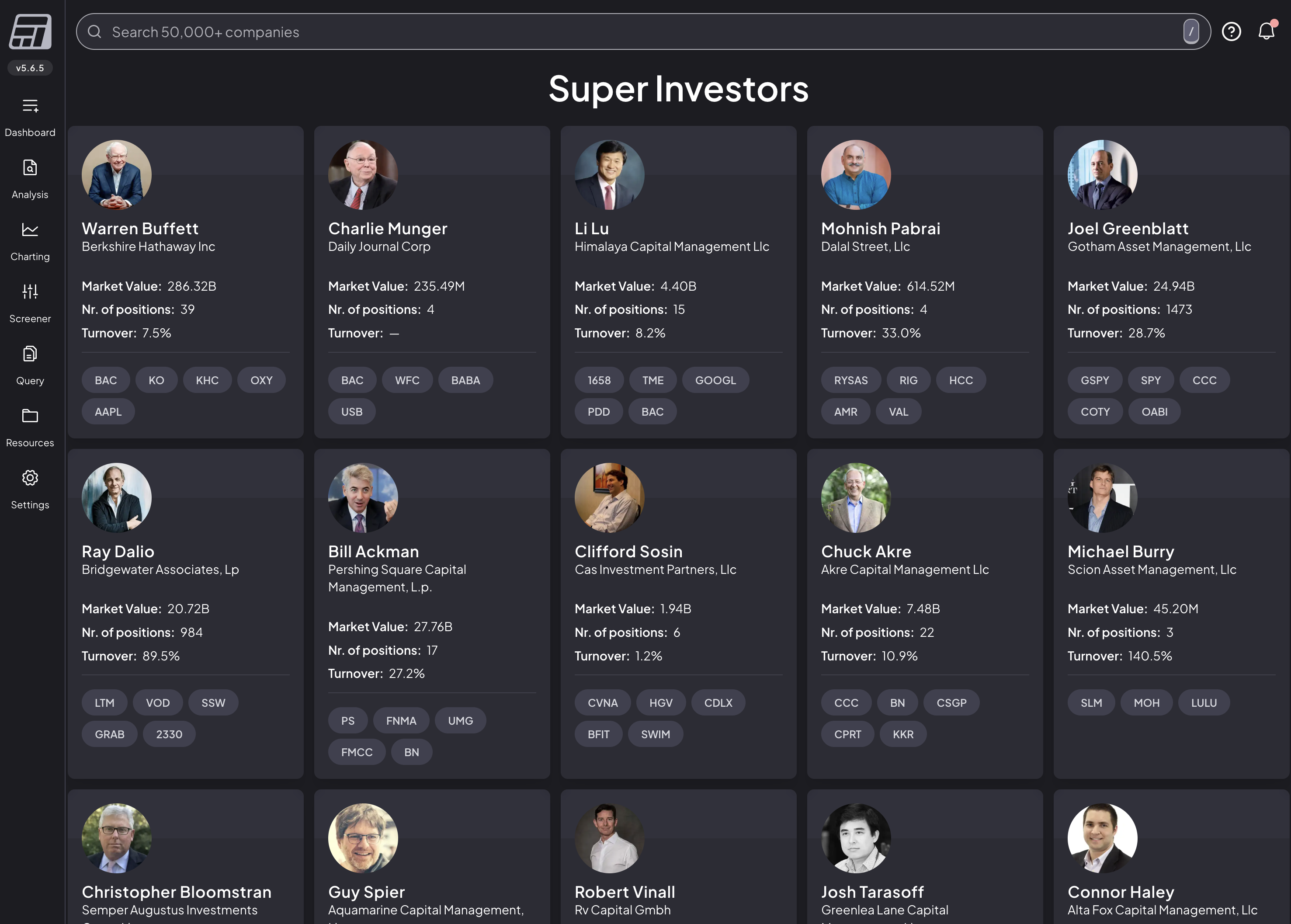
Super Investors at a glance: market value, position count and recent turnover for each fund manager.
Click any investor and you get the full portfolio breakdown, holdings by ticker with quarter-over-quarter changes, share counts, weight in portfolio, and an industry distribution pie. Useful for catching new positions early or seeing when a quality investor is trimming a name.
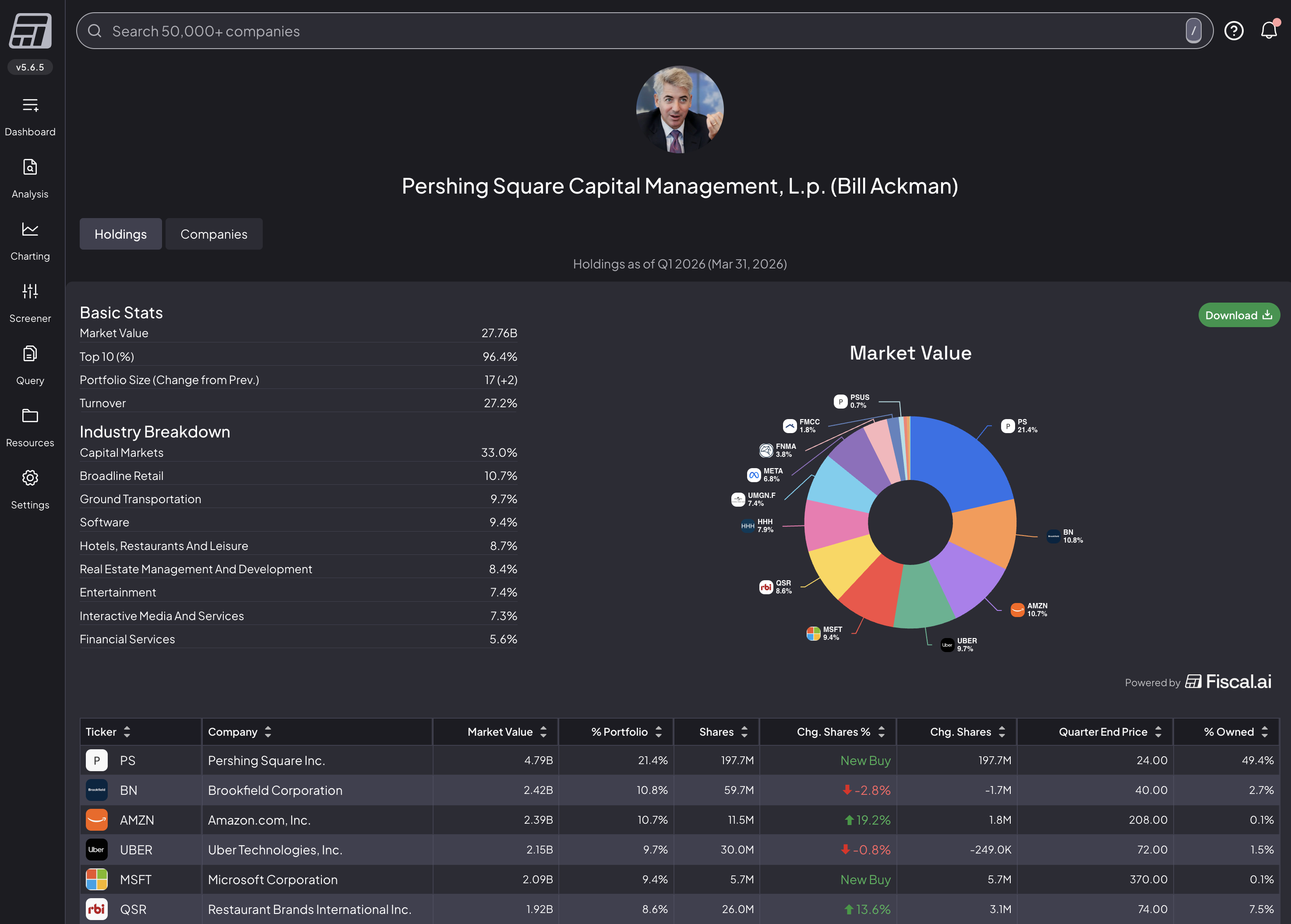
Drilling into Bill Ackman's Pershing Square holdings as of Q1 2026, including new buys and changes in shares quarter-over-quarter.
Fiscal AI Pricing in 2026, Which Plan Makes Sense
Fiscal AI runs on four plans, Free, Pro, Max, and a separate API & MCP product for developers and teams. The pricing changed alongside the 2025 rebrand, so if you saw the old “Plus” or “Pro” tiers on FinChat, here is what they map to now (the names shifted up a tier).
7-day trial, payment details are required at signup. The selected paid plan auto-renews unless you cancel before the trial ends. MatchMyBroker readers can use code MMB for 15% off every payment during the first 11 months.
Pro, $39/month billed annually ($49 monthly), the sweet spot for most serious retail investors. Unlocks 15 years of financials, 10 years of KPI history, 10 dashboards, custom AI summaries, equity research feed, analyst revisions, and unlimited brokerage connections. Roughly $468/year on the annual plan.
Max, $79/month billed annually ($99 monthly), the professional tier. 20+ years of financials, 15+ years of KPI history, unlimited dashboards (up to 250 rows each), click-thru audit to the underlying filing, brand-kit customisation, full data export, and team billing. Roughly $948/year on the annual plan.
Remember the MatchMyBroker reader discount above, code MMB takes 15% off your first 11 months on either paid plan, so the effective cost is lower than the list prices shown here.
API & MCP, Fiscal AI for Developers, Teams and AI Workflows
The newest addition to the lineup is the API & MCP product, a separate data-feed plan aimed at developers, quant analysts, and teams that want Fiscal AI's verified data inside their own tools rather than the web app. This is the tier that institutional users like Morgan Stanley, Raymond James and Salesforce pay for.
What you get with the API plan:
- Full financials and ratios for the same 100,000+ securities
- Segments & KPIs for the 2,500+ verified-coverage companies
- Stock prices, end-of-day and 15-minute delayed
- Adjusted metrics across history
- Filings, with source links back to the original document (image or PDF)
- Claude Connector and ChatGPT integration via MCP, plug Fiscal.ai straight into your AI workflow
The MCP angle is the part worth highlighting. If you spend hours running prompts in Claude or ChatGPT against financial data, the Fiscal.ai MCP connector lets you pull verified, citation-backed data into those conversations rather than relying on whatever the model scraped during training. For a serious analyst that is a meaningful productivity upgrade.
Pricing for the API plan is custom and depends on data scope, call volume, and seats. Fiscal.ai runs it through their sales team rather than self-serve checkout, which is standard for institutional data feeds. There is also a free API trial covering 25 companies and 250 calls per day if you want to try it before committing. Contact sales here or browse the API documentation for a closer look.
Fiscal AI Inside ChatGPT and OpenAI Codex (New for 2026)
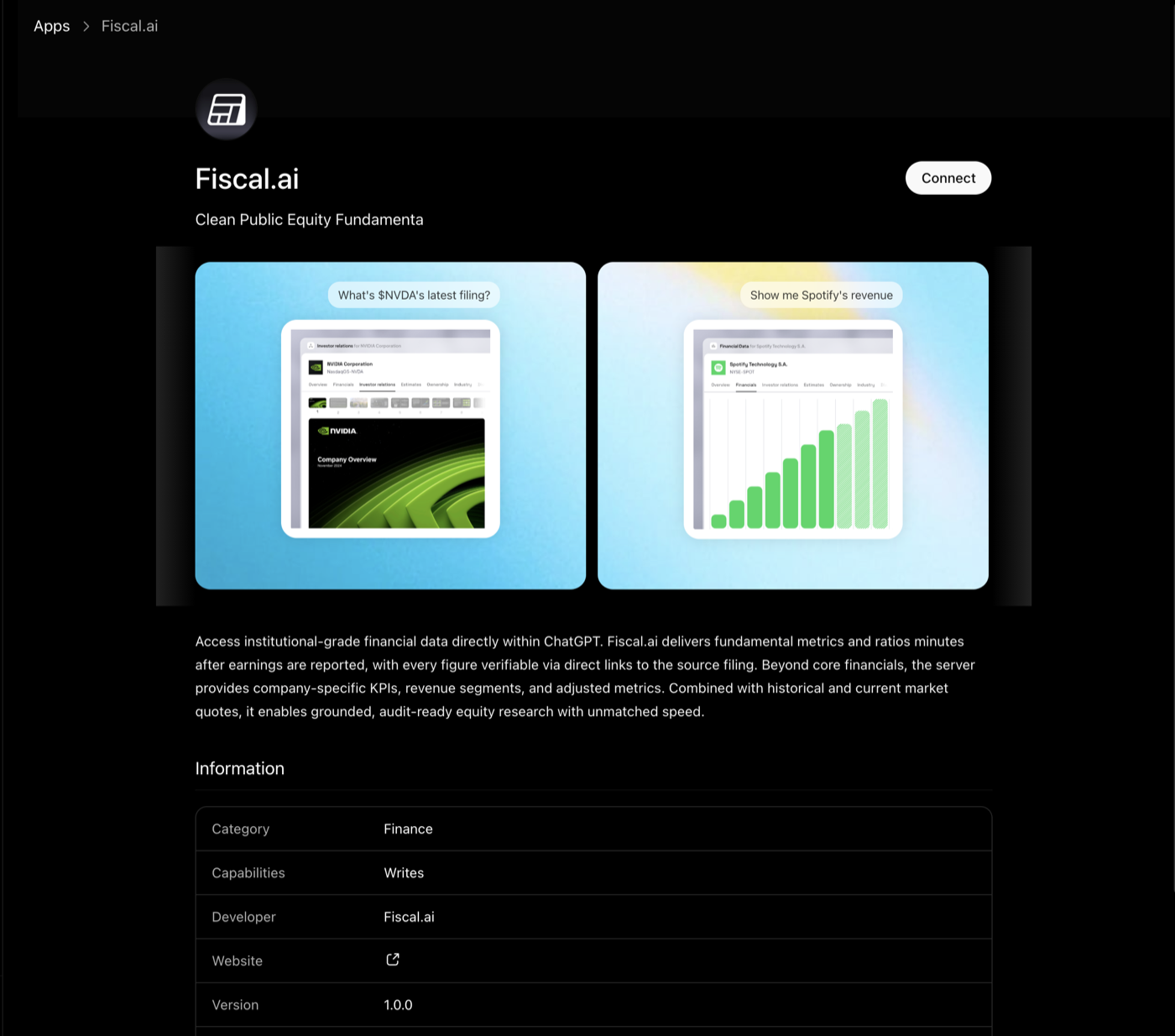
On 2 June 2026, OpenAI opened ChatGPT and its Codex agent up to outside business apps and shipped a set of role-specific plugins, one of them built for public-equity investing. Fiscal.ai launched as an official app in that rollout, so you no longer have to wire up the MCP connector by hand to use Fiscal.ai in ChatGPT, you add it as an app and query it straight from the chat box.
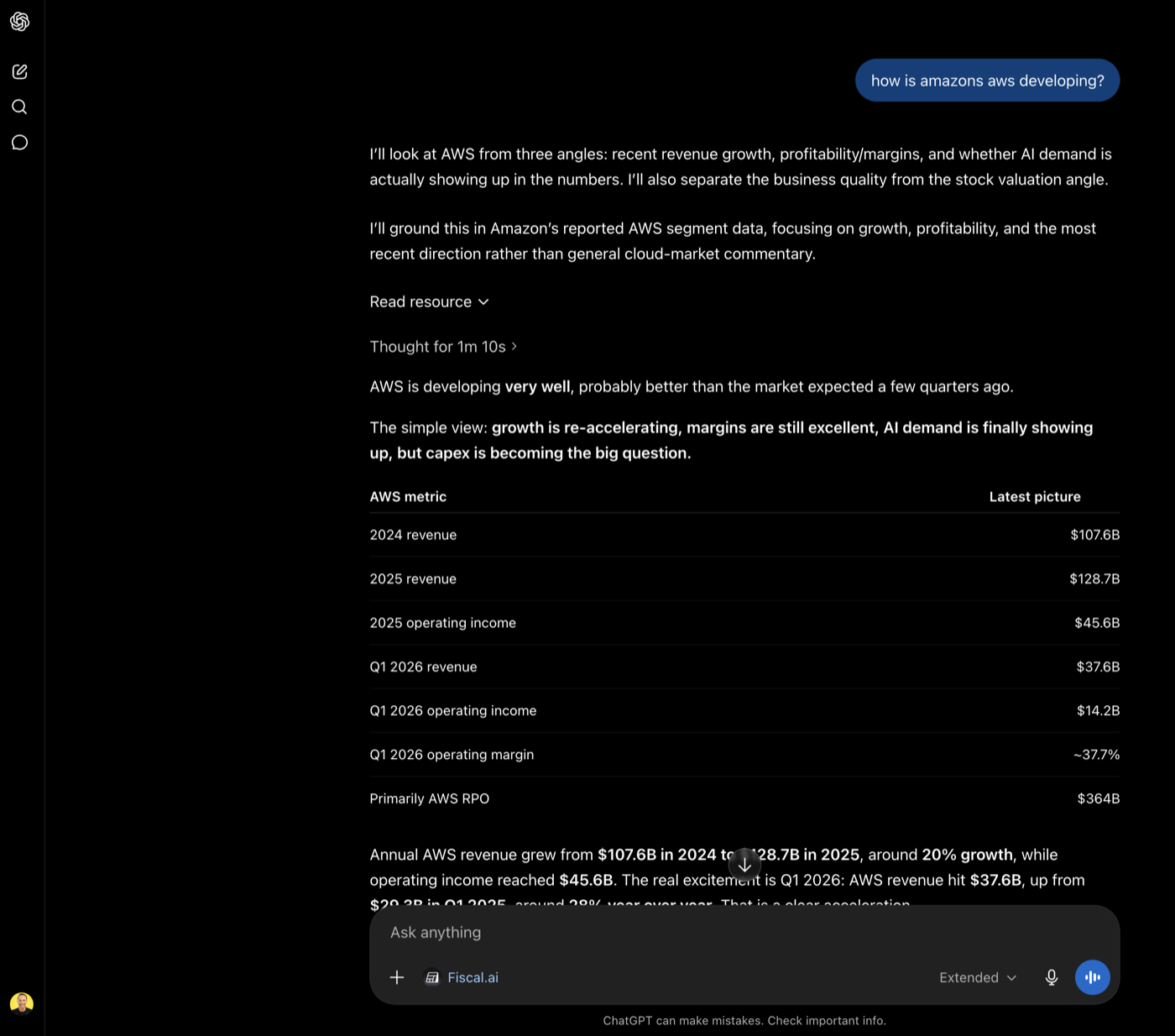
Once it is connected you can ask ChatGPT or Codex something like “how is Amazon's AWS developing?” and get Fiscal.ai's verified, source-linked figures back, segment revenue, operating margin, RPO and the rest, instead of whatever the model picked up in training. It is the same financials, ratios, segments, KPIs, prices and filings that power the web app, now available inside the assistant you already use.
The app is open to ChatGPT Plus, Pro, Business and Enterprise users on the web. You can connect it on the free Fiscal.ai plan to test it, capped at the 25 free-plan companies, while full 100,000-company coverage runs through a paid plan or the API. The MatchMyBroker reader discount still applies, code MMB takes 15% off every payment for your first 11 months.
Security and Compliance
Fiscal AI holds SOC2 Type II accreditation, the standard credential for platforms that hold sensitive financial data. The company is incorporated as Stratosphere Technology Inc. and is the same legal entity that the Morgan Stanley, PwC, EY and Manulife relationships sit under, so the compliance posture is genuinely institutional.
Worth flagging: Fiscal AI is a research platform, not a broker or registered investment adviser. It provides data and analytical tools, it does not execute trades or give personalised advice. You will still need a brokerage account for that side, see our broker reviews for a comparison of the options.
How Fiscal AI Speeds Up Your Investment Process
After running real research workflows on the platform, four clear time-savings stood out:
1. Earnings season becomes manageable. A normal earnings week means a dozen calls, ten 10-Qs and a stack of slide decks. Asking the Copilot to summarise each one with three risk callouts, three growth drivers, and the most-debated line from the Q&A takes minutes instead of hours.
2. KPIs that used to require manual scraping are pre-built. Tracking AWS revenue at Amazon, datacenter at NVIDIA, or Energy Generation at Tesla used to mean extracting tables from 10-Qs and pasting them into a spreadsheet. Fiscal AI ships them as first-class metrics.
3. Natural-language screening reduces the friction of generating ideas. “Show me US-listed companies trading below 12x earnings with 10%+ revenue growth and an investment-grade balance sheet” works as a single prompt.
4. The 13F module surfaces what smart money is doing now. Setting up alerts on a basket of investors you respect is roughly two clicks, and you find out next quarter when one of them starts buying a name.
Fiscal AI Pros and Cons
Like any tool, Fiscal AI does some things brilliantly and has trade-offs worth knowing before committing.
Fiscal AI for Different Investor Types
The right plan depends on how you actually use the platform. Here is a quick map of which tier makes sense for the most common research workflows.
How Fiscal AI Compares to the Alternatives
The research-tool market is crowded, so it helps to be clear about what job each tool actually does. Here is how Fiscal AI stacks up against the three platforms our readers ask about most.
Fiscal AI vs Koyfin
Both cover institutional-quality data, but they are built for different brains. Koyfin leans terminal-style, heavy charting, macro dashboards, and watchlist analytics, so it suits investors who live in charts and top-down data. Fiscal AI leans into conversational AI and verified segment KPIs, so it suits investors who live in earnings calls and management commentary. If your process is macro and chart-driven, Koyfin. If it is bottom-up and company-driven, Fiscal AI.
Fiscal AI vs Seeking Alpha: Different Jobs, Not Better or Worse
This is the comparison worth slowing down on, because the two tools are easy to confuse and they actually solve opposite problems.
Fiscal AI hands you the raw material and the AI to work it yourself. Verified financials, segment KPIs, transcripts and a Copilot that answers your questions. There are no opinions, no ratings, and no stock recommendations. You bring the thesis, Fiscal AI helps you build and pressure-test it faster.
Seeking Alpha hands you the research, the second opinions, and ready-made ideas. You get quant ratings on every stock, thousands of analyst articles arguing both sides, and, with Alpha Picks, a quant-driven service that surfaces two stocks a month so you do not have to screen for them yourself. It is the difference between a workbench and a research desk staffed with analysts.
For most investors who want curated research and a shortlist of ideas without doing all the digging themselves, the Seeking Alpha Bundle (Premium plus Alpha Picks together at a lower combined price) is still our default recommendation, and it remains the option we point most readers to first. Fiscal AI is the better fit if you genuinely enjoy doing your own fundamental work and mainly want to do it faster and with better data.
Plenty of serious investors run both: Fiscal AI as the data and AI layer, Seeking Alpha as the research and idea layer. They complement each other rather than compete. If you are weighing up the Seeking Alpha side specifically, our deeper guides cover Seeking Alpha Premium for full research access, Alpha Picks for the quant-driven stock-pick service and its track record since 2022, and Seeking Alpha Pro for professional and institutional research. Past performance does not guarantee future results, so treat any track record as context rather than a promise.
Fiscal AI vs InvestingPro
InvestingPro sits closest to Fiscal AI in spirit, both blend data with AI-style insight. InvestingPro tends to be cheaper and stronger on fair-value models and news-driven signals. You can compare InvestingPro's pricing here. Fiscal AI is stronger on segment KPIs, earnings-call interrogation, and the AI Copilot. Pick based on what dominates your research process: quick fair-value reads and idea screening point to InvestingPro, deep company-level analysis points to Fiscal AI.
How to Get the Most Out of Fiscal AI
- Ask specific questions. “What was Amazon's international segment growth rate over the last 3 years?” gets a much sharper answer than “tell me about Amazon.”
- Build focused dashboards. One per strategy or sector, not a single megadashboard, makes the data easier to scan.
- Treat AI outputs as a head start, not a final answer. Cross-check anything you would use to make an actual investment decision.
- Use the natural-language screener for idea generation. Phrase it like you would brief a junior analyst, “Show me profitable SaaS companies with revenue growth over 20% and improving gross margins.”
- Set up Super Investor alerts on the names you respect. 13F reporting lags by a quarter, but knowing what a value or growth manager is rotating into is still a strong signal.
Pairing Fiscal AI With the Right Broker
Fiscal AI gives you the research. You still need a broker to execute. A few things to look for when picking one to pair with the platform:
- Asset coverage, especially international markets if you research outside the US
- Low fees and tight spreads, so you keep more of the alpha your research generates
- Decent fractional support, useful for sizing positions properly when running a research-led approach
- Brokerage connection support, Fiscal AI's Pro and Max tiers let you connect unlimited brokerages directly into the dashboard
Find the right broker for your style with the MatchMyBroker quiz.
Final Verdict, Is Fiscal AI Worth It in 2026
For investors who treat fundamental research as a core workflow, yes. Fiscal AI is one of the few tools that genuinely compresses the time from idea to thesis, and the new API & MCP integration means it now slots into AI-driven workflows rather than just being a web app.
The Free plan is a real evaluation tier (not a teaser), Pro at $39/month annually is the sweet spot for serious retail investors who run earnings season properly, and Max at $79/month is fair value if you are a professional or run research for clients. The 7-day trial requires payment details and auto-renews unless cancelled. The MatchMyBroker link also applies the 15% discount.
Where it might not be worth it, if you trade technical patterns and rarely look at fundamentals, you will under-use the platform. If you only research large-cap US tech, you can get most of the way there with broker research and free data. For everyone in between, Fiscal AI is a real productivity upgrade.
Get 15% off Fiscal AI here. Payment details are required for the 7-day trial, which auto-renews unless cancelled.
Frequently Asked Questions
Is Fiscal AI worth the price, or can I get the same data free elsewhere?
You can get basic financials free on sites like stockanalysis.com, and for casual use they are fine. What you pay Fiscal AI for is the combination you cannot easily get for free: verified segment KPIs, earnings-call transcripts, an AI Copilot tied to the underlying data, and 10 to 20+ years of history in one place. If you only glance at headline numbers occasionally, the free plan or a free site is enough. If fundamental research is a regular part of your process, the time saved usually justifies Pro.
Is Fiscal AI just a ChatGPT wrapper, and what happens if AI models change?
A fair question to ask of any AI-first tool. The short answer is no, the AI is a layer on top, not the product itself. The real moat is the underlying data infrastructure, the same verified financials and KPIs that institutions like Morgan Stanley and Franklin Templeton license through the API. The AI model underneath can be upgraded or swapped without the data losing value, so you are not betting on one specific model staying ahead.
How accurate is the data, and does the AI ever get things wrong?
The core financials come primarily from S&P Market Intelligence, so they are reliable. The AI Copilot is far less prone to hallucinating than a general chatbot because it is bounded to that verified data and cites its sources. It is not infallible though, so treat any AI output as a fast first draft and double-check the specific numbers before you act on them.
What do you actually get on the free plan?
The free plan is genuinely usable: 10 years of annual financials, 2 years of KPI data, one dashboard, the stock screener, DCF modelling and AI summaries. New users can start a 7-day trial. Payment details are required, and the trial auto-renews unless cancelled. The main limits are KPI history depth, the number of dashboards, and access to custom AI summaries and the equity research feed, which are Pro and Max features.
How does Fiscal AI compare to Koyfin and TIKR?
Koyfin is the stronger pure data terminal, with better charting and a more Bloomberg-lite feel. TIKR is the favourite for screening and long historical data tables. Fiscal AI's edge is the AI Copilot, the verified segment KPIs, and having transcripts, filings and data in one searchable place. If your priority is a polished visual screener, look hard at TIKR. If it is AI-assisted company deep-dives, Fiscal AI wins.
Does Fiscal AI cover international and smaller companies well?
Coverage is broadest for US and large or mid-cap global names, where the verified KPI data is deepest. It does cover 100,000+ securities globally, but for micro-caps and smaller international companies the segment and KPI depth thins out. If you focus on obscure small-caps, check your specific names on the free plan before subscribing.
What is the Fiscal AI API and MCP product?
It is a separate data-feed plan that pipes Fiscal.ai's verified financials, KPIs, prices and filings into your own tools, including Claude and ChatGPT via MCP. It is aimed at developers, quants and teams. Pricing is custom and handled through their sales team, and there is a free API trial covering 25 companies and 250 calls a day.
What happened to FinChat?
FinChat rebranded to Fiscal.ai in mid-2025 alongside a Series A round. Same product, same team, same data, with a new name and an updated plan structure: the old Plus tier became Pro, and the old Pro tier became Max.
Can I use Fiscal AI inside ChatGPT or OpenAI Codex?
Yes. Since June 2026 Fiscal.ai has been available as an official app inside ChatGPT and OpenAI's Codex, so you can pull its verified financials, KPIs, prices and filings straight into a chat rather than configuring the MCP connector yourself. It is open to ChatGPT Plus, Pro, Business and Enterprise users on the web. You can connect it on Fiscal.ai's free plan to try it, limited to 25 companies, with full coverage on a paid plan or the API.
Risk Disclaimer
Trading and investing involve significant risk and may not be suitable for all investors. The value of investments can go down as well as up, and you may lose some or all of your initial investment. Past performance is not indicative of future results. Fiscal AI is a research platform and does not provide personalised investment advice. Always do your own due diligence and consider consulting a regulated financial adviser before making investment decisions.