Coinbase UK Review 2026: Is It Safe, Worth the Fees, and Right for You?


Coinbase is the crypto exchange most people have heard of, and for good reason. It is the only major crypto exchange listed on a US stock market, it holds the Bitcoin backing some of the world's largest institutional ETFs, and for UK users it offers the cleanest, most regulated on-ramp to crypto available right now. The trade-off is that it is not the cheapest place to trade, especially if you stick to the standard app.
In this review we cover who Coinbase is actually for, the fee question honestly (including the feature most UK users miss that cuts fees by around 80%), what the FCA registration actually means for your money, and why we personally keep over $100,000 of our own crypto on the platform despite the fees.
The quick verdict
Coinbase is the exchange we trust for long-term crypto holdings we are not actively trading. The regulation, the scale, and the fact that it is a publicly listed US company mean there is real accountability and real transparency, something you cannot say for most crypto platforms. For buy-and-hold UK investors, it is hard to recommend anything else with the same level of peace of mind.
If you are an active trader, Coinbase itself is not the cheapest, but the same account gives you access to Coinbase Advanced, where fees drop to a level that is genuinely competitive with dedicated pro exchanges like Kraken. Most retail users do not realise this exists, which is how Coinbase ends up being described as expensive.
Why we personally keep over $100,000 of our crypto on Coinbase
We believe in self-custody. The saying "not your keys, not your crypto" is correct, and for any coins you are never planning to touch, a hardware wallet is the right answer.
But reality is more complicated than that. We travel regularly and live in different places, and carrying a hardware wallet plus a seed phrase that you need to keep safe on you at all times, while also keeping it separate from the wallet itself, is genuinely stressful. Losing a seed phrase to a pickpocket, a hotel fire, or just a moment of forgetfulness is a very real risk when you are moving between cities and countries.
Coinbase solves that trade-off. It is not self-custody, but it is custody by a publicly listed company with the largest commercial crime insurance policy in the industry and a ten-year track record of never losing customer funds to a platform-level hack. For the portion of our crypto we might want to sell, send, or spend in the next 12 months, that peace of mind is worth the custody trade-off.
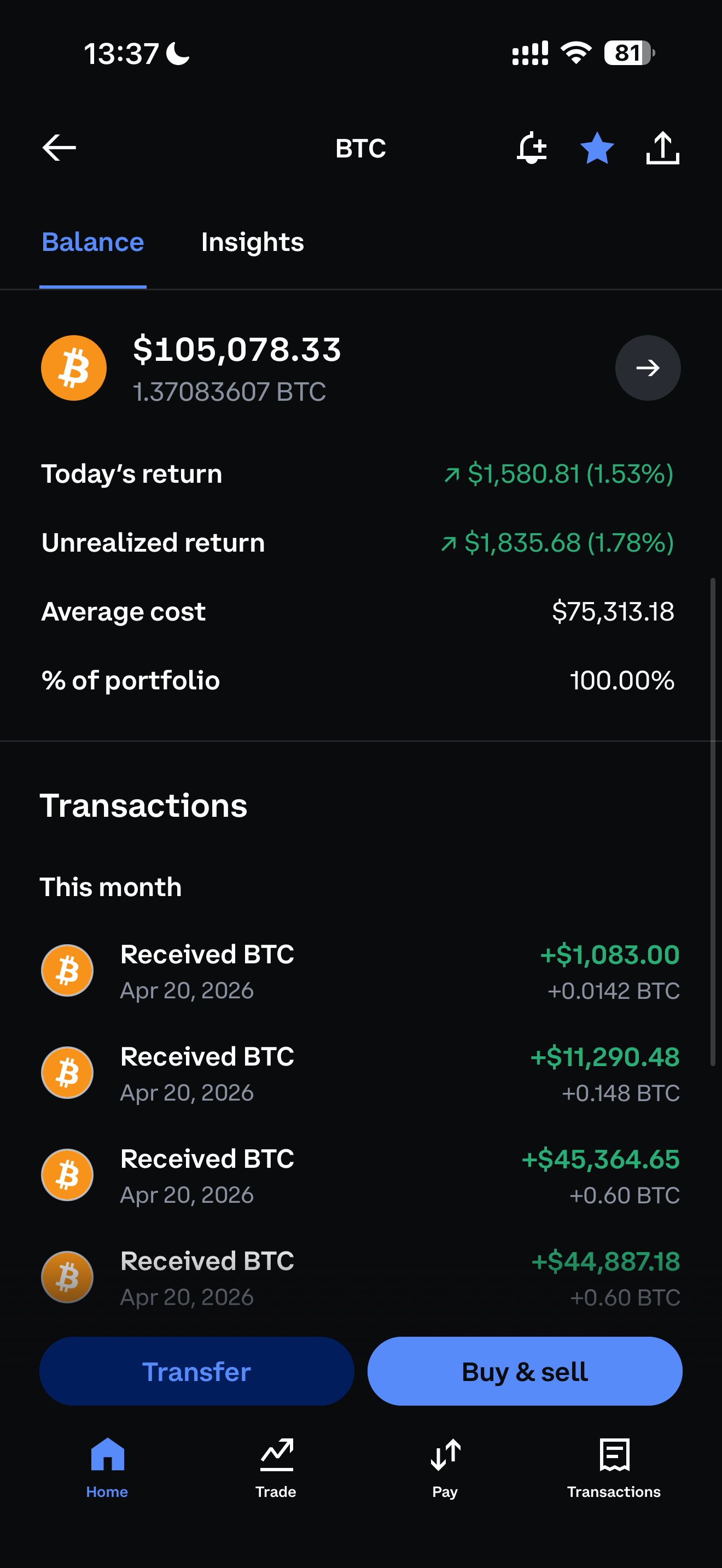
Our own Coinbase holding: 1.37 BTC, worth around $105,000 at time of writing.
If you regularly transact, send crypto around, liquidate to cash, or simply want reliable access to your holdings across different devices, you need an exchange. And if you are going to trust one, it should be one with real regulatory accountability. Coinbase fits that test better than any other option currently available to UK users.
Is Coinbase actually safe? The regulation question
For any UK investor putting meaningful money into crypto, the first question is always the same: what happens if the exchange fails? Coinbase's answer is unusually strong for this industry.
Publicly listed on NASDAQ since 2021
Coinbase Global, Inc., the parent company, is the only major crypto exchange group listed on a major US stock market. The NASDAQ ticker is COIN, and the company has been publicly traded since April 2021. That matters because it means quarterly SEC filings, independently audited financial statements, a real board, and a market capitalisation in the tens of billions of dollars that would be destroyed instantly if they handled customer funds irresponsibly. Kraken, Binance, Bitstamp, and Bitpanda are all private, so you are taking their word for their balance sheets. With Coinbase Global, Inc., you are not.
UK customer services and products are provided by CB Payments Limited (Coinbase UK), a separately regulated UK entity within the Coinbase Global, Inc. group. The distinction matters: when we talk about the NASDAQ listing and SEC reporting, that sits at the group level; when we talk about FCA registration and UK e-money safeguarding, that sits with CB Payments Limited.
FCA-registered under UK regulations
The UK entity is CB Payments Limited (Coinbase UK), registered in London with FCA Firm Reference Number 900635. This registration is multi-layered:
- Authorised as an Electronic Money Institution under the UK's Electronic Money Regulations 2011, meaning your GBP balances are held under safeguarding rules, segregated from Coinbase's operational funds.
- Registered for cryptoasset activities under the Money Laundering Regulations 2017. Coinbase obtained full UK VASP registration in 2025.
- Coinbase Institutional (UK) Limited is a separately registered FCA firm for professional clients.
The one thing to be clear about: crypto holdings are not covered by the FSCS (the UK's £85,000 deposit guarantee scheme). Crypto sits outside the FSCS perimeter everywhere in the UK, not just on Coinbase. The GBP e-money balances you hold on Coinbase are safeguarded, which means in the event of insolvency they should be returned to customers ahead of general creditors, but this is weaker protection than full FSCS cover.
For full transparency: in 2024, the FCA fined Coinbase's UK entity £3.5 million for onboarding a small number of high-risk customers in breach of a 2020 voluntary requirement. The issue has been addressed, the fine is a matter of public record, and we include it here because an honest review should.
The custody story: who already trusts Coinbase
One of the strongest trust signals for Coinbase is not its retail track record but its institutional one. Coinbase serves as custodian for large institutional clients and major institutional Bitcoin products, holding tens of billions of dollars on behalf of professional asset managers. That level of institutional selection is itself a form of due diligence: institutional clients run exhaustive security, operational, and legal reviews before placing assets with any custodian.
Coinbase Prime, the institutional arm, held approximately $245 billion of institutional assets under custody as of 30 June 2025, per Coinbase's institutional disclosures. Coinbase Custody itself is a New York State-chartered limited purpose trust company, which is a higher regulatory bar than most exchange custody arrangements.
Crucially for retail users, this is not a separate system. Retail Coinbase accounts sit on the same underlying custody and security infrastructure that institutional clients rely on. The benefit of institutional-grade cold storage, multi-signature controls, and security engineering flows through to everyday UK customers holding just a few hundred pounds.
On the security specifics:
- Approximately 98% of customer crypto is held in offline cold storage, geographically distributed. Less than 2% sits in hot wallets at any time.
- Coinbase carries a $320 million commercial crime insurance policy on hot wallet holdings, which the company states is the largest in the industry for a crypto exchange.
- Coinbase has never suffered a platform-level hack in over a decade of operation. No cold storage breach, no hot wallet breach, no loss of customer funds from the exchange.
One honest footnote. In 2024 and 2025, Coinbase disclosed that a small number of bribed overseas customer-support contractors had exfiltrated customer data (names, addresses, masked bank info) on approximately 69,461 users. Critically: no passwords, private keys, seed phrases, or customer funds were compromised. Coinbase publicly refused a $20 million ransom demand, posted a $20 million bounty for information leading to the attackers, and committed to reimbursing any user directly harmed. The incident is a useful reminder that social-engineering attacks on support staff are a different category of risk than exchange hacks, and it does not change the underlying "never been hacked" claim.
Coinbase UK fees: the honest answer
Let's address the elephant in the room. If you open the standard Coinbase app and buy £1,000 of Bitcoin, the fee will be higher than on most dedicated trading platforms. This is the main criticism you will read on Reddit, and it is fair.
The cost on the standard Simple interface comes from two layers: a spread built into the quoted price, plus a transaction fee on top. For small trades, that transaction fee is a flat amount (under £3 for trades below £200). For larger trades, the fee scales as a percentage, typically up to around 1.49% for bank-funded purchases and up to 3.99% for debit card purchases. Once you add the spread on top, a £1,000 buy on Simple can cost more than you would like.
For a long-term holder making a one-off purchase, this is annoying but not catastrophic. You are paying for convenience, for the world's easiest crypto UX, and for the peace of mind that comes with a regulated, insured, publicly listed custodian. That trade can make sense.
For anyone buying regularly, or buying larger amounts, paying Simple fees is a mistake. There is a much better option hiding in plain sight inside the same Coinbase account.
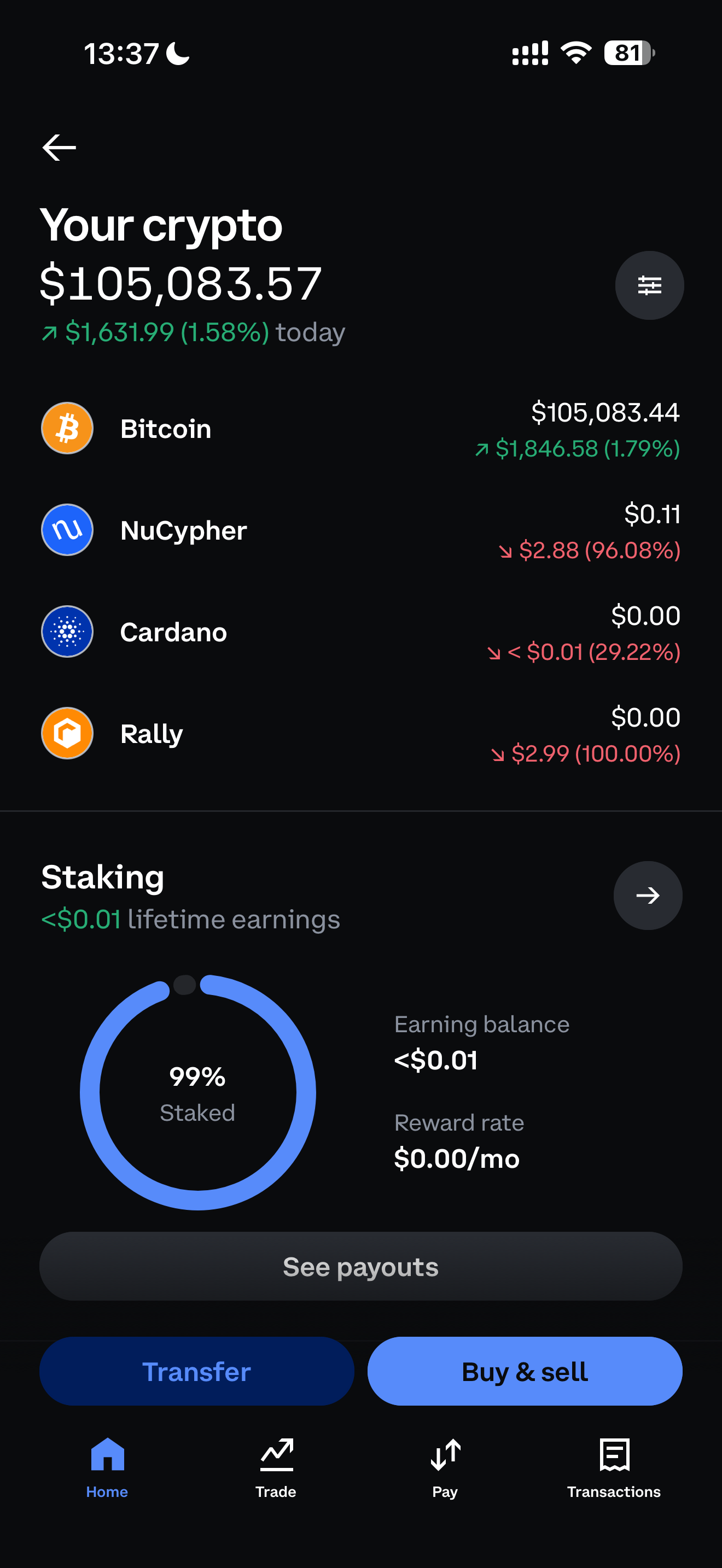
The standard Coinbase app: easy to use, but the Simple interface is not where you want to place large or frequent trades.
Coinbase Advanced: the feature most UK users miss
Inside the same Coinbase account, behind the "Advanced" tab, is a completely different product with a completely different fee schedule. Same login, same verified identity, same wallets. Just a different trading interface.
Coinbase Advanced uses a maker-taker pricing model. At the base tier (under about $10,000 of 30-day trading volume), you pay 0.40% as a maker and 0.60% as a taker. That is roughly a fifth of what you would pay on Simple. As your volume rises, fees drop further. High-volume traders above $250 million in 30-day volume pay 0% maker and just 0.05% taker.
For anyone doing more than a couple of buys per month, Advanced is not a nice-to-have. It is the correct default. You get the order book, limit orders, proper charts, and fee levels that are genuinely competitive with dedicated pro exchanges like Kraken Pro.
In practice, switching is a matter of tapping the Advanced tab. Same account, same KYC, same balances, just a different trading interface and fee schedule.
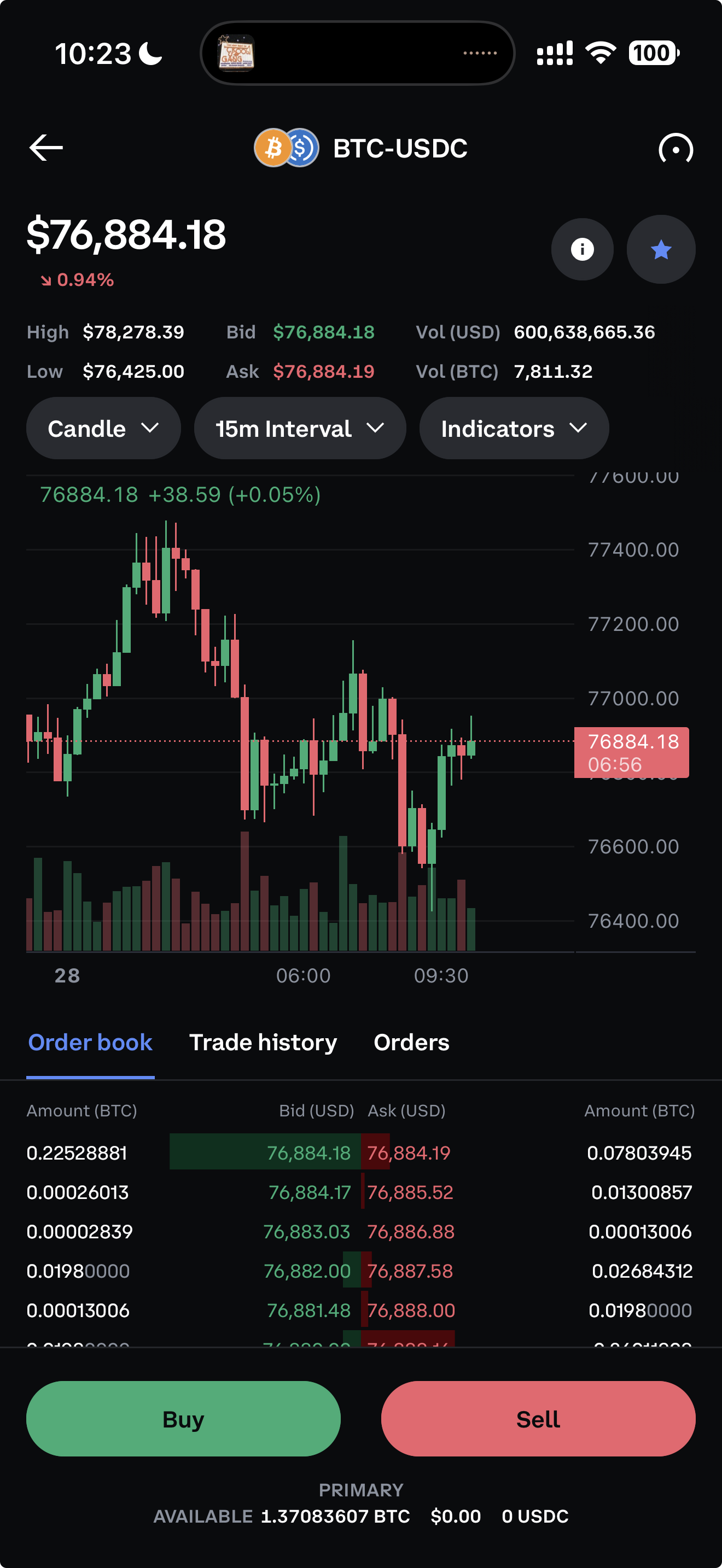
The Coinbase Advanced trading screen for BTC-USDC. Live order book, candle charts, and maker/taker pricing, all inside the same Coinbase account.
Coinbase One: worth paying for in the UK?
Coinbase One is the platform's paid subscription, now available in the UK with three tiers:
- Basic, £4.99 per month (or £49.99 per year). Zero trading fees on up to £500 of monthly volume, unlimited 3.50% APY on USDC balances, a 5% boost on staking rewards.
- Preferred, £19.99 per month (or £209.99 per year). Zero trading fees on up to £10,000 of monthly volume, the same 3.50% APY on USDC, a 10% staking boost, 24/7 priority support, and 25% off Coinbase Advanced spot trading fees (capped at 100 USDC per month).
- Premium, £199.99 per month. Unlimited zero-fee trading, 15% staking boost, concierge support, and unlimited Advanced trade fee rebates at 25% off.
For most UK users, the interesting tier is Basic. At £4.99 a month, the 3.50% unlimited APY on USDC alone is compelling. That's a USD stablecoin paying around five times what a mainstream UK easy-access savings account offers right now, and it's available on the entry tier without a balance cap.
Our honest view: Coinbase One Basic is a quietly strong product for the UK. If you hold any USDC, the yield pays for the subscription many times over. If you also make occasional larger trades on the Simple interface, the zero-fee trading up to £500 a month is a bonus on top. The Preferred tier only makes sense for heavier users, and Premium is really aimed at high-volume traders.
For regular or higher-value UK users, the combination to think about is Coinbase Advanced plus Coinbase One. Advanced gives you institutional-grade pricing on the order book side (roughly 0.40% maker / 0.60% taker at base tier), and Coinbase One layers USDC yield, boosted staking rewards, priority support, and, on Preferred and Premium, partial rebates on Advanced spot trading fees. Used together, this is arguably the best default setup on Coinbase for a UK user who trades more than occasionally or holds a meaningful balance, combining low trading fees, passive USDC yield, and the full Coinbase security stack. Always check current pricing and tier benefits in the app before subscribing.
Staking on Coinbase UK
Coinbase offers staking on a decent list of proof-of-stake assets, including Ethereum, Solana, Cardano, Cosmos, and Tezos. For UK users, the service is available subject to the FCA's financial promotions rules, which means you will complete a mandatory risk questionnaire before you can start.
The staking is simple, custodial, and hands-off. You hold the asset on Coinbase, you opt in, and rewards accrue automatically. The trade-off is the commission: Coinbase takes 25% to 35% of staking rewards, which is meaningfully higher than running your own validator or using certain DeFi protocols. For most UK retail users who are not going to set up an Ethereum validator at home, that fee is the price of convenience. But if you are optimising for yield, it is worth knowing what you are giving up.
Coinbase Card (UK)
The Coinbase Card is a Visa debit card linked to your Coinbase balance. There is no annual fee, and you can use it for everyday spending while holding crypto in the account. UK users get the spending functionality, but not the cashback or crypto rewards that US users receive. That rewards programme remains US-only at the time of writing.
If you have crypto you want to be able to spend on the move without selling first, the card is a reasonable add-on. If you are expecting a rewards programme to offset the real cost of using crypto for spending, set that expectation correctly.
A note on Coinbase Wallet (the Base app)
Coinbase Wallet, sometimes referred to as the Base app, is a completely separate, self-custody product from your Coinbase exchange account. With Coinbase Wallet, you hold your own private keys. Coinbase does not hold your funds there, does not insure them, and your assets sit outside the exchange's balance sheet entirely.
This is fundamentally different from the product this review is about. The custodial Coinbase exchange account uses Coinbase's institutional-grade custody, cold storage, and $320 million insurance on hot wallets. Coinbase Wallet (Base app), by contrast, places the full responsibility for security on you: lose your seed phrase, and nobody, including Coinbase, can help you recover it. If you want to hold crypto yourself with no counterparty, Coinbase Wallet is one option, though dedicated hardware wallets like Ledger offer stronger security for self-custody.
For the rest of this review, when we say "Coinbase," we mean the custodial Coinbase exchange account, not the self-custody Coinbase Wallet or Base app.
The pros and cons
On customer support specifically: it used to be a real weakness. When we have needed to reach out recently, we have had fast and genuinely helpful responses, so our experience in 2025 and 2026 has been materially better than what earlier reviews online describe. It is an area where Coinbase has visibly improved.
Coinbase vs the alternatives
Coinbase is not the right choice for every UK user. Here is where alternatives win:
- Kraken. On the Pro interface, Kraken base fees (0.25% maker / 0.40% taker) are lower than Coinbase Advanced's base. If you are an active trader with moderate volume, Kraken may save you money.
- Bitpanda. Free GBP deposits and withdrawals, lower spreads on the Pro tier. FCA-registered and relaunched for UK users in 2025.
- IG. If you want exposure to crypto inside a traditional broker that also offers stocks and CFDs, IG's recent UK crypto launch is worth considering. Good for investors who prefer one account, not specialised crypto tools.
- Revolut X. A lower-fee UK-focused crypto platform for active traders. See our Revolut X review.
- Ledger hardware wallet. The right answer for coins you do not plan to touch for years. Self-custody, zero counterparty risk. Our Ledger review covers this in detail.
Where Coinbase still wins: long-term holders who want regulation, insurance, a public company's accountability, and do not mind paying slightly more for it. And for most users, the best setup is a combination: Coinbase for the portion you might want to access, a Ledger for the rest.
How to open a Coinbase UK account
Frequently asked questions
Is Coinbase safe to use in the UK?
Yes. Coinbase is regulated by the FCA under both the Electronic Money Regulations and the Money Laundering Regulations, holds roughly 98% of customer crypto in offline cold storage, carries $320 million of hot wallet insurance, and has never suffered a platform-level hack. Your crypto is not FSCS-protected (no crypto is, anywhere in the UK), but the broader protections are unusually strong for this industry.
Is Coinbase regulated by the FCA?
Yes. UK services are provided by CB Payments Limited (Coinbase UK), FCA Firm Reference Number 900635. It is authorised by the FCA as an Electronic Money Institution and registered for cryptoasset activities under the Money Laundering Regulations 2017, with full UK VASP registration obtained in 2025.
Why are Coinbase fees so high?
The fees on the standard Coinbase app (Simple) are above-average because they combine a spread with a transaction fee, and are priced for convenience rather than active trading. The fix is to use Coinbase Advanced, which is available inside the same account and charges roughly 0.40% maker / 0.60% taker at base tier.
What is the difference between Coinbase and Coinbase Advanced?
They are the same account, the same balance, and the same identity verification. Simple is the easy retail interface with higher fees and market orders only. Advanced is the pro interface with an order book, limit orders, and much lower maker-taker fees. You can switch between them at any time.
Is Coinbase One worth it in the UK?
It depends on how you trade. If you use the standard app regularly, the zero-fee trading benefit can pay for the subscription with a single larger trade. If you already use Coinbase Advanced, the value is much smaller. Check the current GBP pricing in the app before subscribing.
Can I withdraw GBP from Coinbase to my UK bank account?
Yes, via Faster Payments. Withdrawals are usually fast, typically within minutes, and cost £1 flat. GBP deposits are free.
Can I stake Ethereum on Coinbase in the UK?
Yes. Coinbase offers Ethereum staking to UK users, subject to completing the FCA-mandated appropriateness assessment. Coinbase takes a commission of 25% to 35% of rewards, which is higher than running your own validator but materially simpler.
Is my crypto safe if Coinbase goes bankrupt?
Customer crypto is held in segregated cold storage wallets and is not part of Coinbase's operational balance sheet. GBP e-money balances are safeguarded under UK EMI rules, which places them ahead of general creditors in an insolvency. Crypto holdings are not FSCS-protected (no crypto is), and you are always taking some level of custodial risk with any exchange. For this reason, holding a portion in self-custody via a hardware wallet remains a sensible diversification.
Our final verdict
Coinbase is not the cheapest crypto exchange available to UK investors, and it does not try to be. What it offers instead is a combination of features that no direct competitor matches: a NASDAQ listing and SEC-reporting transparency, FCA registration layered across e-money and AML regulations, custody of the world's largest institutional Bitcoin products, a decade of operation without a platform-level hack, $320 million of hot wallet insurance, and Coinbase Advanced for users who want institutional-level fees without leaving the account.
For the buy-and-hold UK investor who wants regulated, insured, trustworthy exposure to crypto, Coinbase is the strongest option on the market today. For the active trader, Coinbase Advanced makes it genuinely competitive. For the user who wants the cheapest possible fee, look at Kraken Pro or Bitpanda Pro, while understanding that you are stepping away from public-company accountability to get there.
This is why we personally keep six figures of our own crypto on the platform. The fees are a small price for the peace of mind of knowing our assets sit on the same institutional-grade custody and security infrastructure that Coinbase's largest clients rely on.