Seeking Alpha vs Motley Fool: Which Research Service Wins?



Seeking Alpha and Motley Fool are two of the biggest names in retail investment research, but they are built for very different kinds of investors. One is a deep research platform with quantitative tools and 18,000+ analyst contributors. The other is a pick-and-hold service that tells you which stocks to buy and expects you to trust the call.
We have used both platforms extensively, and we think the choice comes down to one question: do you want to do your own research with professional-grade tools, or do you want a curated list of picks handed to you every month?
For most investors who read MatchMyBroker, Seeking Alpha is the stronger choice. It has a generous free tier, better data depth, a more transparent methodology, and its Alpha Picks service has outperformed the S&P 500 by a significant margin since launch. Motley Fool has legitimate strengths, especially for passive investors, but Seeking Alpha wins on breadth, flexibility, and value per dollar.
Quick Verdict
Seeking Alpha wins on research depth, free tier access, data tools, community quality, and transparent methodology. Motley Fool wins on simplicity and a longer public track record. For self-directed investors, Seeking Alpha is the obvious starting point. For someone who just wants to be told what to buy and does not care about the reasoning, Motley Fool is fine.
What Is Seeking Alpha?
Seeking Alpha is a stock research platform founded in 2004. It combines crowdsourced analysis from 18,000+ contributing analysts with a proprietary quantitative rating system that covers around 5,600 stocks. The platform gets 20 million monthly visitors and publishes more than 400 new articles every day.
What makes Seeking Alpha different is that it is not just a stock-picking service. It is a full research workstation. You get stock screeners, factor grades, quant ratings, earnings call transcripts, analyst price targets, portfolio tracking, and a community of premium-only commenters who discuss every article in real time.
The subscription tiers are:
What Is Motley Fool?
The Motley Fool is a stock-picking service founded in 1993 by David and Tom Gardner. Its flagship product, Stock Advisor, has been running since 2002 and is one of the longest-tenured retail investment newsletters in the industry.
Motley Fool is built around editorial stock recommendations. A team of in-house analysts publishes new picks every month, and subscribers are expected to buy and hold. There is no real research workstation, no quant system with the depth of Seeking Alpha, and no community of analysts. You get the picks, a short write-up explaining the thesis, and access to their Fool IQ data tool.
Current subscription tiers (after Motley Fool restructured in 2025) are:
Pricing: Where Seeking Alpha Has a Structural Advantage
The most obvious pricing difference is that Seeking Alpha has a free tier and Motley Fool does not. That alone changes the risk profile for new users. With Seeking Alpha, you can spend a few weeks exploring the free articles, earnings transcripts, and basic quant ratings before paying anything. With Motley Fool, you are paying upfront for stock picks you have not yet evaluated.
At the entry-level paid tier, Motley Fool Stock Advisor ($199/yr, or $99 introductory) is cheaper than Seeking Alpha Premium ($299/yr, or $269 introductory). But you are getting very different products. Stock Advisor is primarily a pick service with limited tools. Premium is a full research platform with quant ratings on 5,600+ stocks, factor grades, and unlimited analyst articles. On a per-feature basis, Premium is meaningfully better value.
If you want both research tools and monthly picks from Seeking Alpha, the Premium + Alpha Picks Bundle at $629/yr is the sweet spot. It sits between Motley Fool's Stock Advisor and Epic tiers on price, but gives you research depth that Motley Fool does not match at any tier below Epic Plus.
Research Tools and Features: The Depth Gap
This is the area where the difference between the two platforms is most obvious, and where our preference for Seeking Alpha is easiest to justify with visual evidence.
Pull up a popular stock like Amazon on Motley Fool and you get a clean but sparse page. You see a price chart, current price, market cap, a few percentage returns, and a basic revenue growth table going back a few years. That is essentially the full picture.
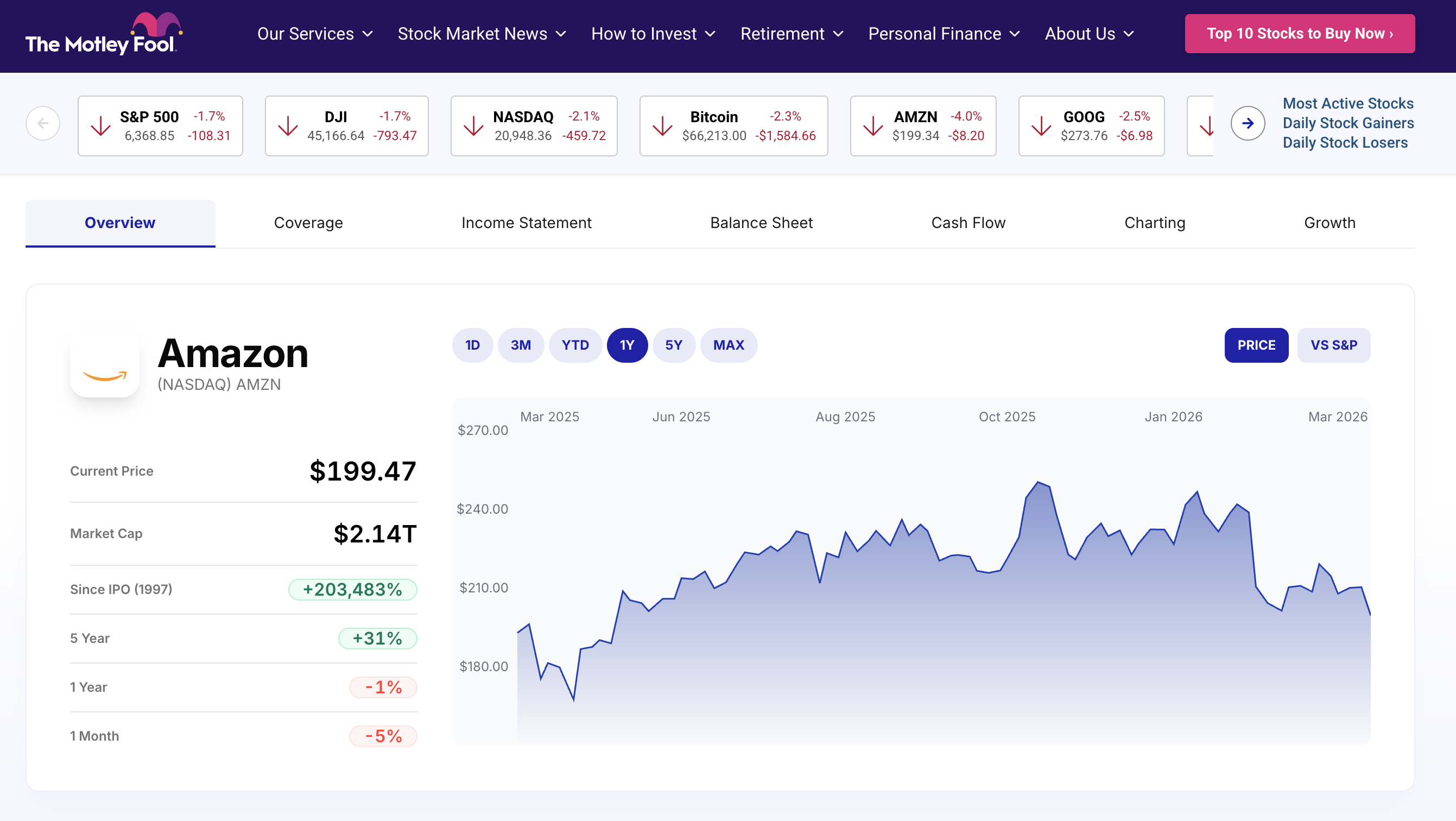
Motley Fool's Amazon page. Clean layout, but very little depth. A basic chart and a handful of stats.
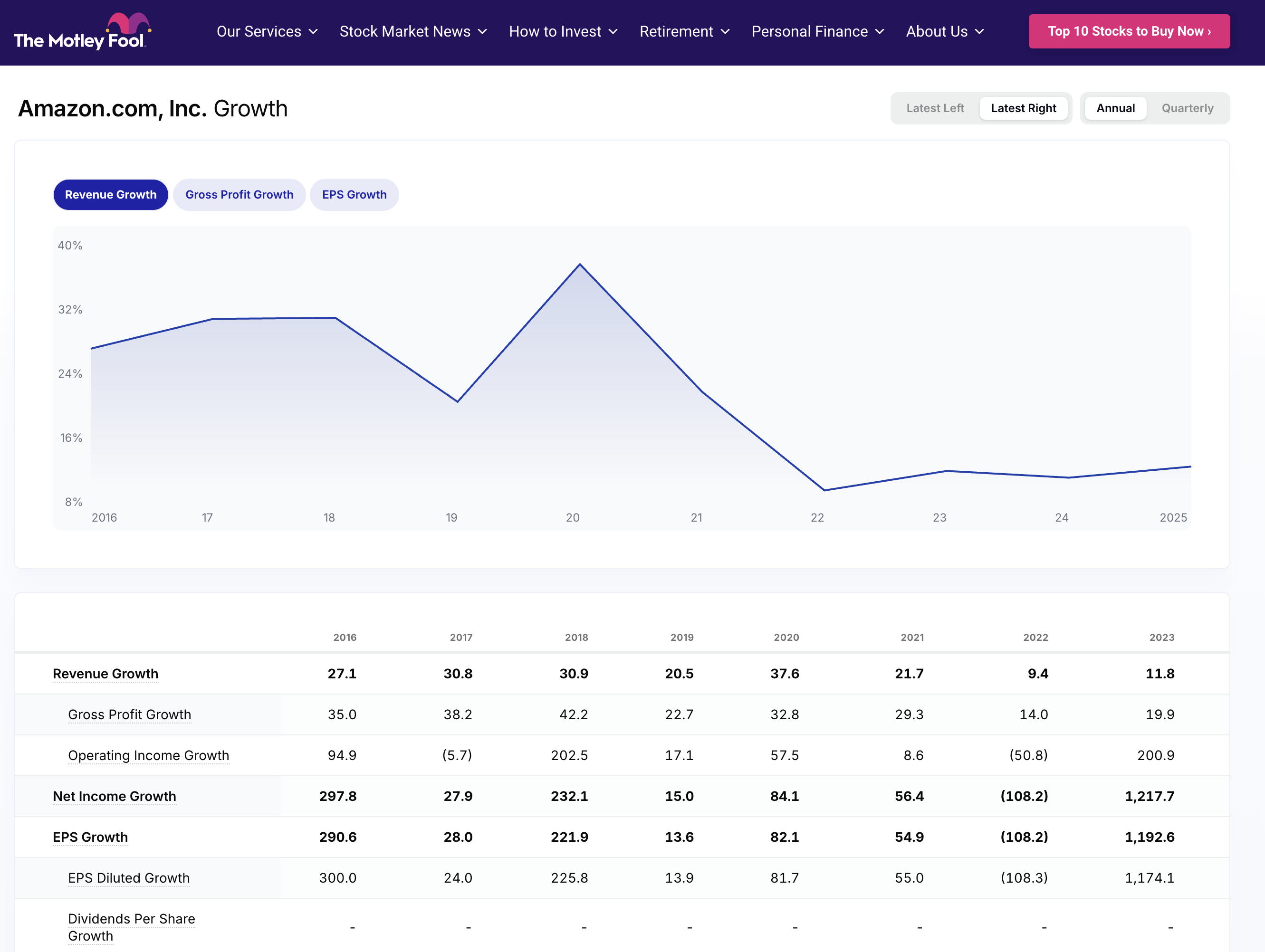
Motley Fool's growth data on Amazon. A few rows of revenue and EPS growth, and that is it.
Now pull up the same stock on Seeking Alpha. You get a ratings summary showing SA Analyst ratings, Wall Street ratings, and Quant ratings side by side. You get factor grades for Valuation, Growth, Profitability, Momentum, and Revisions (each graded A through F). You get a quant ranking showing Amazon is 177 out of 4,260 stocks overall and 19 out of 480 in its sector. You get a feed of analysis articles from different contributors, each with a buy, hold, or sell rating. You get news, transcripts, SEC filings, press releases. And you get a quant rating history chart that shows exactly when the rating changed over time and at what price.
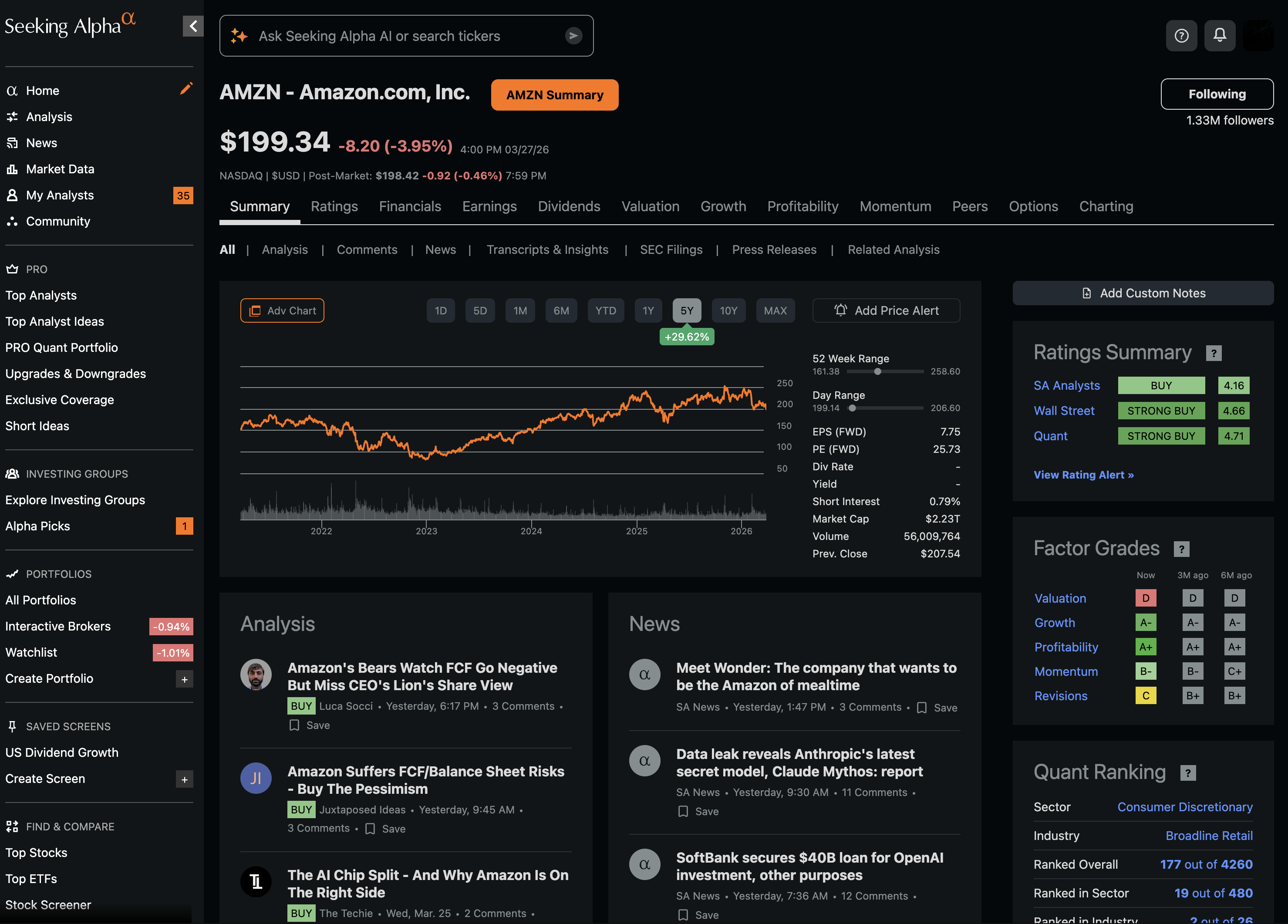
Seeking Alpha's Amazon page. Quant rating 4.71 (Strong Buy), factor grades, multiple analyst ratings, and a live feed of analysis articles.
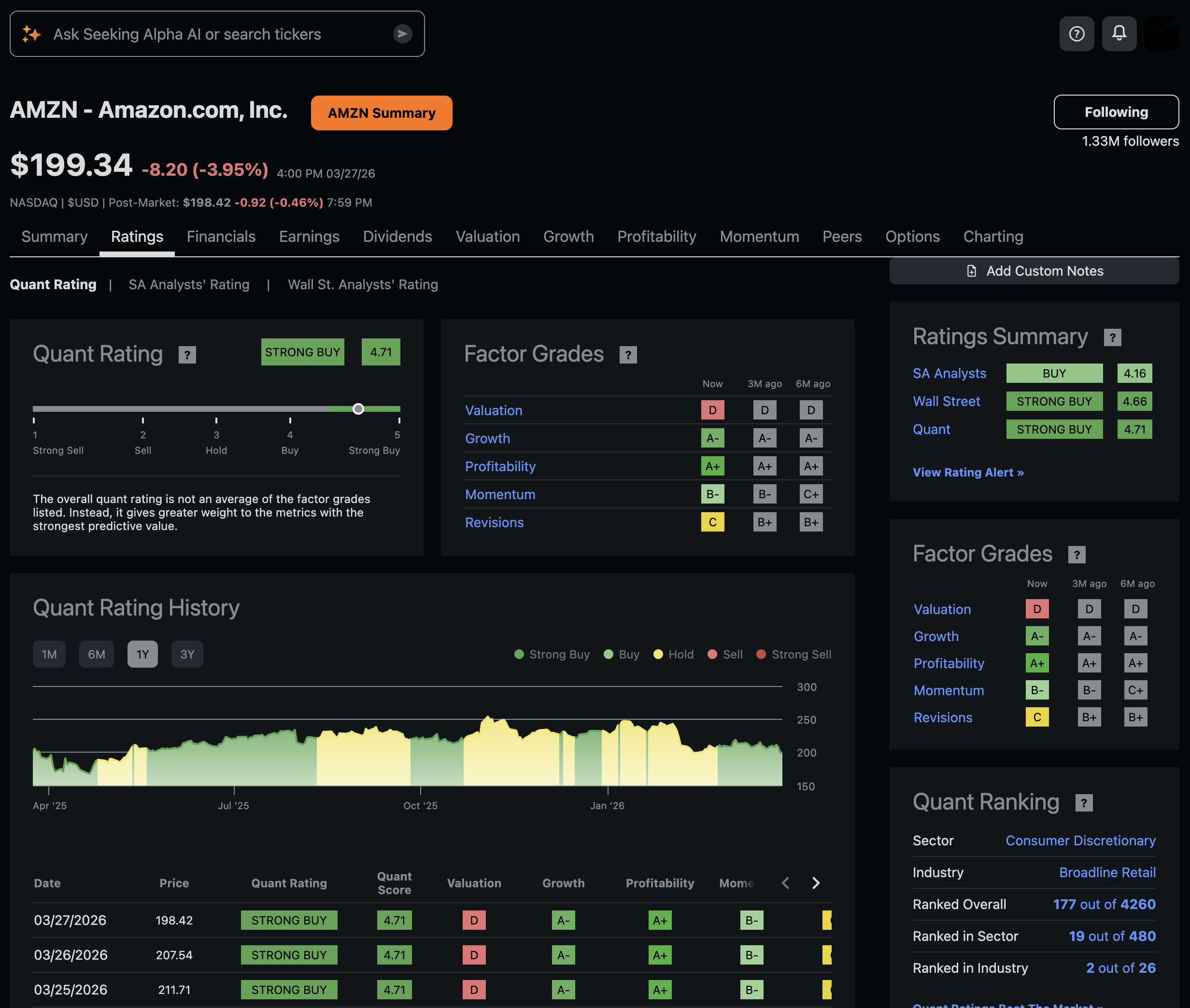
Seeking Alpha's ratings detail page. Factor grades for every key dimension, plus a full quant rating history with price overlay.
The difference is not subtle. Motley Fool gives you a price chart and a recommendation. Seeking Alpha gives you a complete research environment.
A few specific features worth calling out:
Quant Ratings. Seeking Alpha's quant system rates 5,600+ stocks using factor analysis and has been academically validated (University of Kentucky, 2024) as strongly predictive of future returns. Since 2010, Quant Strong Buy stocks have outperformed the market by roughly 8x. Motley Fool has nothing comparable at the Stock Advisor tier. Their Fool IQ tool is newer and much less comprehensive.
Earnings call transcripts. Seeking Alpha has 7,000+ earnings transcripts available, and many are free to access even without Premium. Motley Fool does not offer transcripts at all.
Diverse analyst voices. With 18,000+ contributing analysts, Seeking Alpha gives you multiple perspectives on any given stock. One contributor might be bullish, another bearish, and you can read both arguments before forming your own view. Motley Fool picks come from a small in-house team, which creates a single point of view.
Premium comment section. This is one of the most underrated features. Only paying Premium members can comment on articles, which keeps the discussion quality high. You get real investors with real portfolios debating the thesis, pointing out flaws in the analysis, and sharing their own research. Motley Fool does not have anything like this at the Stock Advisor level.
AI research assistant. Seeking Alpha launched "Ask Seeking Alpha" in 2025, which lets you query analyst recommendations, rankings, and sector breakdowns in natural language. Motley Fool added an AI Playbook in 2025 but only at the Epic Plus tier.
On the other side, Motley Fool does have one genuine advantage: simplicity. If you find Seeking Alpha overwhelming (and many beginners do), Motley Fool's clean, limited interface can feel easier to use. You are not drowning in data. You just see the pick, read the thesis, and act.
Stock-Picking Track Records
Both platforms offer a flagship stock-picking product, and both have legitimate track records.
Seeking Alpha Alpha Picks launched in July 2022. Since then it has delivered a cumulative return of around +319.19%, compared to the S&P 500's +102.18% over the same period. Current leading open picks are Powell Industries (+1,194.36%), Celestica (+1,013.04%), and Sterling Infrastructure (+927.31%). Picks are selected algorithmically from stocks holding a Strong Buy quant rating for 75 consecutive days.
Motley Fool Stock Advisor has been running since February 2002, which gives it a track record of more than 24 years. Stock Advisor claims an average return of +950% since launch, against +216% for the S&P 500 over the same stretch, according to fool.com on 12 October 2026. Both figures are Motley Fool's own calculations. Notable historical picks include Nvidia (recommended in 2005, up more than 100,000%), Netflix (2004, up more than 50,000%), and Amazon (2002, up more than 27,000%), with 42 "ten-baggers" over the lifetime of the service.
Both numbers look impressive. A few things to keep in mind when comparing them:
- Time horizon matters. Motley Fool has a head start of more than 20 years. Alpha Picks has been running for just over 4 years. Direct percentage comparisons between the two are misleading.
- Methodology transparency. Alpha Picks uses a systematic quantitative screen that anyone can understand and evaluate. Motley Fool picks are editorial judgment calls, which makes the track record harder to independently verify.
- Survivorship bias. Motley Fool's headline numbers are heavily influenced by a few massive winners from 20+ years ago.
Neither service guarantees future returns, and past performance does not predict what happens next. What Seeking Alpha offers that Motley Fool does not is a transparent, rule-based methodology you can actually evaluate.
Who Should Choose Seeking Alpha?
Seeking Alpha is the better choice for:
- Self-directed investors who want to do their own research before buying a stock
- Anyone who wants to start with free tools and upgrade only if they find genuine value
- Investors who care about the "why" behind a pick, not just the pick itself
- Active investors who follow earnings calls, analyst ratings, and factor analysis
- People who want multiple perspectives on a stock rather than one editorial voice
- Readers of this site, in our experience. The MatchMyBroker audience skews toward data-driven, research-oriented investing
Who Should Choose Motley Fool?
Motley Fool is the better choice for:
- Passive investors who want a simple list of stocks to buy and hold
- Beginners who find detailed research tools overwhelming
- People who trust editorial judgment and do not want to evaluate a thesis themselves
- Long-term investors who value a multi-decade track record and are comfortable with a handful of big winners carrying the performance
We are not going to pretend Motley Fool is a bad service. It is a legitimate product that has helped a lot of beginner investors get started. The approach is just narrower than what Seeking Alpha offers. If you want to check out Motley Fool's Stock Advisor for yourself, you can visit Motley Fool here.
Our Verdict
For most investors, Seeking Alpha is the stronger platform. The free tier alone makes it the obvious place to start. You can read articles, check earnings transcripts, and explore the quant ratings without paying anything. If you decide you want more, Seeking Alpha Premium at $269/yr gives you a full research workstation, and the Premium + Alpha Picks Bundle at $629/yr adds monthly quant-driven picks with a strong recent track record.
Motley Fool works for a narrower audience: investors who want a simple pick service and do not want to do their own research. Stock Advisor at $99 introductory is reasonable if that is genuinely what you want. But for anyone who wants to understand their portfolio, evaluate analyst views, and grow their research skills over time, Seeking Alpha gives you substantially more.
Start with Seeking Alpha's free plan. If the tools and community add value to your process, upgrade to Premium. If you want monthly picks on top, the Bundle is where most investors end up.
Looking beyond these two? See how the main stock newsletters compare on performance, price and method.
Frequently Asked Questions
Is Seeking Alpha better than Motley Fool?
For research depth, data tools, and self-directed investors, yes. Seeking Alpha offers quant ratings on 5,600+ stocks, factor grades, earnings transcripts, and 18,000+ analyst contributors. Motley Fool is simpler and works better for passive investors who just want stock picks. For most investors who want to understand their portfolio, Seeking Alpha is the stronger platform.
Is Seeking Alpha free?
Yes. Seeking Alpha has a generous free tier that includes articles, news, basic quant ratings, and earnings transcripts. Premium starts at $269/yr (intro) or $299/yr regular, with a 7-day free trial.
Is Motley Fool Stock Advisor worth it?
If you want a simple pick service and are comfortable with editorial judgment, Stock Advisor at $99 introductory is reasonable. The track record of more than 24 years is legitimate, although headline returns are skewed by a few very large historical winners. For investors who want research tools, Seeking Alpha Premium offers substantially more for a similar price.
Can I use Seeking Alpha and Motley Fool together?
Some investors use Motley Fool for stock ideas and Seeking Alpha for deeper research before buying. That works, but Seeking Alpha alone covers both needs through Alpha Picks (monthly quant-driven picks) and the full research platform, so most investors do not need both.
What is Seeking Alpha Alpha Picks?
Alpha Picks is Seeking Alpha's quant-driven stock-picking service. It delivers 2 stock picks per month selected from stocks that have held a Strong Buy quant rating for 75 consecutive days. Since launching in July 2022, Alpha Picks has returned around +319.19% cumulatively versus the S&P 500's +102.18% over the same period. See our full Alpha Picks review for more detail.
How much does Motley Fool cost?
Stock Advisor is $199/yr regular ($99 intro). Epic is $499/yr ($299 intro). Epic Plus is $1,999/yr. Fool One is $13,999/yr. There is no free tier and no free trial, only a 30-day money-back guarantee.
Does Seeking Alpha have a free trial?
Yes, Seeking Alpha Premium offers a 7-day free trial. Alpha Picks does not have a free trial. It can be bought standalone or as part of the Premium + Alpha Picks Bundle, which also has no free trial. Both are sold as discounted annual subscriptions that auto-renew at the standard list price after the first year.
Which platform has better performance?
Over the longest available time periods, Motley Fool Stock Advisor claims a higher cumulative return (+950% since 2002, against +216% for the S&P 500 on Motley Fool's own figures, as of 12 October 2026). Since July 2022, Alpha Picks has returned +319.19% versus +102.18% for the S&P 500, to 16 October 2026. Both track records are real, but they cover very different time horizons, so direct comparisons are misleading.
Trading and investing involve significant risk and may not be suitable for all investors. The value of investments can go down as well as up, and you may lose some or all of your initial investment. Past performance is not indicative of future results. We may earn a commission through affiliate links at no extra cost to you.
Kai is an investor who helps people choose the right broker and invest with confidence. He founded MatchMyBroker, a broker-comparison site for a global audience, and EU Investing Hub, his European-focused investing site. He also runs the Smart Money with Kai YouTube channel, where he breaks down investing, brokers and personal finance.