.png)
Interactive Brokers Currency Conversion Guide: Auto vs Manual FX



Most investors obsess over trading commissions. They compare $0 vs $1 per trade, switch brokers to save a few cents, and feel clever about it. Then they wire $10,000 from their home currency into US dollars to buy Apple shares, and hand over $50 in currency conversion fees without even noticing. The commission was the tip. The iceberg was the FX.
Interactive Brokers is, in our view, the cheapest place in the market right now to convert currencies as a retail investor. That is one of the main reasons we rank it as our top broker. But IBKR gives you two ways to do it, and picking the wrong one can cost you real money. There is a clean, boring cutoff, and once you know it, currency conversion on IBKR becomes a solved problem.
UAE residents can see how account entity and funding route affect the practical setup in our Interactive Brokers UAE review.
This guide walks through both methods, the exact fees, the breakeven point, how to actually do a manual conversion, and why this still makes IBKR the cheapest option for anyone investing across currencies.
Quick answer: for smaller conversions, IBKR auto conversion is usually fine. Around USD 6,667 and above, manual FX through IDEALPRO usually becomes cheaper because auto conversion uses a 0.03 percent spread adjustment, while manual spot FX has a USD 2 minimum commission at the lowest tier.
Auto vs manual conversion cost
Why currency conversion matters more than you think
If you live in the UK, Germany, the Netherlands, or anywhere outside the US, and you want to buy US stocks or ETFs, you need US dollars. Your broker has to convert your home currency at some point. How they do that, and what they charge, is often worse than their headline commission.
To give you a sense of the spread across the market: many retail brokers charge between 0.15% and 0.70% per currency conversion, some bake it into a worse exchange rate rather than show it as a line item. On a €10,000 conversion, that is anywhere from €15 to €70 gone before you have bought a single share. Do that four times a year and you are giving up hundreds of euros annually to an expense most investors never track.
Interactive Brokers sits at the bottom of that range, and with the manual route, significantly below it. That is the real story here.
The two ways to convert currency on IBKR
IBKR gives you two distinct methods:
Option 1: Auto-conversion. When you place a trade in a currency you do not hold, IBKR converts the required amount for you automatically. You do nothing. The cost is baked into the rate.
Option 2: Manual conversion via IDEALPRO. You place a currency trade yourself before you buy the asset. You are routed onto IBKR's professional FX marketplace. The cost is a small commission with a minimum.
Both work. Both are cheap by industry standards. But one is cheaper below a certain threshold, and the other is cheaper above it.
Option 1: Auto-conversion, the easy route
Auto-conversion is the default behaviour for most retail accounts. You buy a US stock, IBKR notices you do not have enough US dollars, and it converts what you need on the fly. You do not place a separate FX trade. It just happens.
The currency you hold matters even more once you borrow, because IBKR margin rates differ by currency. See how margin works at Interactive Brokers for the full breakdown.
The cost, as stated on IBKR's official spot currencies commissions page, is 0.03% added to or subtracted from the exchange rate. There is no separate commission. The cost is baked into the rate you get.
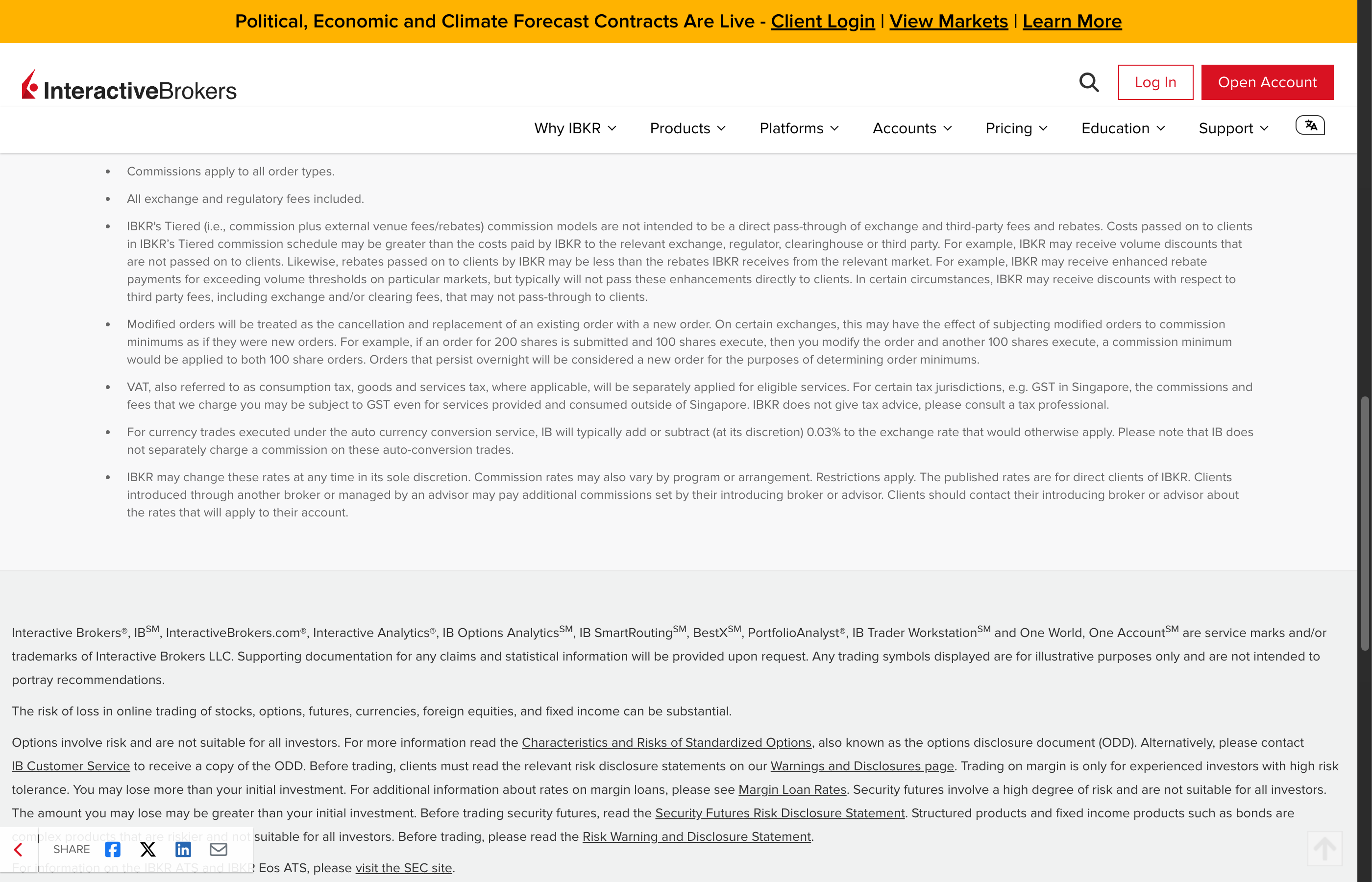
Source: Interactive Brokers' official commissions page for spot currencies, confirming the 0.03% auto-conversion figure.
In practical terms, on a €1,000 conversion, auto-conversion costs you around €0.30. On €3,000, it is €0.90. These are tiny numbers, and for most casual investors buying a US stock here and there, auto-conversion is perfectly fine. It is simple, fast, and still cheaper than most brokers' manual processes.
The cost only becomes meaningful at size. At €20,000 converted, auto-conversion costs you €6. At €100,000, it is €30. That is where Option 2 starts to matter.
Option 2: Manual FX on IDEALPRO, the cheaper route at scale
IDEALPRO is IBKR's institutional-grade FX marketplace. It aggregates quotes from 17 of the world's largest interbank dealers and passes them through to you at displayed spreads as tight as 0.1 pip. This is the same venue that professional traders and hedge funds use. Retail investors on IBKR Pro get access to it as standard.
The pricing is tiered by monthly FX volume. For retail investors, you will sit in Tier I (under $1 billion monthly volume, which, let us be honest, covers all of us), and the schedule is:
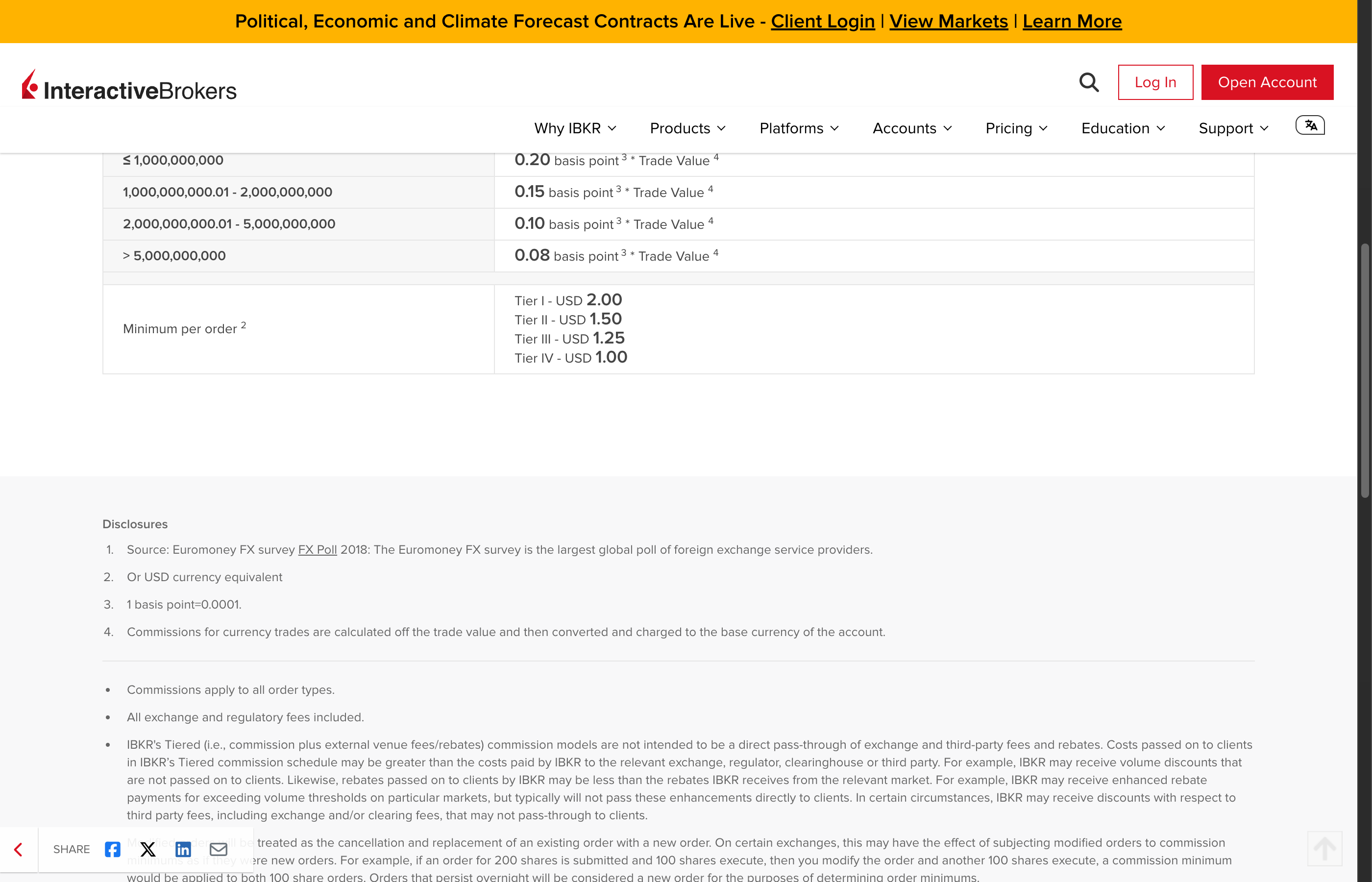
IBKR's tiered FX commission schedule. Retail investors fall into Tier I, paying 0.20 basis points per trade with a USD 2.00 minimum per order.
The key numbers for retail:
- Commission: 0.20 basis points of trade value (that is 0.002%, or two hundredths of a percent)
- Minimum per order: USD 2.00
- Spread: Typically 0.1 pip on major pairs like EUR.USD and GBP.USD
The minimum is what drives the breakeven. At small conversion amounts, the $2 minimum is worse than paying 0.03% on the amount. At large conversion amounts, the $2 minimum is a tiny fraction of the value, and the 0.20 basis point charge is laughably small.
The $6,667 rule (this is the whole point)
The breakeven is simple arithmetic. Auto-conversion costs 0.03% of the amount. Manual costs a flat $2 minimum until your conversion is large enough that the 0.20 basis point charge exceeds $2. Set them equal:
$2.00 ÷ 0.0003 = $6,666.67
Below roughly $6,667 converted, auto is cheaper. Above it, manual is cheaper. And it gets cheaper fast, because manual's cost barely moves as the amount grows, while auto's 0.03% scales linearly.
Look at the $100,000 row. Auto-conversion costs you $30. Manual costs you $2. Same result in your account, different cost by a factor of fifteen. That is why professional and high-volume investors always use manual FX. And once you have done it once, the process takes under a minute.
How to do a manual currency conversion on IBKR
The Client Portal makes this easier than people expect. There is a dedicated "Convert Currency" tab inside the Order Ticket. You do not need to know order routing, venues, or pair syntax. You just pick what you have, pick what you want, and submit.
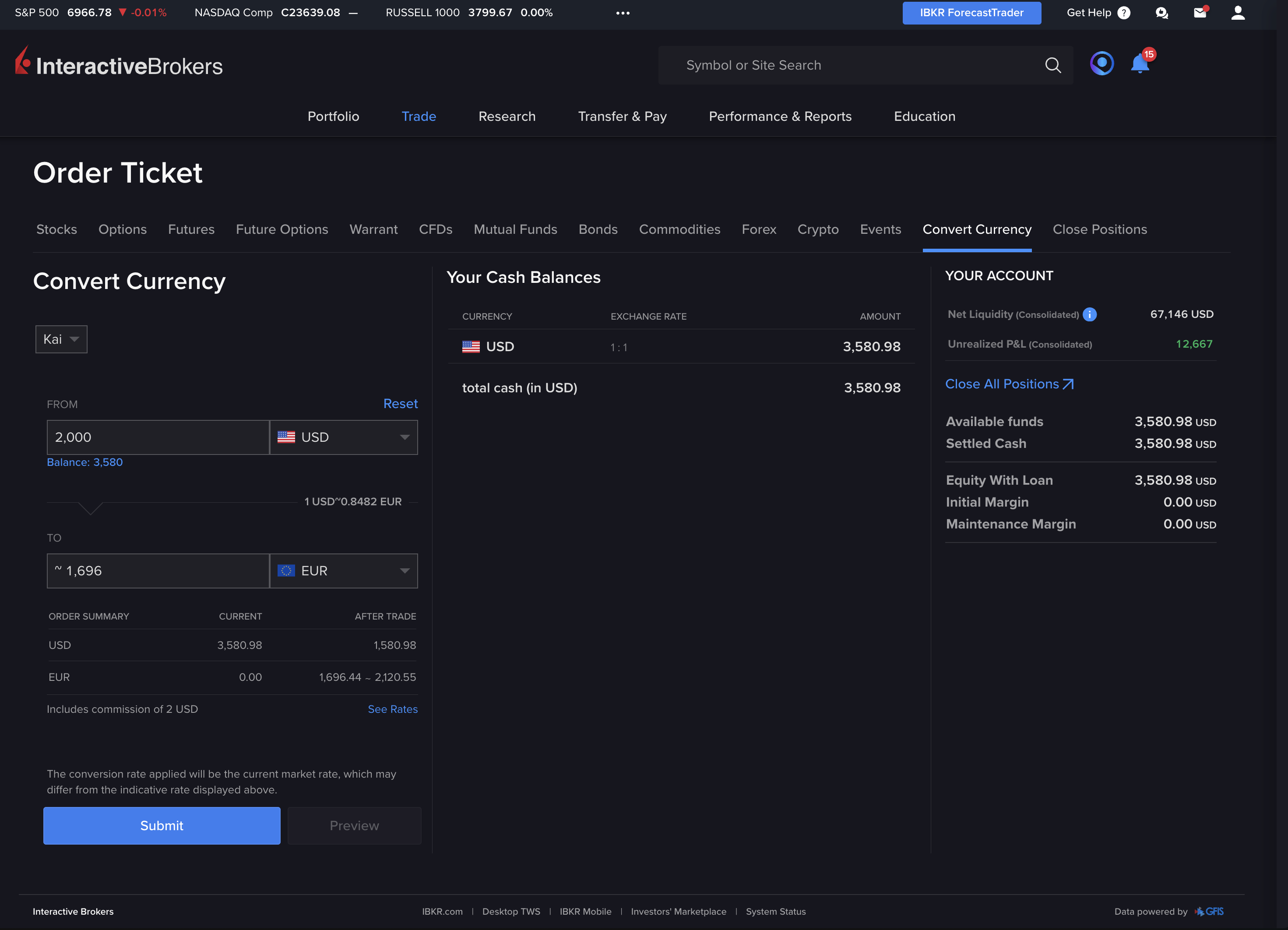
The Convert Currency tab in the IBKR Client Portal. Note the "Includes commission of 2 USD" line. This is a manual FX trade routed to IDEALPRO.
IBKR Pro vs IBKR Lite: which one can do this?
This matters. Manual FX on IDEALPRO is an IBKR Pro feature only. IBKR Lite accounts use a different pricing structure focused on commission-free US stocks and ETFs, and they do not get access to IDEALPRO's tiered FX pricing.
The good news: if you are opening an account outside the US, you are almost certainly being routed to IBKR Pro by default. IBKR Lite is primarily marketed to US retail clients. If you are in Europe, the UK, the Middle East, or elsewhere, you will likely get Pro automatically, which means you have access to manual FX from day one.
If you already have a Lite account and you want manual FX, you can request an upgrade to Pro inside your account settings. For the full comparison, see our IBKR Lite vs IBKR Pro breakdown.
Why this still makes IBKR the cheapest option, by a lot
Step back and compare. A €10,000 conversion looks like this across the market:
- Interactive Brokers (manual): around €2
- Interactive Brokers (auto): around €3
- Trading 212: 0.15% FX fee, so €15
- eToro: around 1.5% baked into the rate, so €150
- Your high-street bank: often 2 to 4%, so €200 to €400
The gap between IBKR and every other mainstream retail broker is not marginal. It is an order of magnitude or more. If you invest seriously across currencies, this single line item can be worth hundreds or thousands of euros per year. For our full fee deep dive, see IBKR Fixed vs Tiered Pricing. For the T212 comparison, see Trading 212 vs Interactive Brokers.
Our take
If you convert currency on IBKR at any meaningful scale, use manual FX. It takes under a minute, costs $2, and scales almost for free from there. If you only convert a few hundred or a few thousand dollars occasionally, auto-conversion at 0.03% is fine and saves you the friction.
The bigger point is this: IBKR's currency conversion is so cheap that the choice between auto and manual is a rounding error compared to what you would pay at almost any other retail broker. That is what makes IBKR the right home for anyone serious about investing across currencies, and it is one of the reasons it sits at the top of our broker rankings. See the full review context at MatchMyBroker Reviews.
FAQ
What is the cheapest way to convert currency on Interactive Brokers?
Manual FX on IDEALPRO is the cheapest method for conversions above roughly $6,667. Below that, auto-conversion is cheaper because the manual route has a $2 minimum commission. Both methods are cheaper than almost any other retail broker on the market.
How much does IBKR charge for automatic currency conversion?
IBKR charges 0.03% (three basis points) added to or subtracted from the exchange rate. There is no separate commission on auto-conversion trades. This figure is published on IBKR's official spot currencies commissions page.
What is the minimum commission for manual FX on IBKR?
The minimum per order is USD 2.00 for Tier I (monthly FX volume under $1 billion, which covers all retail investors). Beyond the minimum, the commission is 0.20 basis points of trade value.
Can IBKR Lite users do manual currency conversion?
No. Manual FX on the IDEALPRO venue is an IBKR Pro feature. IBKR Lite uses a different pricing structure focused on commission-free US stocks and ETFs. Most non-US investors are automatically routed to IBKR Pro at signup.
How do I actually place a manual FX trade on IBKR?
In the Client Portal, open the Order Ticket and click the Convert Currency tab. Choose your source and target currencies, enter the amount, review the indicative rate and $2 commission, and submit. In TWS, type a pair ticker like EUR.USD and use a limit order.
How long does a manual FX conversion take to settle?
Settlement is T+2 for most major currency pairs. The converted currency appears in your cash balance immediately for trading purposes, so you can buy US stocks right after the FX trade fills. T+2 only matters if you plan to withdraw the cash.
Does IBKR mark up the exchange rate on manual FX?
No significant markup. On IDEALPRO, you get displayed spreads from 17 major interbank dealers, typically as tight as 0.1 pip on major pairs. IBKR adds the tiered commission (0.20 basis points with a $2 minimum) on top, rather than baking a markup into the rate.
Risk disclaimer
Kai is an investor who helps people choose the right broker and invest with confidence. He founded MatchMyBroker, a broker-comparison site for a global audience, and EU Investing Hub, his European-focused investing site. He also runs the Smart Money with Kai YouTube channel, where he breaks down investing, brokers and personal finance.