Spread Betting vs CFDs

Advertisement Feature
Stake £10 per point on the UK 100 through a spread bet, or hold a CFD position sized to the same £10 per point, and equal exposure produces the same gross result for the same market move: a 50-point rise pays £500 gross in either wrapper, and a 50-point fall costs £500 gross.
Everything that separates the two sits around that gross number: tax treatment, whether a losing trade can offset gains elsewhere, the currency the result arises in, holding costs, and expiry. We compare the wrappers on those points, using HMRC manuals, FCA rules, and providers' published terms as the evidence.
Both products are leveraged derivatives, and either one can consume an entire trading balance. Readers who want to own assets, compound long-term investments, collect dividends as shareholders, or use a product where the trading balance is never at risk will not find any of that in either wrapper. This comparison is for readers who already accept the risk profile and want the mechanics.
Spread betting and CFDs in plain terms
Both wrappers let you take a position on a market rising or falling without owning the underlying asset, buying if you expect a rise and selling if you expect a fall. The practical difference at the order ticket is how each one expresses size.
In this GBP-account example, a spread bet states your position as a sterling stake per point of market movement. Stake £10 per point on the UK 100 and every point the index moves changes your open profit or loss by £10, in pounds. Account and settlement currencies depend on the provider. If the ticket itself is unfamiliar, our beginner's guide to spread betting works through stakes, points, and margin.
A CFD states your position in contracts or units, and the contract specification sets what each point is worth. If a specification sets one UK 100 contract at £1 per point, ten contracts create the same £10 per point as the spread bet above. Contract values and point sizes vary across providers and instruments, so check each specification before sizing a position.
In neither case do you acquire the shares or index constituents behind the price, so there is no shareholding and no dividend paid to you as an owner.
Margin, exposure, and planned loss
Three numbers govern every leveraged position, and they are easy to conflate. Margin is the collateral your provider requires to open and keep the position. Notional exposure is the full size of the position, and it determines how much you gain or lose for a given market move. Planned loss is what you expect to lose if your stop is hit, and it depends on position size, stop distance, any slippage, and the terms of a guaranteed stop if you use one.
Margin is not a cap on loss. When the market moves against a position, the loss follows the notional exposure rather than the collateral that opened it, and it can run through the rest of the account balance. Under FCA rules, negative balance protection stops a UK retail client's losses from exceeding the total funds in the trading account. It does not stop you losing everything in that account.
Stops need the same precision. A standard stop closes at the next available price once your level trades, so in a gap or fast market it can fill worse than you set. A guaranteed stop closes at the selected level if triggered, for a fee, which helps manage gap risk rather than removing the risk of the position itself.
The same UK 100 trade in both wrappers
Now attach a verified specification to that generic sizing. Capital.com specifies one UK 100 CFD contract as £1 per point, so ten of its contracts held alongside a UK 100 spread bet staked at £10 per point create two positions that both move £10 for every point the index moves.
Spread bets and CFDs are complex instruments and come with a high risk of losing money rapidly due to leverage. 65% of retail investor accounts lose money when trading spread bets and CFDs with this provider. You should consider whether you understand how spread bets and CFDs work and whether you can afford to take the high risk of losing your money.
Put those positions side by side and the gross arithmetic is identical. If the index rises 50 points in your favour, the spread bet returns £500 gross and the CFD position returns £500 gross. If it falls 50 points instead, each wrapper loses £500 gross on the same assumptions.
The £500 figure is gross. It excludes the spread crossed on entry, any overnight funding, any currency conversion, a guaranteed-stop premium if triggered, and applicable tax treatment. Those layers, not the market move, are where the wrappers separate.
One caution before generalising: the £1 per point contract belongs to Capital.com's UK 100 specification, and another provider or another market can define contracts differently, so the equivalence has to be recalculated for each instrument you trade.
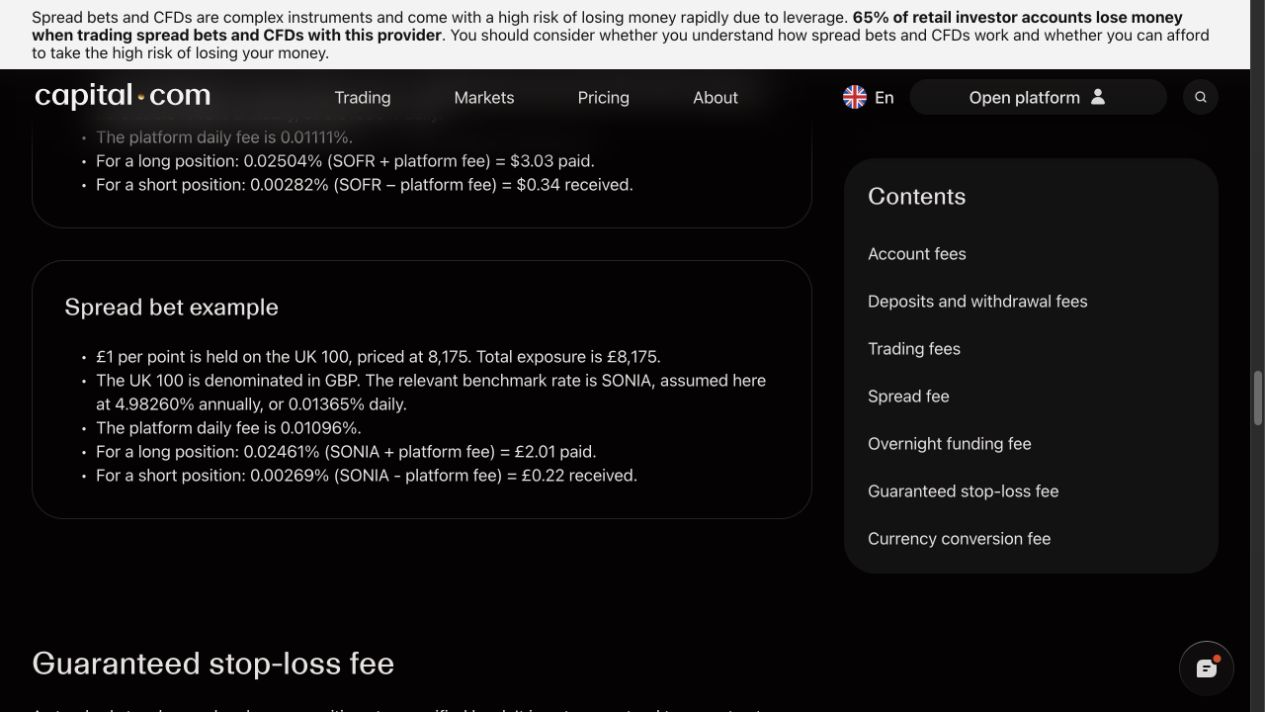
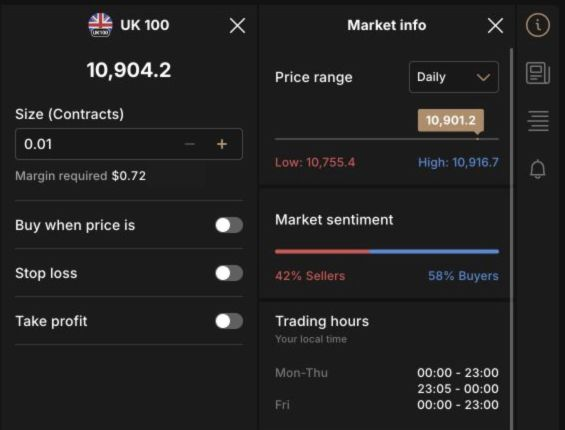
The two evidence panels above make the sizing difference visible: the published spread-bet example states a sterling stake per point, while the CFD deal ticket states a number of contracts. Behind both sits the same set of controlling numbers, margin, notional exposure, and planned loss, and the breakdown below works through them for this UK 100 example at equal exposure.
A 50-point move produces GBP 500 gross in either direction.
At GBP 1 per point per contract, exposure also equals GBP 10 per point.
Stop distance, slippage, and any guaranteed-stop fee determine planned loss.
Key differences at a glance
With exposure held equal, the deciding differences sit in the surrounding structure, and none settles the choice on its own.
- Sizing. The GBP-account spread-bet example uses pounds per point; other account currencies can be available. CFDs are sized in contracts or units, with the specification setting the point value.
- Tax treatment. An ordinary standalone spread bet sits outside the capital gains regime because no asset changes hands. Individual retail CFD results normally fall within it. The next section sets out the HMRC sources and the exceptions.
- Allowable losses. An allowable CFD capital loss may offset chargeable gains under the normal rules. A loss on an ordinary standalone spread bet creates no allowable capital loss.
- Currency handling. A GBP-denominated spread bet stakes and settles in sterling, which can reduce conversion steps. A CFD's profit or loss can arise in the instrument's currency and may need converting into your account currency.
- Product structure. Daily funded spread bets and cash CFDs can incur overnight adjustments while open. Forward spread bets and futures CFDs carry an expiry, and providers can incorporate funding into a wider spread instead of applying the same daily adjustment structure.
Because specifications, product menus, and charges differ from firm to firm, we keep provider comparisons separate; our guide to the best CFD brokers in the UK covers how those terms vary in practice.
| Feature | Spread betting | CFD |
|---|---|---|
| Sizing | GBP per point in this example | Contracts or units |
| Ordinary UK tax | Outside CGT in the ordinary case | Normally within CGT for an individual |
| Allowable loss | No allowable capital loss | May offset chargeable gains |
| Result currency | GBP in this example; account currencies vary | Can arise in instrument currency |
| Structure | Daily funded or forward | Cash or futures CFD |
UK tax treatment
Tax is where the wrappers separate most sharply, and where shorthand goes wrong most often. Two caveats first: treatment depends on your circumstances, and it can change. What follows is HMRC's published framework, not advice on your position.
For an ordinary standalone financial spread bet, HMRC's Capital Gains Manual is direct: the client acquires no asset and disposes of no asset, so the result creates no chargeable gain and no allowable capital loss. The reasoning sits at CG56105 and applies to losses as well as gains.
A common follow-up asks whether heavy activity, or living off the winnings, changes the answer. HMRC's Business Income Manual states at BIM22017 that earning a living from betting does not by itself amount to carrying on a taxable trade. The words by itself matter: frequency and income reliance alone do not turn betting results into trading income under that guidance.
CFDs sit on the other side of the line. HMRC treats an individual retail client's CFD results as normally falling within the capital gains regime, unless the activity forms part of a trade taxable as income. The relevant guidance is at CG56100 and BIM56880.
That split creates an asymmetry that a tax-free headline hides. An allowable CFD capital loss may offset chargeable gains under the normal rules, while a spread-bet loss creates no allowable capital loss at all. The wrapper that keeps winning trades outside capital gains tax also strands losing ones, and which side helps you depends on your other gains and your results.
Purpose can override the ordinary treatment. A derivative or a spread bet used as a commercial hedge for a business can form part of that trade's taxable results, per BIM56880 and the guidance that follows it. We do not attempt to classify any reader's position from an article; a business hedge is a question for a qualified tax adviser.
Stamp duty is simpler. A CFD involves no purchase of the underlying security, so it creates no stamp duty or stamp duty reserve tax on a securities purchase, per STSM118040, and a spread bet involves no purchase either. We have left current capital gains allowances and rates out because they change and the structure above does not depend on them.
| Wrapper | Winning position | Losing position | Key caveat |
|---|---|---|---|
| Spread bet | No chargeable gain in the ordinary case | No allowable capital loss | A commercial hedge can differ |
| CFD | Normally within capital gains rules | Allowable loss may offset gains | Trading activity can differ |
Costs and holding period
Reducing this comparison to spread versus commission misses most of the cost stack. Several components can apply to a single position, depending on provider and product: the bid-offer spread, any separate dealing commission, overnight funding, currency conversion, and a guaranteed-stop premium under the provider's terms.
The spread is the difference between the provider's buy and sell price, and you cross it to open. A new position therefore starts with an open loss roughly equal to the spread applied to your position size, since closing at once means dealing back at the other side of the quote. The market has to move through the spread before the position reaches break-even.
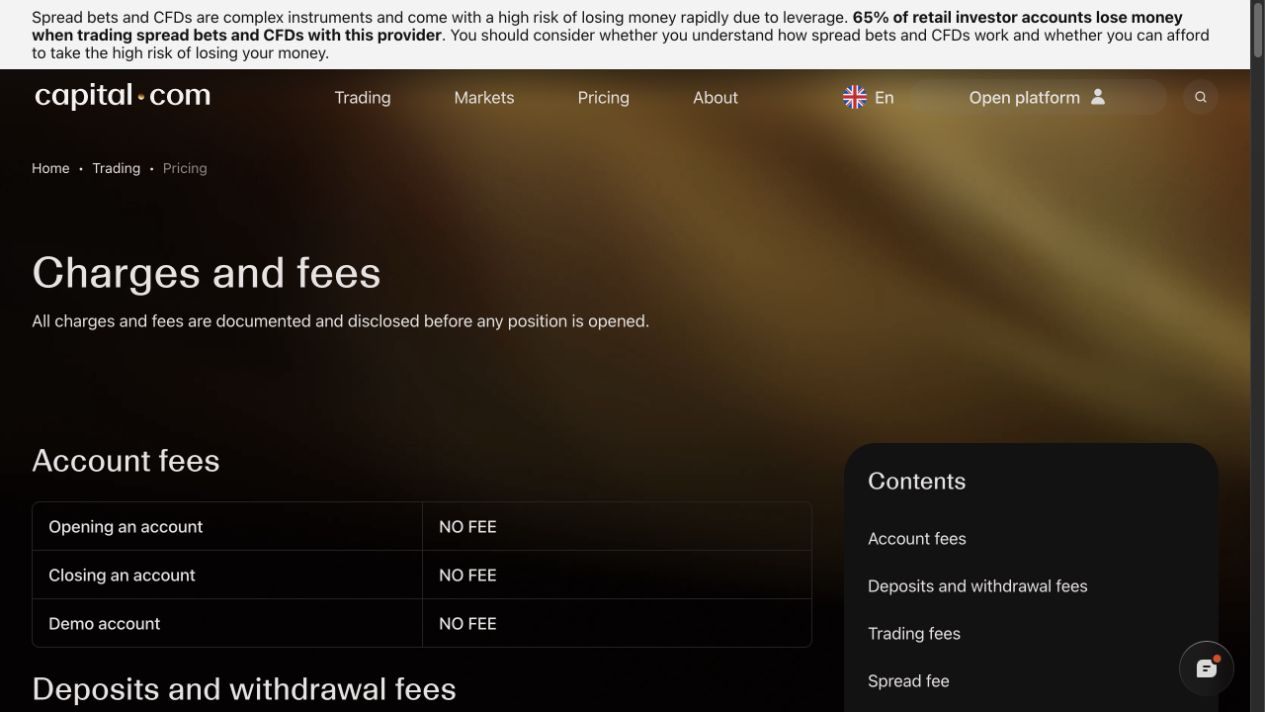
Some firms charge a separate dealing commission on certain markets, so check the schedule wherever you trade. Capital.com charges no separate dealing commission (Other fees apply), and it does charge a spread, overnight funding on relevant leveraged positions, a 0.7% retail currency conversion mark-up where conversion applies, and a guaranteed-stop premium if that order triggers, with the amount shown on the deal ticket. For index positions, its overnight adjustment includes a platform component of 4% a year, applied daily, alongside the benchmark component. The formula varies by instrument and direction. The published schedule sits on the Capital.com fees page.
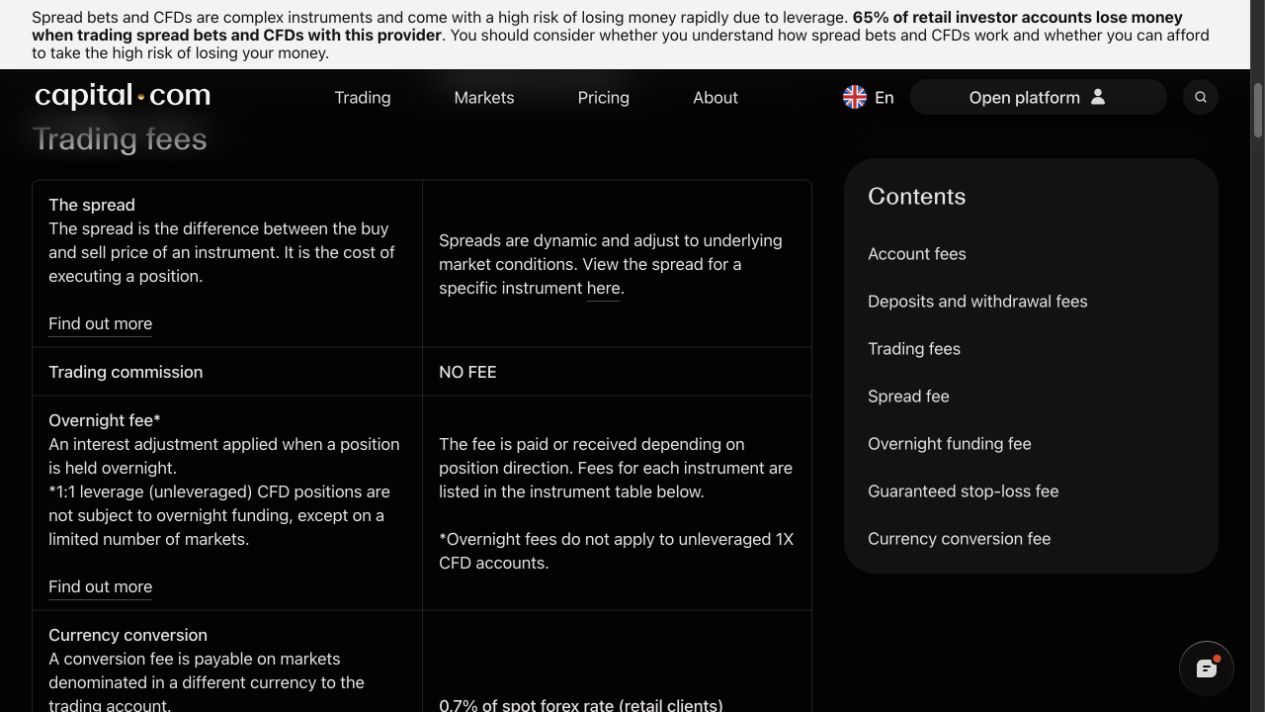
Holding period then decides how much the funding structure matters. On cash and daily funded products, the overnight adjustment accrues at each funding cutoff the position is held across, so a longer-held position can accumulate more overnight adjustments than one held across fewer funding cutoffs. Forward spread bets and futures CFDs take the other route: an expiry date, and providers can incorporate funding into a wider spread instead of applying the same daily adjustment structure. Neither structure is cheaper for everyone, and the comparison depends on the instrument's actual numbers over the period you expect to hold.
Currency conversion and economic currency exposure
Currency raises two separate questions worth keeping apart.
The first is conversion mechanics. In a GBP-account example, a spread bet stakes in pounds per point and produces its profit or loss in sterling, which can reduce the conversion steps between your trade and your account balance. A CFD's profit or loss can arise in the instrument's own currency, and how it converts into your account currency depends on the provider's account structure. Capital.com applies its 0.7% retail mark-up where conversion happens; other firms structure and price this differently.
The second question is economic exposure, and a sterling wrapper does not answer it. When the market or company underneath your position operates in another currency, exchange-rate movements can still feed into its price and its business. A pound-denominated stake changes the currency your result settles in, not the underlying market's relationship with its own currency. Choosing a GBP version narrows the conversion mechanics, not the economics.
Retail protections and professional status
UK retail clients using either wrapper sit inside the FCA's rulebook for CFDs and CFD-like products, and the protections in it are regulatory requirements rather than provider generosity.
Those rules cap retail leverage between 30:1 and 5:1 by asset class and impose negative balance protection. The FCA applies an account-level 50% margin closeout rule. The current restrictions sit in the FCA Handbook. Negative balance protection stops your losses exceeding the total funds in your trading account, and it does not stop that account going to zero.
Stop orders sit alongside those rules: a standard stop can fill at the next available price in a gap or fast market, while a guaranteed stop at Capital.com executes at the selected level when triggered, incurs a fee, and helps manage gap risk without changing the exposure behind it.
The Financial Services Compensation Scheme covers a different failure entirely: eligible clients can receive up to £85,000 from FSCS if an authorised firm fails and cannot meet its obligations, and it does not reimburse ordinary trading losses. It protects against a broker collapse, not against the market.
Professional status removes parts of this framework. At Capital.com, professional clients do not receive negative balance protection and may have more limited access to the Financial Ombudsman Service, as its professional terms set out. In October 2025 the FCA warned about firms pressuring retail clients to opt up to professional status or move to offshore entities, both of which strip away many retail protections. We treat the retail framework as the baseline, and nothing in this article assumes professional classification.
A neutral decision framework
No single wrapper wins this comparison for every reader, so we frame the decision as a set of questions rather than a verdict.
Start with tax and losses: would your circumstances benefit more from results outside capital gains tax, or from losses that stay usable against other chargeable gains? Then holding period: does your expected timeframe favour a daily funded structure or an expiring product once you run the funding numbers? Then currency: which currency the result arises in, and what conversion costs apply at your provider.
Three further questions round it out: is the position a speculation or a hedge connected to a business, since a commercial hedge can change the tax analysis; are the intended market, sizing method, and expiry structure available in both wrappers at the selected provider; and what retail protections would you keep or lose under each arrangement on the table?
Which ordinary treatment and loss-relief position fits your circumstances?
How do daily funding and forward pricing compare over your expected timeframe?
Which currency does the result arise in, and what conversion costs apply?
Is the position standalone speculation or a hedge connected to a business?
Are the intended market, sizing method, and structure available in both wrappers?
Which retail protections remain under the status and entity you are considering?
Working through those questions does not require picking a side today, and some readers will conclude that neither wrapper suits them, which is a legitimate result.
Worked example with Capital.com
The neutral comparison above uses HMRC manuals, FCA rules, and published provider terms. The worked examples in this article use Capital.com's published UK 100 specification and its published charges, so this section sets out that firm's verifiable details in one place.
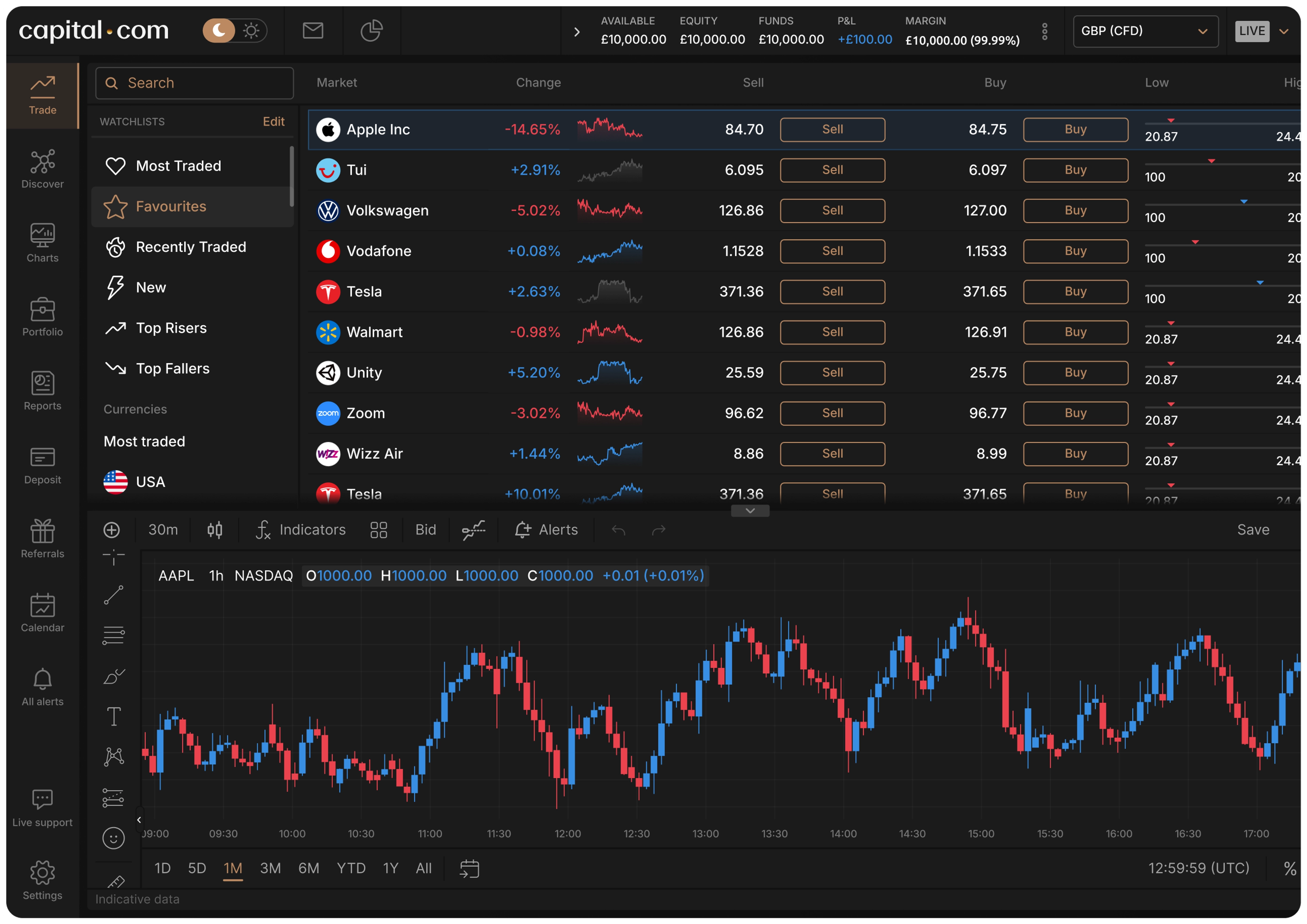
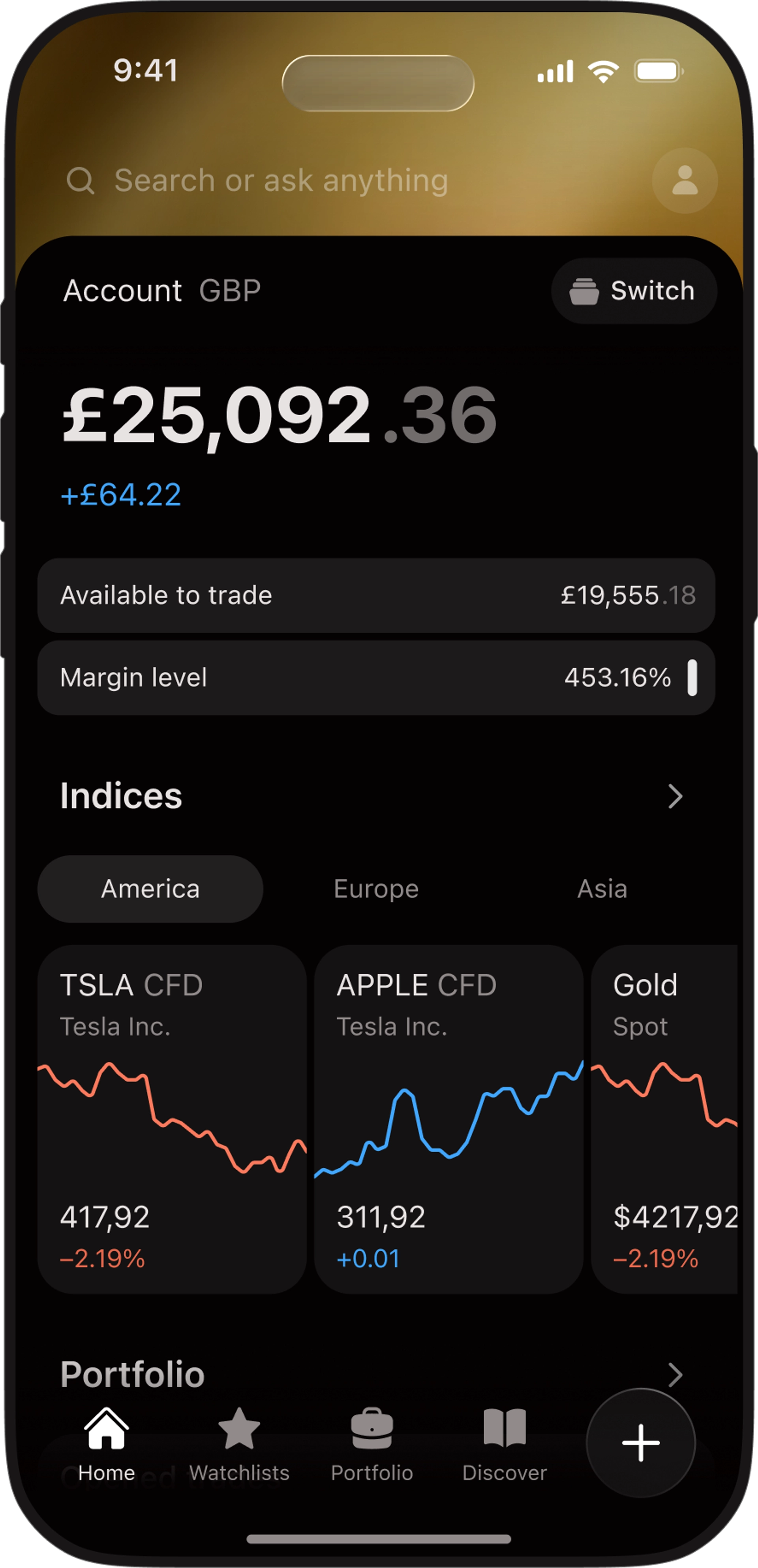
Capital Com (UK) Ltd is authorised and regulated by the Financial Conduct Authority under reference 793714. It offers both spread betting and CFDs to UK clients, and it describes its spread-betting range as thousands of markets. It charges no separate dealing commission (Other fees apply), with its charges sitting in the spread, overnight funding, the 0.7% retail currency conversion mark-up where conversion applies, and the guaranteed-stop premium if that order triggers. The minimum deposit is currently £20. Its wider current platform offering includes web and mobile, and the firm announced its refreshed app and brand identity on 1 June 2026, following global mobile-app availability from May 2026. Our Capital.com spread betting review covers the platform in depth.
None of this makes Capital.com the right provider for every reader, and this article has not ranked it against alternatives. The details above are current, sourced facts about one FCA-authorised firm offering both wrappers. Whether its fee structure, market range, and account terms fit your own comparison is a judgement this framework leaves with you.

FCA reference 793714
Other fees apply: dynamic spreads, overnight funding, 0.7% retail currency conversion where applicable, and a guaranteed-stop fee when triggered.
Frequently asked questions
Does spread betting become taxable if it supplies most of my income?
Not by itself. HMRC's guidance at BIM22017 states that earning a living from betting does not on its own amount to carrying on a taxable trade, and CG56105 keeps an ordinary standalone spread bet outside chargeable gains because no asset is acquired or disposed of. Circumstances differ and treatment can change, so take advice if your situation is unusual.
Is my margin deposit the most I can lose?
No. Margin is the collateral that opens and maintains the position, while your gain or loss follows the notional exposure, so a loss can exceed the margin held against a position and continue into the rest of your balance. For UK retail clients, negative balance protection caps losses at the total funds in the trading account, and that whole account remains at risk.
Why does a new position open with a loss, and how does the spread affect break-even?
You open at one side of the provider's quote and would close at the other, so a brand-new position is marked down by the spread applied to its size. The market must move through the spread before you reach break-even, and overnight funding and conversion costs push break-even further out while the position stays open.
Can daily funding make a position unsuitable for a holding period of weeks or months?
It can change the arithmetic. Overnight adjustments on cash and daily funded products accrue at each funding cutoff the position is held across, so a longer-held position can accumulate more of them than one held across fewer funding cutoffs. Forward spread bets and futures CFDs carry an expiry, and providers can incorporate funding into a wider spread instead of applying the same daily adjustment structure. Run the instrument's actual numbers over your expected holding period before assuming either structure costs less.
Does choosing a GBP version of a market remove currency risk?
No. A sterling-denominated stake changes the currency your result settles in and can reduce conversion steps, while the underlying market or company can still carry economic exposure to its own currency. The exchange rate can keep influencing the position through the asset itself.
Why would a UK trader use CFDs if spread-bet results usually sit outside capital gains tax?
Because the spread-bet treatment cuts both ways. An allowable CFD capital loss may offset chargeable gains under the normal rules, while a spread-bet loss creates no allowable loss, and a CFD's profit or loss can arise in the instrument's own currency where that suits the trader.
Can a spread bet used to hedge a business receive different tax treatment?
Yes. HMRC guidance at BIM56880 and BIM56900 explains that a derivative or spread bet operating as a commercial hedge can form part of the trade's taxable results, which displaces the ordinary standalone treatment. Whether that applies turns on the facts of the business, so it is a question for a qualified tax adviser rather than a comparison article.
Conclusion
Sized to the same pounds per point, a spread bet and a CFD produce the same gross result for the same market move, so the choice between them never rests on the direction you expect. It rests on the layer around the trade: results outside capital gains tax or losses usable against gains, holding period and its cost under a daily funded or expiring structure, the currency the result arises in, hedge purpose, and the retail protections each arrangement preserves. Those answers differ from reader to reader, which is why we have issued no single verdict, and why the equal-exposure arithmetic at the top of this article begins the comparison rather than ends it.
Advertisement Feature. Capital.com paid for placement as the featured provider. MatchMyBroker may receive compensation if you use an affiliate link. This content is for information and does not assess your personal circumstances.
Spread bets and CFDs are complex instruments and come with a high risk of losing money rapidly due to leverage. 65% of retail investor accounts lose money when trading spread bets and CFDs with this provider. You should consider whether you understand how spread bets and CFDs work and whether you can afford to take the high risk of losing your money.