
Trading 212 ISA Review 2026: Cash ISA and Stocks & Shares ISA


Before comparing rates or platforms, decide what the money in front of you is for. Savings you may need within a year or two should hold their value and stay within reach. Money you will not touch for a decade can be invested for growth, which means accepting that markets fall as well as rise. Trading 212 offers an ISA for each: a flexible Cash ISA currently paying 3.60% AER variable, and a flexible Stocks and Shares ISA. Which one fits depends on that timeline more than on the provider.
The combination suits app-first UK adults who want both wrappers in one place, flexible withdrawal rules, and low listed account charges, and who are comfortable making every investment decision themselves. The service is execution-only, so anyone who wants personal advice or hands-on telephone support needs a different model. This review focuses on the two ISAs; our full Trading 212 review covers the wider platform.
How the Trading 212 Cash ISA works
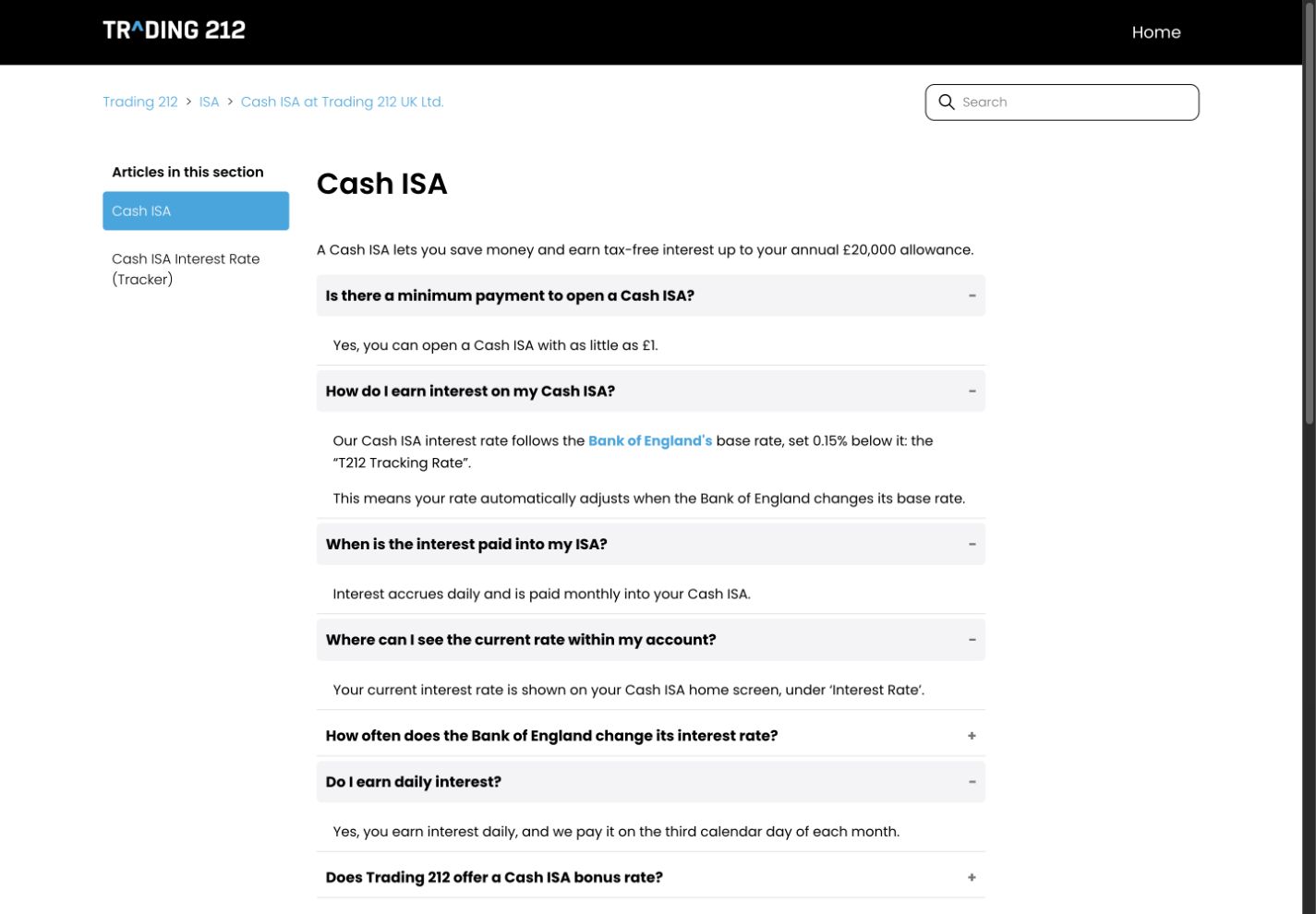
The Cash ISA pays 3.60% AER variable as of 20 July 2026. The figure comes from a formula: Trading 212 sets the standard rate at Bank Rate minus 0.15 percentage points, and Bank Rate is 3.75% following the 18 June 2026 decision.
A tracker cuts both ways. You are not relying on the provider choosing to stay competitive, because the formula sets the rate. Equally, the tracker means the rate can move in either direction when Bank Rate changes, and there is no fixed term to lock in today's figure. Treat 3.60% as a snapshot and plan around the mechanism rather than the number.
The practicalities are simple. The minimum is £1, interest accrues daily and is paid on the third calendar day of each month, and the account is instant access. It is also flexible, which matters for withdrawals and is covered in its own section below.
The rate is the moving part, and Trading 212 publishes exactly how it is set.
Even a sensible tracker deserves context. Our guide to the best Cash ISAs in the UK follows the wider market, including fixed-term accounts that work on different terms, and is the place to check how this rate compares in any given week.
How the Stocks and Shares ISA works
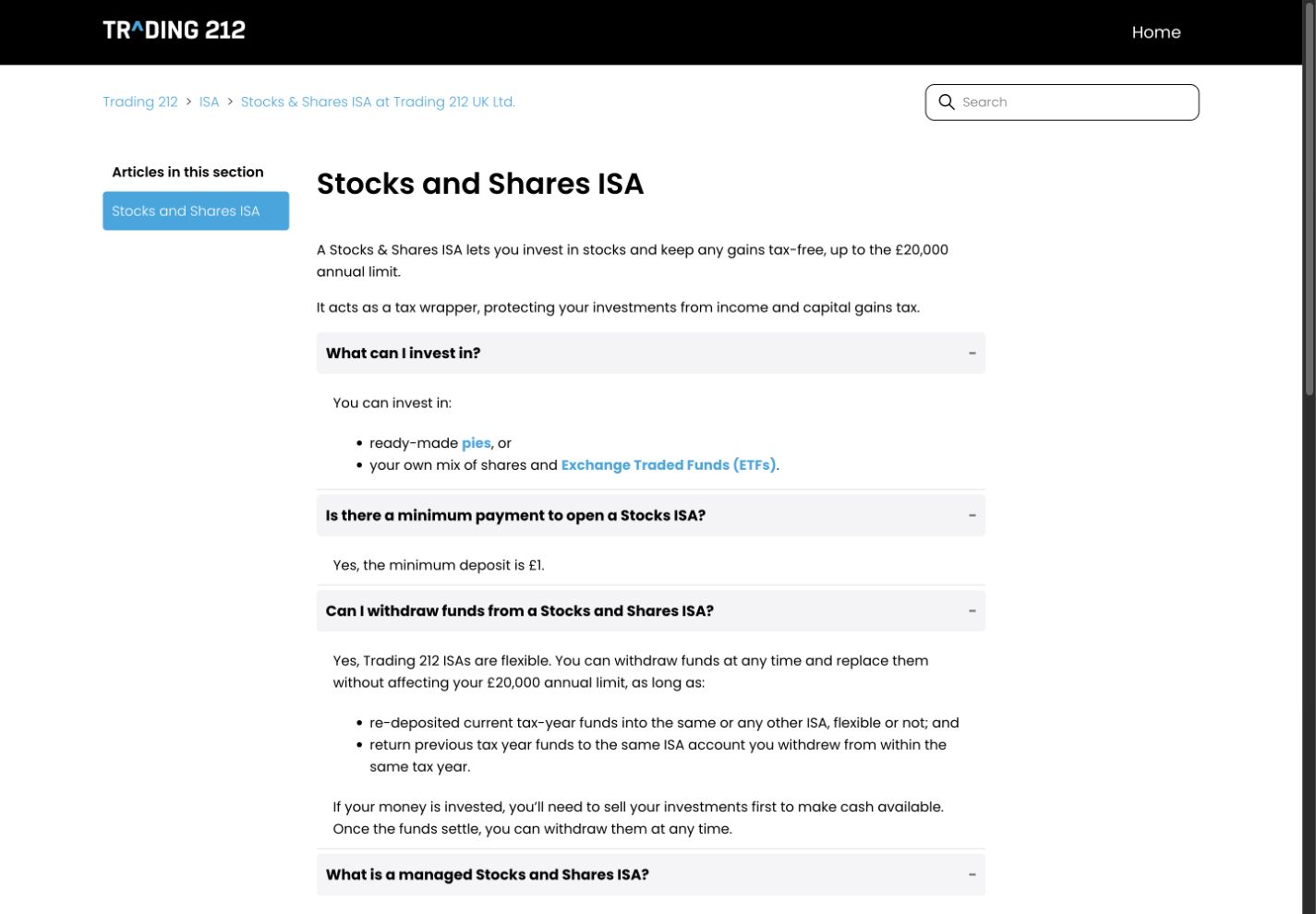
The Stocks and Shares ISA is execution-only from the first pound. Trading 212 provides the account, the market access, and the order screen; every decision about what to buy, when to sell, and how to respond when prices fall is yours. Eligible investments include shares, ETFs, ETPs, ETCs, REITs, and investment trusts, and the minimum is £1.
The official summary makes the same point in Trading 212's own words: not a managed portfolio.
Fractional dealing matters most at small account sizes. Most eligible instruments can be bought in fractions, so a modest monthly deposit can be spread across several holdings rather than waiting until it covers a full share, although not every instrument qualifies. Trading 212 does not list an extra charge for fractional dealing. Our guide to fractional shares explains the mechanics, and one transfer restriction, covered later in this review, is worth knowing before you build a portfolio of fractions.
Pies and AutoInvest sit on top of the same account. A Pie is a portfolio you design yourself, with a target weighting for each holding, and AutoInvest executes your scheduled deposits into it. Used with discipline, the pairing turns regular investing into a routine, but the tools only carry out your instructions; they do not pick investments or manage your weightings for you. We walk through the setup in our guide to Trading 212 Pies and AutoInvest.
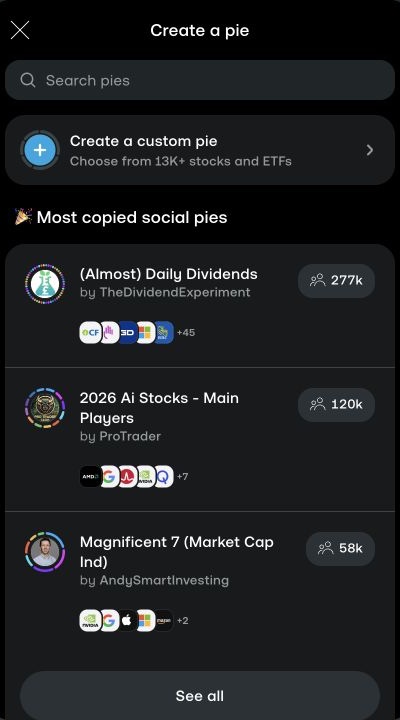 Pie discovery in the Invest account
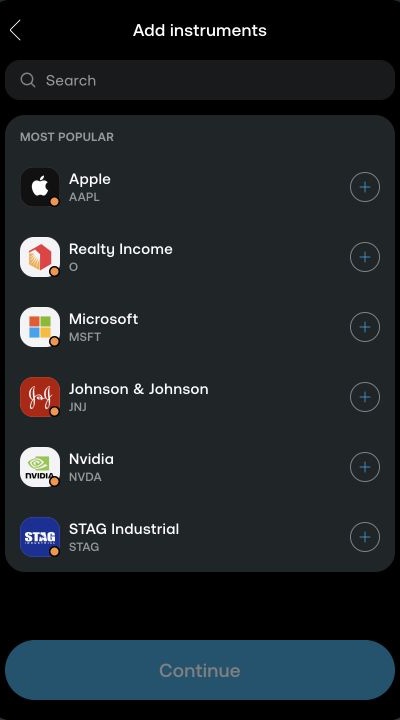 Pie instrument picker in the Invest account
Choosing between the Cash ISA and the Stocks and Shares ISA
The comparison that matters most is not Trading 212 against another provider but these two accounts against each other. The Cash ISA suits money with a date attached: a house deposit due in eighteen months, next January's tax bill, the emergency fund. The rate is variable, but the balance does not fall when markets do, and access is instant. The Stocks and Shares ISA suits money without a deadline, where you can sit through volatile years for the possibility of long-term growth and accept that you may get back less than you put in.
Time horizon is the honest dividing line. Money that must be spent soon cannot afford a bad year in the markets, however attractive the long-run averages look. Money with a decade to run can usually absorb several.
You do not have to choose. Both accounts sit inside the same overall ISA allowance, £20,000 for the 2026/27 tax year, and you can split new subscriptions between them in whatever proportion fits your situation. Because both are flexible, money can move out and back within the rules without permanently using up allowance.
What the ISAs cost
Trading 212's listed charges make short reading. For its Invest, ISA, and SIPP accounts it lists no trading commission, no custody fee, no ISA account fee, and no closure, statement, or inactivity fees. An account with no listed charges is not an account with no costs, but the direct price list for the ISA itself is minimal.
One line on the schedule is not free.
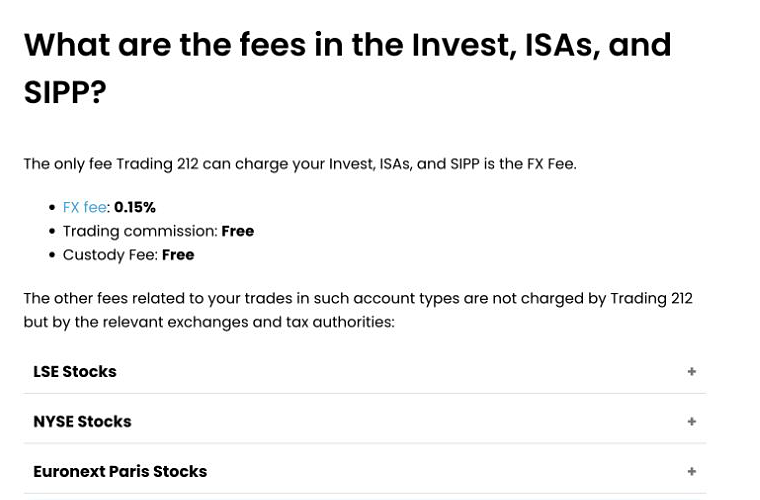
The charge most investors will actually meet is currency conversion. Buy an investment priced in dollars or euros from a sterling balance and the money has to be converted, with the conversion charged at 0.15%. Sticking to GBP-denominated holdings avoids it, though that is an investment decision in its own right rather than a cost-saving trick.
Beyond the platform sit the usual indirect costs. Product charges built into the funds you hold, market and tax charges on certain transactions, funding costs, and third-party charges can still apply. None of that is unique to Trading 212, but it belongs in an honest account of what investing here costs.
Transfers, withdrawals and the flexible rules
Both ISAs are flexible, and the rules reward precision. Money you subscribe and withdraw in the current tax year can be replaced within the same tax year without reducing your remaining allowance. Money withdrawn from previous years' subscriptions must go back into the same ISA before the tax year ends, or the flexible treatment is lost. Used deliberately, flexibility lets an emergency fund do its work without permanently costing allowance.
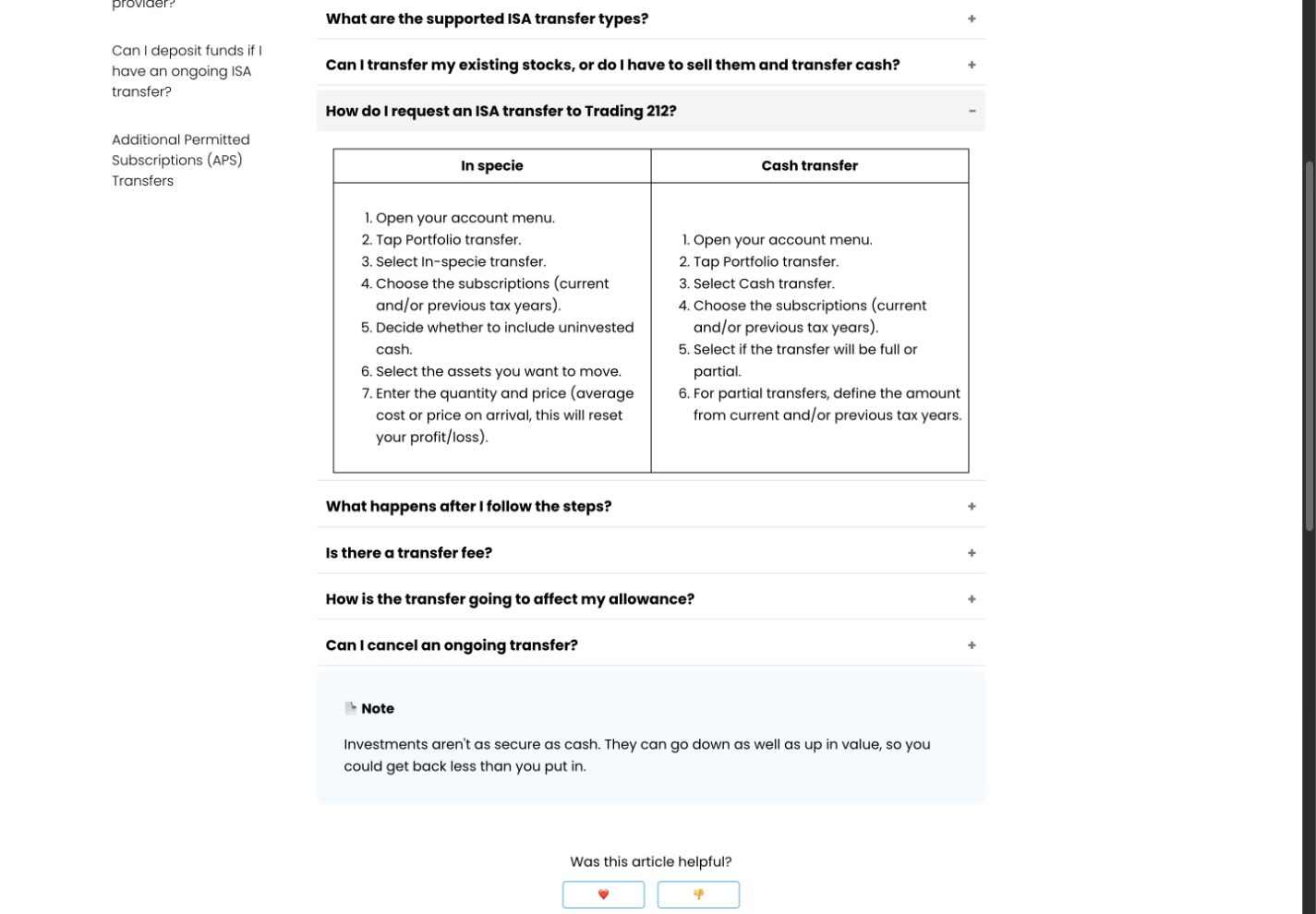
Transfers in can arrive as cash or in specie, subject to support for the holdings involved, and Trading 212 does not list a transfer fee. The official targets are 15 working days for Cash ISA to Cash ISA transfers and 30 calendar days for other ISA transfers. Treat these as targets rather than commitments; individual transfers can take longer, so build in slack if you are working to a deadline.
The steps depend on which route the transfer takes.
Leaving is more constrained than arriving. Moving investments out as stock requires transferring the whole ISA, while partial outbound transfers are available in cash only. Fractional positions cannot transfer in specie at all, which is the restriction flagged earlier: a portfolio built from fractions has to be sold and moved as cash, at whatever prices apply on the day.
Whichever direction you move an ISA, use the receiving provider's formal ISA transfer process rather than withdrawing and re-depositing the money yourself. A manual withdrawal can lose the tax wrapper.
Regulation and FSCS cover
Trading 212 UK Ltd is authorised and regulated by the Financial Conduct Authority under firm reference number 609146. What FSCS cover applies depends on which account you hold, and the two strands are worth keeping apart.
For deposits, eligible money can be covered up to £120,000 per eligible person per authorised banking group. The per-banking-group basis matters: cover follows the institutions holding the cash, not the app on your phone, so savers with large balances should know where their money sits.
For investments, eligible claims can be covered up to £85,000 per eligible person per firm, and only where the provider fails and a valid claim involves a shortfall or a legal liability. The scheme does not cover investment losses caused by markets falling; a drop in the value of holdings you chose is market risk, not a claimable event. Our Trading 212 safety guide looks at how client money and assets are held in more depth.
Interest on uninvested cash in the Stocks and Shares ISA
Cash waiting inside the Stocks and Shares ISA can earn interest, but only if you opt in. Enabling the feature changes how the money is held: with interest on, Trading 212 can hold your cash in qualifying money market funds and banks, while leaving it off means cash is held only in banks. Rates change, so we are not quoting a figure here. Check the current rate with Trading 212 before deciding, and weigh the change in how your cash is held, not just the number.
Strengths and limitations
The case for the Trading 212 ISA rests on three things working together. The Cash ISA rate moves by a stated formula (Bank Rate minus 0.15 percentage points) rather than at the provider's discretion. Both wrappers are flexible, which turns the ISA rules from a constraint into something you can use. And the listed direct charges are minimal, which matters most for people investing modest monthly amounts. Both accounts open from £1, and fractional dealing lets small deposits be spread across several holdings.
The limitations are mostly the flip side of the same model. There is no advice and no hands-on support for people who want a conversation before acting. The variable rate can fall when Bank Rate does. And the outbound transfer rules (whole-ISA only for stock, cash only for partial moves, no in-specie transfer of fractions) mean leaving takes more planning than joining. None of this is hidden, but all of it is real.
Who the Trading 212 ISA suits
The strongest fit is a self-directed saver and investor who wants both accounts in one place: near-term cash earning a tracker rate with flexible, instant access, and long-term money invested at low direct cost through a portfolio they are willing to own completely. If your cash moves around during the year, the flexible rules will earn their keep.
The fit weakens for anyone who wants guidance, support on the phone, a fixed savings rate, or certainty around a deadline-driven transfer. Those are legitimate needs, and paying more to meet them can be entirely rational; it is simply a different service model. If that sounds closer to you, start with our guide to the best stock brokers in the UK and weight service above price.
The planned 2027 Cash ISA change
One policy development is worth watching. The government has announced a planned £12,000 Cash ISA subscription limit for people under 65 from 6 April 2027, with the overall £20,000 allowance retained, which would leave the rest of the allowance for other ISA types. Draft regulations entered consultation on 16 July 2026, so nothing changes for the 2026/27 tax year and the final rules could still move. We will update this review as the position is confirmed.
Our verdict
Judged as a pair, the Trading 212 ISAs deliver what a low-cost, self-directed platform should. The Cash ISA is a credible home for near-term money, with a transparent tracker, daily accrual, and flexible instant access, provided you accept a variable rate that can move with Bank Rate. The Stocks and Shares ISA is a capable execution-only account with a broad range of eligible assets, and Pies bring structure to regular investing without taking the decisions off your desk.
If you are comfortable making the decisions and you match each pot of money to its timeline, these two accounts give you a practical way to hold near-term savings and long-term investments in one place at low listed direct cost.
Frequently asked questions
Is the Trading 212 Cash ISA rate fixed or variable?
It is variable. The standard rate tracks Bank Rate minus 0.15 percentage points, which produces 3.60% AER while Bank Rate is 3.75%. Because of the tracker formula, the rate can move in either direction when Bank Rate changes.
Which ISA suits money I might need soon?
As a general rule, money you expect to need soon sits better in the Cash ISA, where the balance does not move with markets and access is instant. The Stocks and Shares ISA is designed for long-term investing, and you may get back less than you invest. This is general information, not personal advice.
Can I pay into both Trading 212 ISAs in the same tax year?
Yes. Both accounts share the overall ISA allowance of £20,000 for 2026/27, and you can split subscriptions between them in any proportion. Keeping near-term savings in the Cash ISA while investing long-term money through the Stocks and Shares ISA is a sensible way to use the split.
How do the flexible ISA rules work?
Money subscribed and withdrawn in the current tax year can be replaced within that same tax year without reducing your remaining allowance. Money withdrawn from previous tax years' subscriptions must be returned to the same ISA before the end of the tax year to keep its flexible treatment.
How long does an ISA transfer to Trading 212 take?
The official targets are 15 working days for Cash ISA to Cash ISA transfers and 30 calendar days for other types. These are targets rather than commitments, and individual transfers can take longer. Always use the receiving provider's formal transfer process, because a manual withdrawal can lose the tax wrapper.
What FSCS cover applies to Trading 212 ISAs?
Eligible deposits can be covered up to £120,000 per eligible person per authorised banking group. Eligible investment claims can be covered up to £85,000 per person per firm where the provider fails and a valid claim involves a shortfall or legal liability. The scheme does not cover investment losses caused by market movements.
What is the planned 2027 Cash ISA change?
The government has proposed a £12,000 annual Cash ISA subscription limit for people under 65 from 6 April 2027, with the £20,000 overall allowance retained. Draft regulations entered consultation on 16 July 2026, and the change is not in force for the 2026/27 tax year.
Advertisement, subject to compensation from the companies mentioned in this content. When investing, your capital is at risk and you may get back less than invested. Past performance doesn't guarantee future results.
Other fees may apply. See terms and fees. 0,15% FX fee applies when converting funds. Other fees may apply.
Interest on uninvested cash: When investing, your capital is at risk. If you enable interest, Trading 212 will hold your cash in qualifying money market funds and banks. Otherwise, your cash will be held only in banks. Interest applies on cash in an investment account. Terms apply.
Pies & AutoInvest is an execution-only service. Not investment advice or portfolio management. Automatic investing refers to executing scheduled deposits. You are responsible for all investment and rebalancing decisions.
This information is not investment advice. Do your own research.

.png)
.png)