Revolut Review 2026: Features, Fees and Who It's For

Revolut has evolved from a prepaid travel card into one of Europe's largest financial platforms, now serving over 70 million customers across 40+ countries. As a stock broker, it is not the cheapest or the most powerful, but its unique position as a financial super app makes it genuinely useful for investors who want banking, trading, crypto, and currency exchange in a single place. We rate it 4.5 out of 5.
The Company Behind the Platform
Revolut was founded in 2015 by Nik Storonsky and Vlad Yatsenko, originally as a multi-currency travel card that offered interbank exchange rates. The company has since expanded into a full financial platform covering banking, stock trading, crypto, insurance, and even mobile phone plans. Headquartered in London with a growing European hub in Paris, Revolut now serves over 70 million customers across more than 40 countries.
The company's financial trajectory is remarkable. In 2024, Revolut posted $4.0 billion in revenue (up 72% year-on-year) and $1.4 billion in pre-tax profit. It is targeting $9 billion in revenue and $3.5 billion in profit for 2026. A November 2025 secondary share sale valued the company at $75 billion, backed by investors including Coatue, Fidelity, a16z, and Franklin Templeton. An IPO is widely expected within the next few years.
Revolut holds a full EU banking license via the European Central Bank and Bank of Lithuania, and its UK banking license (with restrictions) was granted in July 2024. Investment services are provided by Revolut Trading Ltd (FCA-authorised) in the UK and Revolut Securities Europe UAB (Bank of Lithuania) in the EEA.
Pros and Cons
Revolut's investing features have improved significantly over the past year, but they still trail dedicated brokers in several areas. Here is our honest assessment.
The biggest strength is also the biggest caveat: Revolut is not trying to be the best broker. It is trying to be the best financial app, and the investing features are one piece of that puzzle. If you already use Revolut for banking, adding stock trading feels seamless. If you are looking for the cheapest or most powerful trading platform on its own merits, dedicated brokers like Trading 212 or Interactive Brokers will serve you better.
Fees and Commissions
Revolut's fee structure is tied to its subscription plans. Every plan includes a small number of commission-free stock and ETF trades per month. Once you exceed the free allowance, a percentage-based commission applies. This model is more complex than what you will find at brokers offering flat free trades, and for active traders, the costs add up.
On the Standard plan (free), you get 1 commission-free trade per month. After that, each trade costs 0.25% of the order value with a minimum of EUR 1. Moving up to Plus (EUR 3.99/month) gets you 3 free trades, Premium (EUR 7.99/month) gives you 5, and Metal (EUR 14.99/month) gives you 10. The Ultra tier (EUR 45/month) also provides 10 free trades but reduces the commission to 0.12% with no minimum after the allowance is used.
The Trading Pro add-on (EUR 15/month, free for Ultra subscribers) cuts the post-allowance commission to 0.12% across all plans and unlocks the Trading Terminal web platform with TradingView-powered charts. For anyone making more than a handful of trades per month, it is worth considering.
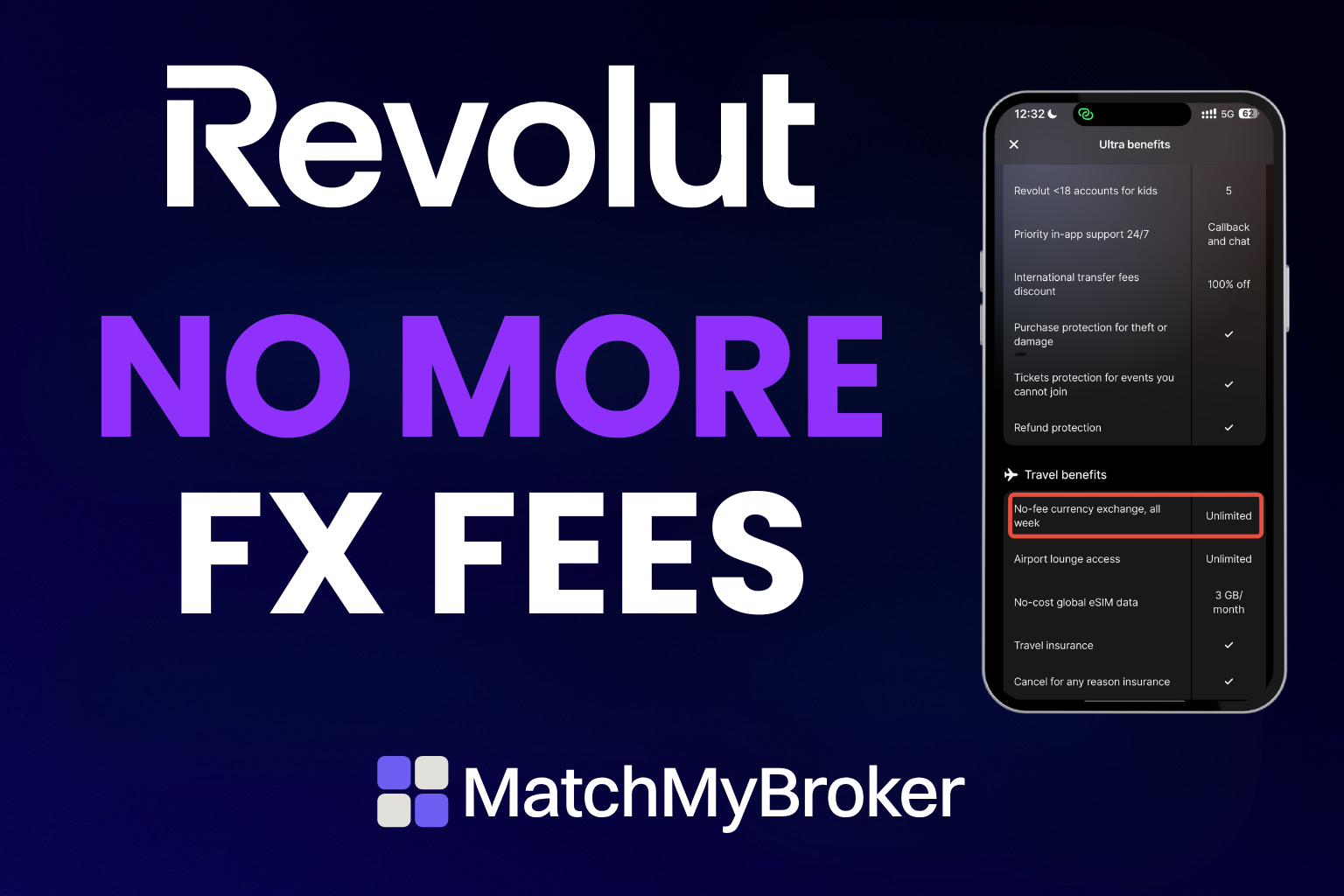
Beyond trading commissions, the FX conversion fee is an important cost to watch. If you are buying US stocks from a EUR or GBP account, you need to convert currency first. On the Standard plan, you get a limited free FX allowance (around GBP 1,000/month), after which a 0.5% fee applies. Premium, Metal, and Ultra subscribers get unlimited FX at interbank rates, which is a genuine advantage.
On the positive side, Revolut eliminated its 0.12% annual custody fee in March 2024. There are no inactivity fees, no withdrawal fees, and no account maintenance charges. These are meaningful improvements that bring Revolut more in line with the competition.

*After monthly free trade allowance. Trading Pro subscribers pay 0.12%.
The takeaway: Revolut is not the cheapest broker if trading costs are your primary concern. Trading 212 offers genuinely free trading, and Lightyear caps US stock commissions at $1. But Revolut's value proposition is the complete financial ecosystem. If you are already a Premium or Metal subscriber for the banking and FX benefits, the trading fees become much more reasonable since you get interbank FX rates and a healthy allowance of free trades included in what you are already paying.
What Can You Trade?
Revolut's product range has expanded significantly but still lags behind dedicated brokers. Here is what is available:
- Stocks: Over 2,000 US-listed stocks (NYSE and NASDAQ), plus UK and European stocks depending on your entity. Fractional shares are available from as little as $1.
- ETFs: A growing selection of ETFs, including major Vanguard and BlackRock funds added in 2025. The EEA entity offers around 150+ ETFs, and the UK selection has been expanding.
- Crypto: 280+ tokens available in the main app, with competitive tiered pricing based on volume. The dedicated Revolut X platform offers advanced crypto trading with 0% maker fees and just 0.09% taker fees.
- Bonds: Corporate and government bonds available for EEA customers, with a minimum investment of EUR/USD 100.
- Commodities: Gold (XAU) and silver (XAG) for Premium, Metal, and Ultra subscribers.
What is missing is notable. There are no options, no futures, no forex/CFD trading, and the number of available markets is limited compared to brokers like Interactive Brokers (which offers 170 markets). If you need access to Japanese equities, emerging market stocks, or options strategies, Revolut is not the right tool.
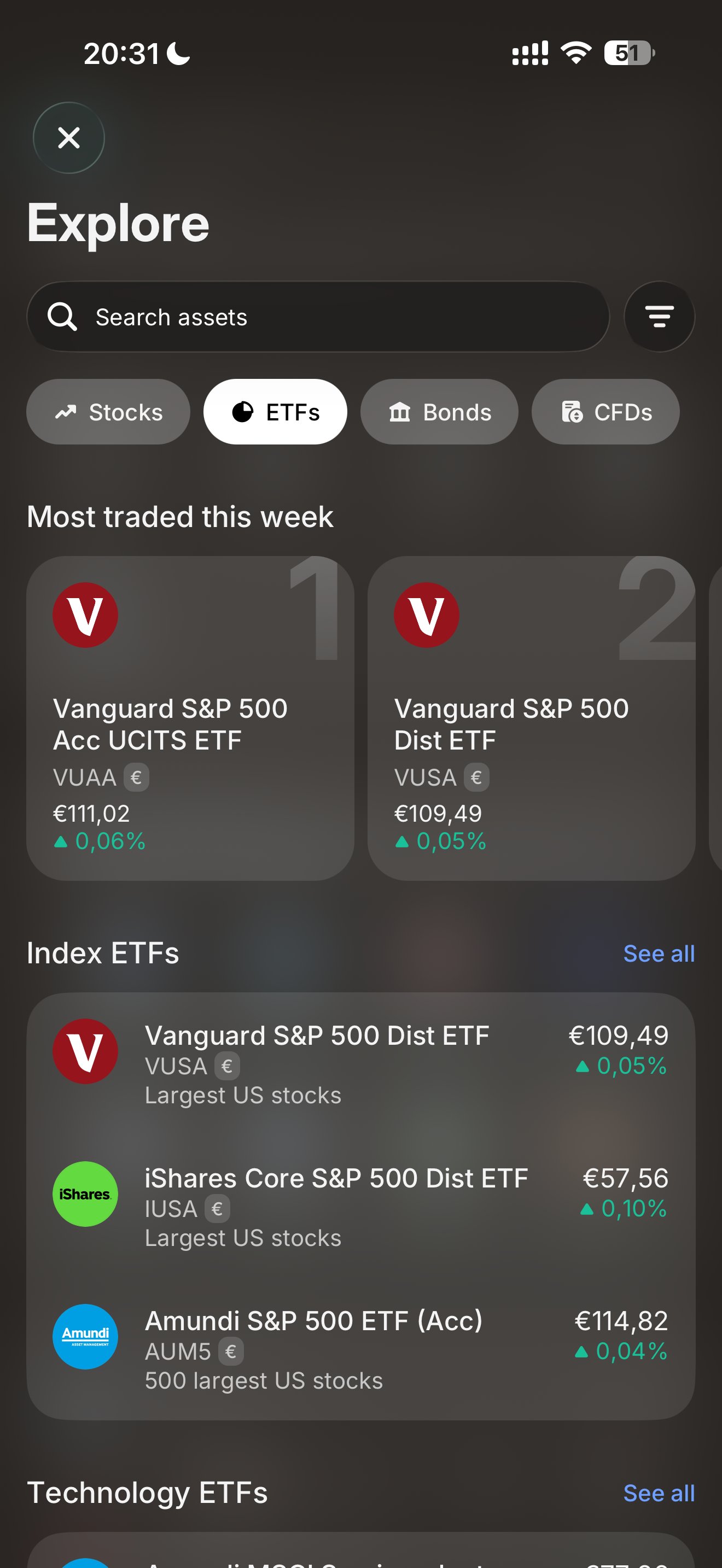
That said, for the majority of retail investors who want US stocks, a handful of ETFs, and some crypto exposure, the selection is perfectly adequate. The fractional shares feature is particularly well-implemented, allowing you to build a diversified portfolio even with small amounts.
Platform Experience
Revolut is a mobile-first platform, and the mobile app is where the experience shines. Buying a stock is as simple as navigating to the Invest tab, searching for a ticker, and tapping Buy. The interface is clean, fast, and familiar to anyone who already uses Revolut for banking. You get real-time price data, basic charting, analyst consensus ratings, price alerts, and a news feed.
Order types include market orders, limit orders, stop orders, and market-on-open orders. It is not the most comprehensive set, but it covers the essentials for most investors.
For more advanced users, the Trading Terminal (available with Trading Pro or Ultra) offers a proper web-based desktop platform at trade.revolut.com. It features TradingView-powered charts with technical indicators, customizable workspaces, performance benchmarking, and real-time data from institutional providers like Refinitiv. It is a significant step up from the mobile app and makes Revolut viable for more active traders. For a detailed breakdown of this feature, see our Revolut Trading Pro Review.


Where the platform falls short is in portfolio tools. Revolut now offers recurring investments, which is a welcome addition for passive investors who want to automate regular contributions. However, there are no portfolio pie or basket features like Trading 212's Pies, no auto-rebalancing, and no copy trading like eToro's CopyTrader. For investors who want a fully automated, set-and-forget portfolio approach, dedicated brokers still offer more.
Customer support is available via in-app chat, but there is no phone support. Response times vary, and more complex issues can take time to resolve. This is a common complaint among Revolut users and an area where traditional brokers still have an edge.
The Financial Super App
This is what sets Revolut apart from every other broker on this list, and it is the main reason the rating stays at 4.5 despite the trading-specific shortcomings. No other stock broker offers the breadth of financial services that Revolut packs into a single app.
Beyond stock trading, you get:
- Full banking: Current accounts with direct debits, standing orders, and a physical debit card. EUR 100,000 deposit protection for EEA customers through the Lithuanian Deposit Guarantee Scheme.
- Multi-currency exchange: Hold and exchange 36+ currencies at interbank rates (for Premium and above). This is particularly valuable for international investors or frequent travellers.
- Savings vaults: Competitive interest rates of up to 5% AER (Ultra tier) on GBP savings, with interest paid daily. See our guides to the best high-yield savings accounts in the UK and best high-yield savings accounts in Europe for broader comparisons.
- Crypto trading: 280+ tokens in the main app, plus the advanced Revolut X exchange with professional-grade features.
- Budgeting and analytics: Automatic spending categorisation, monthly spending reports, and the ability to set budgets by category.
- Insurance: Travel insurance, overseas medical cover, and phone insurance bundled with higher plan tiers.
- RevPoints: A loyalty program where you earn points on card spending, redeemable with airlines and partners.

The practical benefit is consolidation. Instead of managing separate apps for banking, investing, crypto, and currency exchange, everything lives in one place. Your salary arrives, gets automatically sorted into vaults and spending categories, and you can invest the remainder without leaving the app. For people who value simplicity and integration over having the absolute best tool for each individual task, this is compelling.
A significant recent improvement is the introduction of portfolio transfers. Previously, once your assets were in Revolut, they were effectively locked in, as there was no way to transfer positions out to another broker. This was a major drawback that made many investors hesitant to commit serious capital. Revolut now supports portfolio transfers for both stocks and crypto, which removes one of the biggest barriers to using the platform. You are no longer locked in, and if you decide to move to a different broker down the line, you can transfer your holdings rather than being forced to sell and rebuy.
Safety and Regulation
Revolut's regulatory picture is strong but somewhat complex due to its multi-entity structure across different jurisdictions.
In the EEA, banking services are provided by Revolut Bank UAB, which holds a full banking license from the European Central Bank via the Bank of Lithuania. Deposits are protected up to EUR 100,000 under the Lithuanian Deposit Guarantee Scheme. Investment services come through Revolut Securities Europe UAB, with investor compensation coverage of up to EUR 22,000.
In the UK, stock trading is handled by Revolut Trading Ltd, which is authorised and regulated by the Financial Conduct Authority. Investment protection is up to GBP 85,000 through the FSCS. The UK current account, however, operates under an e-money license (not yet a full bank), meaning your cash deposits are safeguarded per FCA rules but are not covered by the FSCS deposit protection scheme. Revolut received a UK banking license with restrictions in July 2024 but has not yet exited the mobilisation stage.
For crypto, Revolut holds a MiCA license via CySEC in Cyprus, making it one of the first major fintechs to secure this EU-wide regulatory framework for crypto assets. Note that crypto holdings are not covered by deposit guarantee or investor compensation schemes.
Securities are held in nominee accounts (pooled with other clients), which is standard industry practice. Client assets are segregated from Revolut's own assets.
The company's financial health is reassuring. With $4.0 billion in 2024 revenue, $1.4 billion in pre-tax profit, and a $75 billion valuation backed by institutional investors, Revolut is one of the most financially robust fintechs in the world. The main concern is the still-restricted UK banking license, but this does not affect investment account protections.
How to Open a Revolut Account
Opening a Revolut account is one of the fastest processes in the industry. The entire setup happens within the app, and most people are verified within minutes.
UK investors can also open a Stocks and Shares ISA, which launched in July 2025. The ISA has no subscription or custody fees and provides access to the full range of stocks and ETFs. You can transfer in from other ISA providers, and the annual allowance is the standard GBP 20,000.
Who Should (and Shouldn't) Use Revolut
Revolut is ideal for:
- People who already use Revolut for banking and want to add investing without switching apps
- Beginners who want a simple, mobile-first way to start investing in stocks and crypto
- International users and frequent travellers who benefit from multi-currency exchange at interbank rates
- UK investors looking for a fee-free Stocks and Shares ISA with a clean interface
- Anyone who values having banking, investing, crypto, and FX in a single app
Revolut may not be the best fit for:
- Active traders who make frequent trades and want truly commission-free execution. Trading 212 or XTB are better options here.
- Investors who need access to global markets beyond US, UK, and European exchanges. Interactive Brokers is the clear choice for multi-market access.
- Passive investors who want full portfolio automation with pies, auto-rebalancing, or copy trading. Revolut offers recurring investments, but lacks the broader automation tools found on platforms like Trading 212.
- Investors who prioritise advanced research tools and in-depth analysis. Even the Trading Pro terminal, while improved, is basic compared to what IBKR or dedicated platforms offer.
Alternatives to Consider
No single broker is perfect for everyone. Here are our top alternatives depending on your priorities:
- Trading 212: Genuinely free stock and ETF trading, excellent Pies feature for portfolio automation, and competitive cash interest. The best pure-trading alternative if you do not need banking integration. We rate it 4.9/5.
- Interactive Brokers: Access to 170 markets, professional-grade tools, and competitive interest on cash. The best option for serious investors who need global market access and advanced features. We rate it 4.9/5.
- Lightyear: A modern, mobile-first broker with capped US stock commissions ($1 max), multi-currency accounts, and a clean interface. A good middle ground between Revolut's simplicity and IBKR's depth. We rate it 4.8/5.
Not sure which broker fits your needs? Try our BrokerMatch tool for a personalised recommendation.
Our Verdict
Revolut is not the best stock broker. It is not the cheapest, it is not the most powerful, and it does not have the widest product range. But it is the best financial super app with stock trading built in, and for millions of users who already rely on it for banking and spending, the convenience of adding investing to the same platform is hard to overstate. The addition of portfolio transfers removes what was previously a significant lock-in concern, and the expanding product range, ISA support, and Trading Pro features show the team is serious about improving the investing experience. We rate Revolut 4.5 out of 5.
FAQ
Is Revolut good for investing?
Revolut is good for beginner and casual investors who want a simple, mobile-first experience integrated with their banking. It offers fractional shares, a growing selection of stocks and ETFs, and a clean interface. However, for active traders or those seeking the lowest fees, dedicated brokers like Trading 212 offer better value.
How much does Revolut charge for stock trading?
Each plan includes a number of free trades per month (1 on Standard, up to 10 on Metal/Ultra). After the free allowance, commissions are 0.25% per trade (minimum EUR 1) or 0.12% for Ultra and Trading Pro subscribers. There are no custody, inactivity, or withdrawal fees.
Is Revolut safe for investing?
Yes. In the UK, Revolut Trading Ltd is FCA-authorised with FSCS protection up to GBP 85,000. In the EEA, Revolut Securities Europe UAB is regulated by the Bank of Lithuania with investor compensation up to EUR 22,000. The company posted $1.4 billion in profit in 2024 and is valued at $75 billion.
Can I transfer my portfolio out of Revolut?
Yes. Revolut now supports portfolio transfers for both stocks and crypto. This is a significant improvement over previous years when your holdings were effectively locked in. You can transfer positions to another broker without needing to sell and rebuy.
Does Revolut offer a Stocks and Shares ISA?
Yes. Revolut launched its Stocks and Shares ISA for UK customers in July 2025. It has no subscription or custody fees, supports the full range of stocks and ETFs, allows transfers from other ISA providers, and uses the standard GBP 20,000 annual allowance.
What is Revolut Trading Pro?
Trading Pro is an add-on subscription (EUR 15/month, free for Ultra subscribers) that reduces trading commissions to 0.12%, unlocks the Trading Terminal web platform with TradingView charts, and provides advanced portfolio analytics. Read our detailed Trading Pro review for more.
Does Revolut pay interest on uninvested cash?
Revolut does not pay interest on cash held within the investment account. However, you can earn up to 5% AER on GBP savings in Revolut's separate Savings Vaults (rates vary by plan tier). This is different from brokers like Trading 212 and Interactive Brokers, which pay interest directly on uninvested trading account balances.
Disclaimer
When investing, your capital is at risk. The value of your investments can go down as well as up, and you may receive less than you invest. Past performance is not a reliable indicator of future results. This article contains affiliate links. If you open an account through our links, we may receive a commission at no extra cost to you. This does not affect our editorial independence or the objectivity of our reviews.