Morningstar vs Seeking Alpha: Which Research Service Is Better?


Last updated: 1 Oct 2026

Morningstar and Seeking Alpha both sell research, but they answer different questions. Morningstar Investor suits you better if your portfolio holds mutual funds and ETFs, if you want an analyst-led view of what a business is worth, and if you need to see how your holdings fit together. Seeking Alpha Premium suits you better if you research individual US stocks, want systematic ratings and factor grades, read earnings-call transcripts, and value several independent viewpoints on the same ticker.
On price, Morningstar Investor costs $249 per year or $34.95 per month at standard pricing, and Morningstar's official affiliate page takes $50 off the first annual term, which puts the first year at $199. Seeking Alpha Premium costs $299 per year plus applicable taxes or VAT, and Seeking Alpha's official affiliate Premium page offers eligible new subscribers a seven-day trial and $269 for the first year, a $30 discount. Both renew rather than expire, so plan around the ongoing price rather than the introductory one.
Neither subscription makes investment decisions for you, and neither earns its cost if your holdings are a handful of broad index funds you rarely change. In that case, skip both and revisit the question when your research habits change.
Morningstar vs Seeking Alpha at a glance
The pairing most readers mean is Morningstar Investor against Seeking Alpha Premium, and that is the comparison below. Both are paid research subscriptions aimed at self-directed investors, and both sit alongside the tools your broker already gives you rather than replacing them.
Morningstar works from a valuation opinion. Its stock pages connect the current market price with an analyst fair value estimate, an uncertainty rating, star ratings, and economic moat analysis. On the fund side, backward-looking star ratings sit next to the forward-looking Medalist Rating, with full ratings available to Investor subscribers. You get a documented framework for asking whether an asset looks attractively priced, and whether your holdings complement each other. Our full write-up is in the Morningstar Investor review.
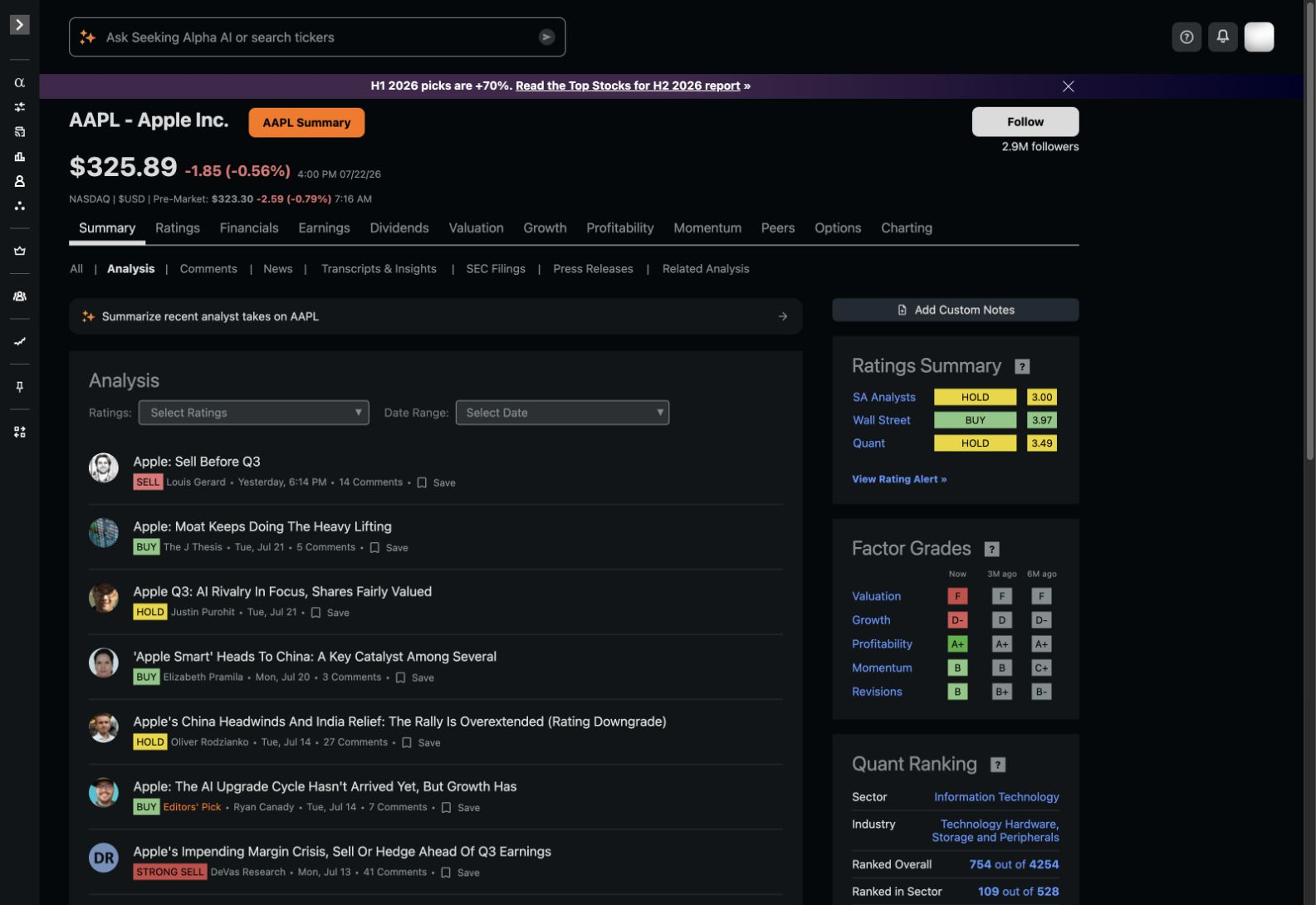
Seeking Alpha works from measurement and disagreement. A Premium stock page can show a Quant Rating, an SA Analysts' rating, a Wall Street analysts' rating, and factor grades for Valuation, Growth, Profitability, Momentum, and EPS Revisions. Contributor research, screeners, top-stock lists, and earnings transcripts sit around those ratings. You get a fast read on how a stock scores against measurable factors, plus the arguments of analysts who reach opposite conclusions about it. Our full write-up is in the Seeking Alpha Premium review.
 Morningstar InvestorValuation, funds, portfolios
 Seeking Alpha PremiumUS stocks, Quant, viewpoints
Pricing, trials, offers, and renewals
Morningstar Investor costs $249 per year or $34.95 per month at standard pricing. Morningstar's official affiliate page takes $50 off the first annual term, which puts the first year at $199. A seven-day trial is available, and a user who has already taken that trial is not eligible for another one. Morningstar states that a paid subscription renews at the price then in effect for the selected term unless canceled, and that the promotional pricing applies only to the initial term.
Seeking Alpha Premium costs $299 per year plus applicable taxes or VAT. Seeking Alpha's official affiliate Premium page offers eligible new subscribers a seven-day trial and $269 for the first year, a $30 discount. Premium then renews at the then-current annual list price, currently $299, plus applicable taxes or VAT.
The two introductory offers work the same way and differ in size: $50 off for Morningstar, $30 off for Seeking Alpha, each applying to the first term only. At today's stated standard prices, Morningstar Investor costs less on an ongoing basis, though neither company has committed to holding those prices, so treat that gap as current rather than permanent. Price is also the weakest reason to pick between them, since the two products answer different research questions.
Both paid subscriptions renew unless you cancel. Note your renewal date when you sign up and review the current terms before the next charge, because offer and pricing terms change over time.
Seeking Alpha's offers move around, and we track the current position in our Seeking Alpha discount guide.
Morningstar InvestorSeeking Alpha PremiumResearch approach: analyst-led valuation versus Quant plus contributors
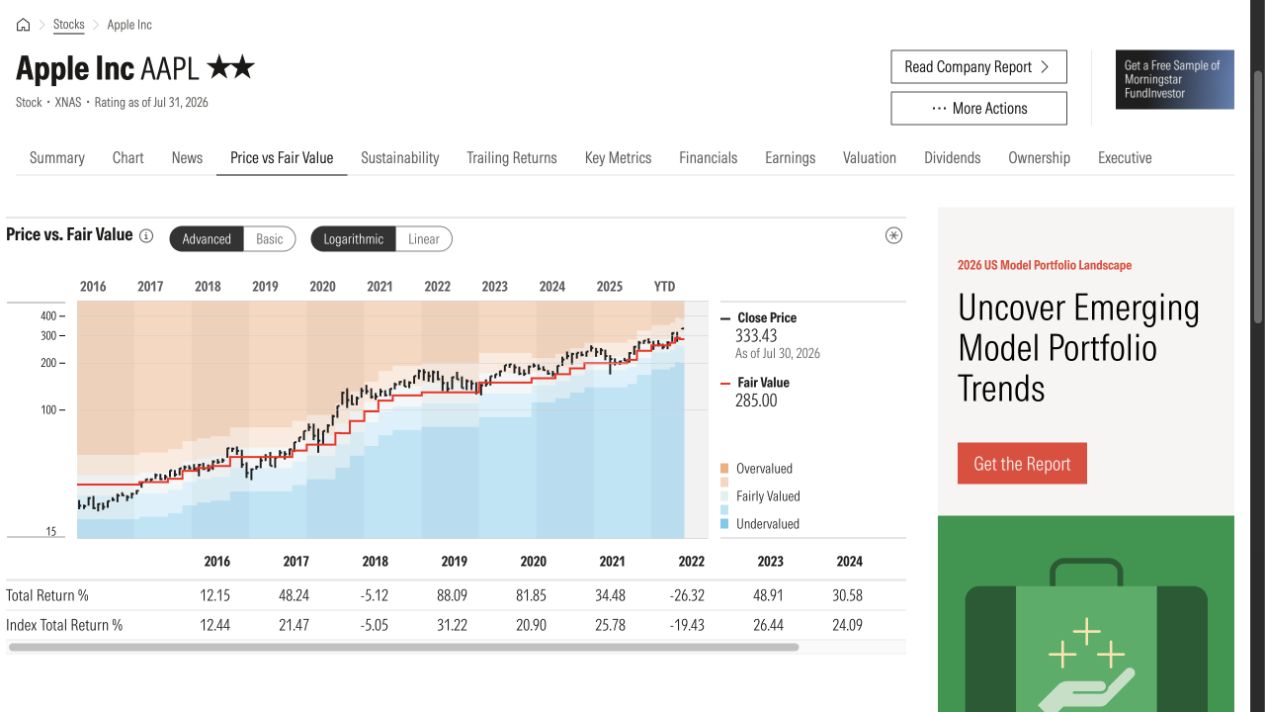
Morningstar starts from an opinion about value. A stock page puts the market price next to an analyst fair value estimate, an uncertainty rating, star ratings, and economic moat analysis, so the gap between what a share costs and what an analyst thinks the business is worth is the first thing you see. Subscriber company reports go further, covering strategy, the bull and bear case, financial strength, economic moat, the drivers behind the fair value estimate, risk, and capital allocation. You end up asking whether the current price holds up against a documented framework, and how much confidence that framework has earned.
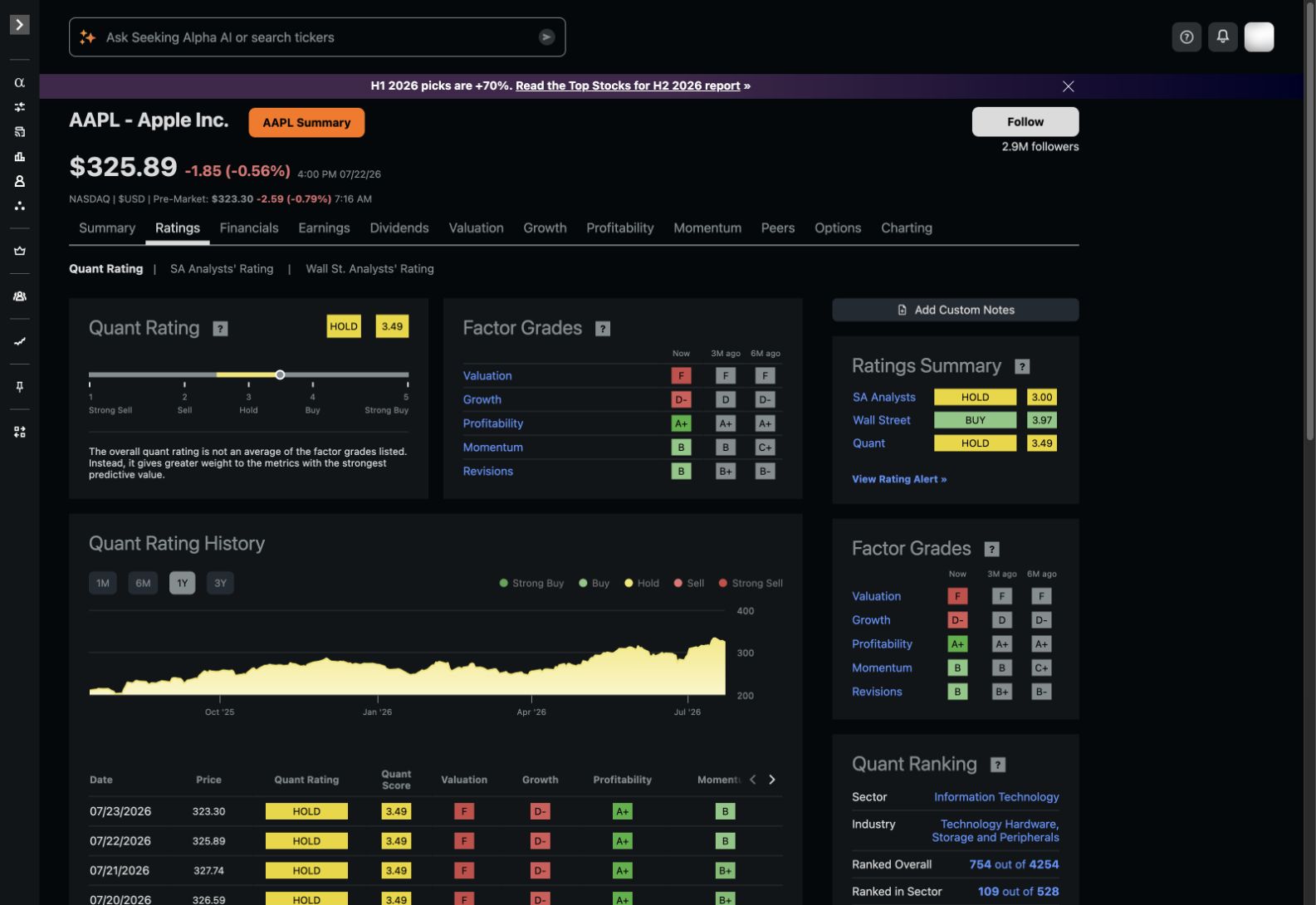
Seeking Alpha starts from measurement. A Premium stock page can show a Quant Rating, an SA Analysts' rating, a Wall Street analysts' rating, and factor grades for Valuation, Growth, Profitability, Momentum, and EPS Revisions. Those ratings and grades update regularly, and they are built as research inputs rather than guaranteed outcomes. You end up asking how a stock scores against measurable factors right now, and where the systematic view parts company with the human ones.
In daily use, the difference shows up in pace. A fair value estimate invites you to stop and read why the analyst arrived at it. A factor grade invites you to keep moving, then read the contributors arguing the other side. Neither approach removes your judgment from the decision, and neither rating system is an instruction to trade. Past or backtested rating outcomes do not guarantee future results, and the ratings stay research inputs rather than conclusions.
Stock research and idea discovery
Morningstar goes deep on the companies its analysts cover, and the subscriber company report is where that depth lives. If you hold a shortlist of larger names and want a structured second opinion on valuation, moat, financial strength, and capital allocation, the company report gives you that in one document. The limit is coverage, since an analyst-written report exists only for companies Morningstar analysts follow.
Seeking Alpha covers more ground. Premium spans more than 4,000 stocks and ETFs with unlimited articles and data-driven research tools, including screeners and top-stock lists built on the ratings and factor grades. For discovery, that matters: you can run a factor-based filter, build a shortlist, and read opposing arguments on those names in one sitting. Contributor research supplies the opposing arguments, including explicit bull and bear cases.
Both strengths carry a cost. Contributor quality varies by author, so part of your work is learning whose analysis to trust and skipping the rest. Factor grades summarize measurable characteristics rather than reaching a verdict on a business, and a stock can show strong momentum alongside a weak valuation grade. That combination is information for you to weigh, not an answer, and treating a Quant Rating or a contributor's conclusion as a trade instruction misuses the product.
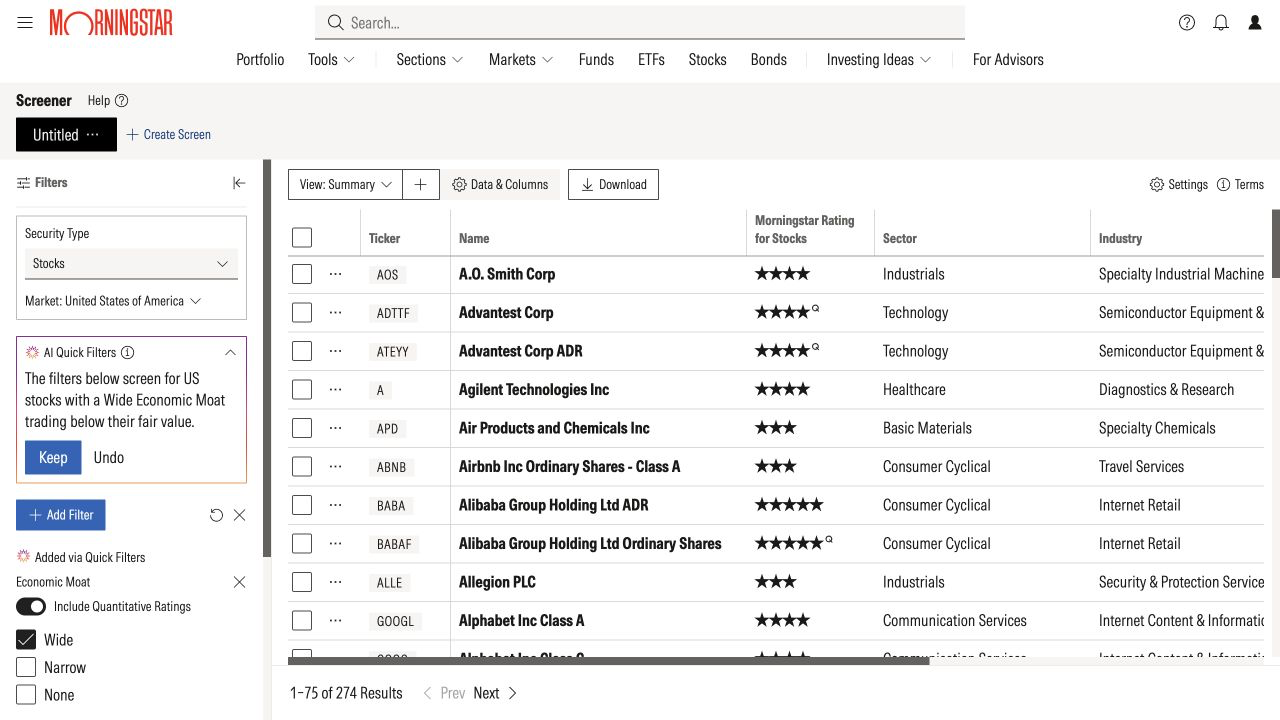
If broad US stock research fills most of your week, Seeking Alpha Premium fits better. If you follow fewer companies and want a structured valuation check on each one, Morningstar fits better.
Mutual funds, ETFs, and portfolio analysis
Morningstar's lead is widest here. On the fund side, backward-looking star ratings sit alongside the forward-looking Medalist Rating, with full ratings available to Investor subscribers. Separating those two ratings does real work, because it keeps what a fund has already delivered apart from what an analyst expects next.
The portfolio toolkit covers Portfolio X-Ray, Stock Intersection, allocation views, benchmark comparisons, and performance tracking, all running across portfolios you enter manually or link. Stock Intersection identifies duplicated underlying stock exposure across funds. Hold a broad US index fund, a growth fund, and a technology fund, and your exposure to a handful of large companies may run well past what a three-fund structure suggests.
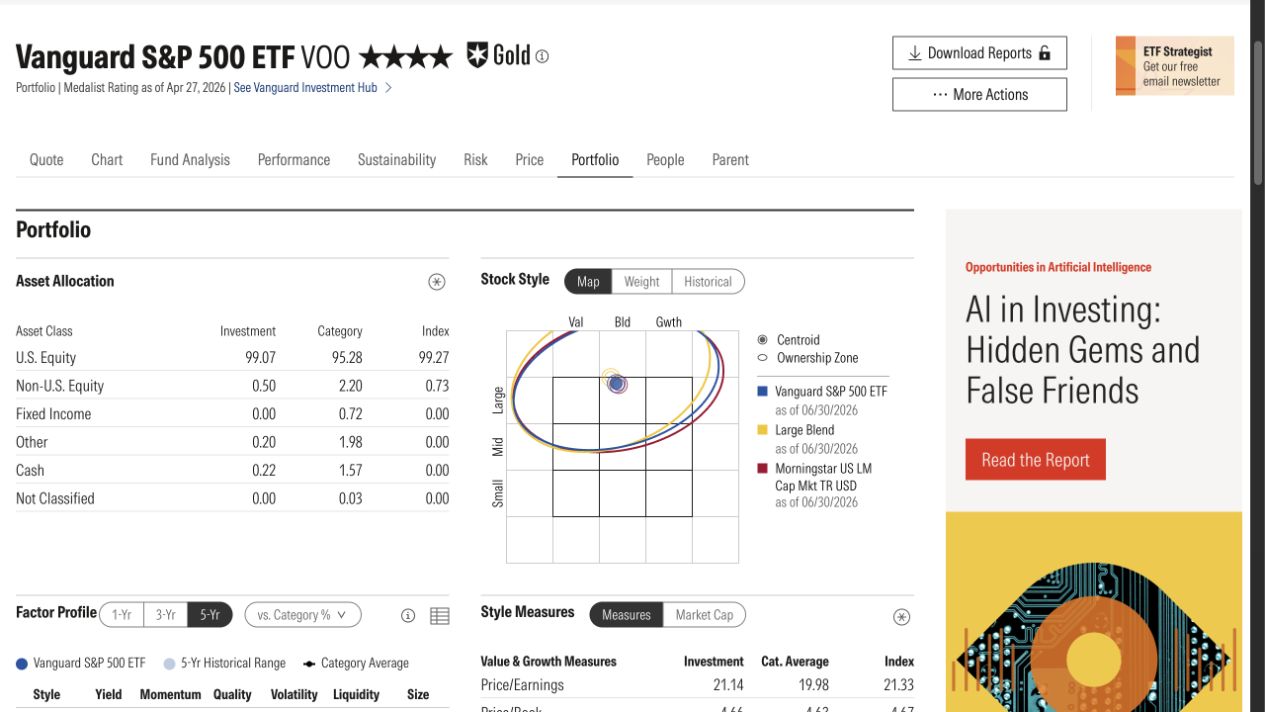
Morningstar answers the question better whenever you are asking whether your portfolio is diversified, whether several funds overlap, or whether an analyst's valuation framework supports the current price. Seeking Alpha Premium covers ETFs within its universe of more than 4,000 stocks and ETFs, and gives you stock and ETF screeners, ratings, factor grades, and top-stock lists, but the fund rating framework and the overlap analysis described above are Morningstar features.
Transcripts, community analysis, and the stock-picks ecosystem
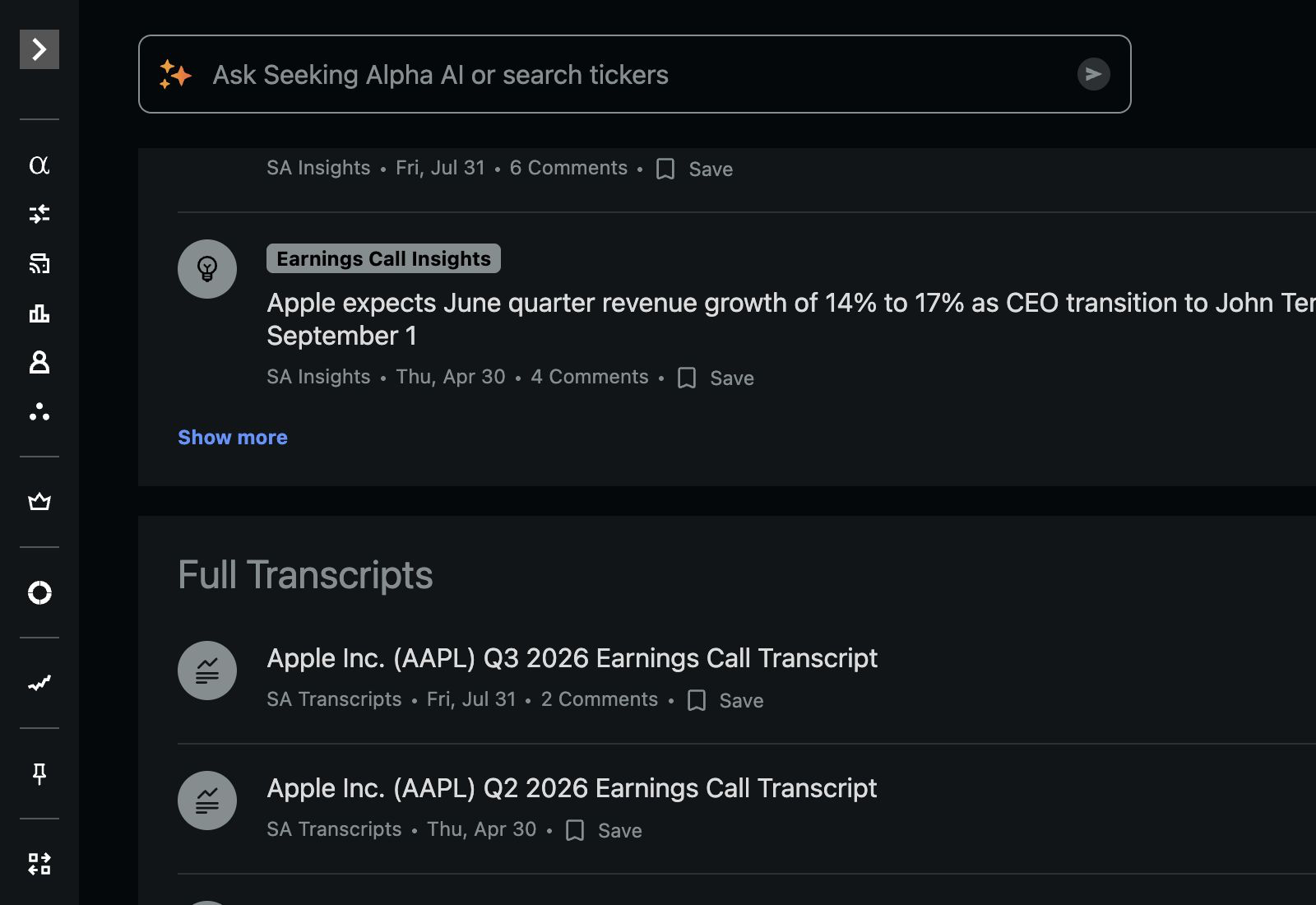
Premium includes unlimited earnings-call and event transcripts, searchable by theme and keyword. Reading what management said is a different exercise from reading a summary of it, and searching by keyword across quarters lets you watch a stated priority firm up, soften, or disappear. If you follow a small number of companies closely, this feature alone may carry the subscription for you.
Contributor research is the other half of the community layer. You get multiple viewpoints on the same company, including bull and bear cases written from different assumptions, which gives you something to push against when your conviction runs ahead of your evidence. Quality varies by author, and filtering is part of the job.
Premium, Alpha Picks, and the Bundle are easy to confuse. Premium is a research subscription, and it should not be described as a stock-picks subscription. Alpha Picks is a separate service, providing two quant-backed stock recommendations each month with accompanying analysis, webinars, and sell alerts. Alpha Picks lists at $499 per year, so running it alongside Premium at $299 brings the combined list price to $798. The Bundle combines Premium and Alpha Picks in a single subscription, and you should check the current offer terms before you subscribe. We set out the differences in our guide to Seeking Alpha subscriptions compared, and we assess the combined product in our Seeking Alpha Premium and Alpha Picks Bundle review.
The Bundle sits beside this comparison rather than inside it. Morningstar Investor against Seeking Alpha Premium is the decision most readers face, and a wider stock-picks ecosystem is a reason to understand the product line before you buy, not a reason to buy more of it.
User experience and recurring community concerns
Community discussion is anecdotal. It comes from self-selected users, it is not representative survey data, and it cannot demonstrate anything about investment outcomes. It does surface recurring usability and value themes, so read it as a signal about what owning the subscription feels like rather than as evidence about results.
Long-term Morningstar users praise the depth of fund detail, Portfolio X-Ray, and allocation analysis, and some describe treating Morningstar reports as one input among several rather than a signal to follow. Recurring complaints include slow pages, occasional reliability problems, and a sense that the subscription does not earn its cost against a simple broad-index portfolio. One alternative is worth checking before you pay, since some US libraries and brokers provide access to Morningstar research. Treat that as a caveat rather than a substitute, because what is available varies and may not include the Investor portfolio tools.
Seeking Alpha users value the breadth of stock data, the factor grades, the transcripts, the coverage of less-followed names, the comment threads, and the screeners. The complaints mirror that breadth: contributor quality varies, filtering noise takes time, and the total cost climbs once Alpha Picks joins Premium. Readers also mix up Premium, Alpha Picks, and the Bundle, which is an avoidable frustration if you check what each one includes before you subscribe.
Choose Morningstar if these conditions fit
- Mutual funds and ETFs make up a meaningful share of your portfolio, and you want ratings that separate past performance from a forward-looking view.
- You want to see whether your funds overlap and how concentrated your underlying stock exposure is.
- You prefer an analyst fair value estimate, an uncertainty rating, and moat analysis over a score.
- You review allocation, diversification, and benchmark comparisons across the whole portfolio rather than ticker by ticker.
- You are a US citizen or resident, or based in a US territory, since Morningstar's terms say the service is intended for that audience.
- You plan to keep the subscription past the first year, so today's standard $249 annual price matters more to you than the $199 introductory term.
Choose Seeking Alpha if these conditions fit
- Individual US stocks are what you research most, and you want one workflow for them.
- You want systematic ratings and factor grades across Valuation, Growth, Profitability, Momentum, and EPS Revisions.
- You read earnings-call transcripts and want to search them by theme and keyword instead of hunting quarter by quarter.
- You want several independent viewpoints, including explicit bull and bear cases, on the same company.
- You use screeners and ratings-driven lists to build a shortlist before doing deeper work.
- You may add the separate Alpha Picks service later, understanding that it is an additional subscription at an additional cost rather than an upgrade to Premium.
When neither paid service is necessary
Plenty of investors do not need either subscription. If your portfolio is two or three broad index funds held for the long term, and your routine is contributing on schedule and rebalancing occasionally, most of what you would pay for will sit unused.
Check what you already have before you subscribe. Some US libraries and brokers provide access to Morningstar research at no additional cost. Company filings and investor relations material are first-party sources for company research. Working through a free stack first tells you whether a paid layer would change any decision you make.
The other reason to wait is expecting a subscription to supply conviction. Ratings, grades, fair value estimates, and contributor articles feed a decision that stays yours, and no service takes that responsibility off you. If you want to see what a broader research stack looks like before committing, our guide to the best stock analysis tools covers the wider set of options.
Choose MorningstarChoose Seeking AlphaFinal verdict
There is no universal winner. Morningstar Investor is the better subscription for mutual funds, ETFs, analyst-led valuation, and whole-portfolio research, because its fund ratings, company reports, and overlap tools answer questions about what you own as a whole. Seeking Alpha Premium is the better subscription for US stock research, Quant Ratings and factor grades, earnings transcripts, and contributor analysis, because its breadth and its competing viewpoints answer questions about individual companies.
Base the decision on what you own and how you research. If funds and ETFs dominate your holdings, Morningstar answers more of your questions, and if you spend your research time on individual stocks, Seeking Alpha does. If you hold a simple passive broad-index portfolio, you may not need either subscription. Whichever you pick, use the trial, set a reminder for the renewal date, and judge the subscription on whether it improved a decision you had to make.
FAQ
Is Morningstar better than Seeking Alpha for stock research?
If your priority is broad US stock research, Seeking Alpha Premium is stronger. It covers more than 4,000 stocks and ETFs with Quant Ratings, factor grades, screeners, transcripts, and contributor viewpoints in one workflow. Morningstar is stronger when you want a structured analyst valuation on a covered company, including fair value, uncertainty, moat, and capital allocation.
Is Morningstar better than Seeking Alpha for ETFs and mutual funds?
Yes. Morningstar combines backward-looking star ratings with the forward-looking Medalist Rating, with full ratings available to Investor subscribers, and its portfolio tools include X-Ray, Stock Intersection, allocation views, and benchmark comparisons. Stock Intersection helps you spot duplicated underlying stock exposure across several funds.
Does Seeking Alpha Premium include stock picks?
No. Premium is a research subscription. Alpha Picks is a separate service that provides two quant-backed stock recommendations each month, along with accompanying analysis, webinars, and sell alerts. The Bundle combines Premium and Alpha Picks into one subscription. Buying Premium alone does not give you the Alpha Picks recommendations.
Which service is cheaper after the first year?
Morningstar Investor, on both current figures. At today's verified offers, the first year costs $199 with Morningstar Investor and $269 with Seeking Alpha Premium. At today's stated standard prices, Morningstar Investor costs $249 annually while Seeking Alpha Premium costs $299 plus applicable taxes or VAT. Morningstar renews at the price then in effect for the selected term, and Seeking Alpha Premium renews at the then-current annual list price, so what you pay at renewal can change.
Can I use Morningstar Investor outside the United States?
Morningstar's terms say the service is intended only for US citizens or residents and US territories. If you are based elsewhere, check the current user agreement before subscribing.
Can I get Morningstar research through a library or broker?
Sometimes. Some US libraries and brokers provide access to Morningstar research, and checking that before you pay is a reasonable step. What is included varies by provider, and such access may not extend to the Investor portfolio tools like X-Ray and Stock Intersection, so confirm what you would get.
Kai is an investor who helps people choose the right broker and invest with confidence. He founded MatchMyBroker, a broker-comparison site for a global audience, and EU Investing Hub, his European-focused investing site. He also runs the Smart Money with Kai YouTube channel, where he breaks down investing, brokers and personal finance.
MatchMyBroker has commercial relationships with Morningstar and Seeking Alpha. Morningstar provided complimentary Investor access for review purposes. These arrangements did not determine the comparison verdict.

.png)
.png)