Is Morningstar Worth It in 2026? Review and $50 Discount



Morningstar Investor is worth paying for if you are a US-based long-term investor who holds mutual funds, ETFs, and individual stocks across more than one account, and who wants independent analyst research sitting behind those holdings. The subscription lists at $249 for a full year, and eligible new users can start with a 7-day free trial. Through MatchMyBroker's affiliate link, new annual subscribers pay $199 for the first annual term, a $50 saving against the standard price. That buys Morningstar's analyst research on stocks, funds, and ETFs, a Screener carrying more than 200 data points, Watchlists and notifications tied to rating and Fair Value changes, and Portfolio X-Ray, which takes a whole portfolio apart by asset allocation, sector, region, equity style, and fees.

Two limits matter before anyone pays. Morningstar's US User Agreement states that the Investor service is intended only for US citizens or residents, which makes it unsuitable for most of MatchMyBroker's international readership. The value also narrows sharply for investors who hold one or two broad index funds, for active traders (US market quotes can run 15 minutes behind), and for anyone expecting the mobile app to match the website. Public feedback through 2026 also returns often to site reliability, and we treat that as a genuine cost rather than background noise.
Get $50 off Morningstar Investor
Key facts and the reader offer
- Standard annual price: $249, billed once per year
- Standard monthly price: $34.95
- MatchMyBroker offer: $199 for the first annual term, a $50 saving on the standard annual price
- Trial: eligible new users can start with a 7-day free trial before the first annual term bills
- Renewal: subscriptions renew automatically unless the subscriber cancels
- Availability: Morningstar's US User Agreement states the Investor service is intended only for US citizens or residents
Morningstar promo code and $50 discount
Readers who reach Morningstar through our affiliate route do not need to enter a MatchMyBroker promo code. The link carries Morningstar's own offer code, PARTNER1, and lands on Morningstar's affiliate page, which is where the $50 reduction is applied. Morningstar's partner manager confirmed in July 2026 that this runs as an evergreen offer rather than a seasonal promotion.
Through that route, the first annual term costs $199 rather than the standard $249, and eligible new users can start with a 7-day free trial before that first term bills. Confirm that the annual total shows $199 at checkout before completing payment, because the saving depends on the attribution surviving the journey. The offer applies only to the first year of a yearly subscription, cannot be combined with another offer, and cannot extend a Morningstar Investor subscription that is already running.
Morningstar cannot apply the student, teacher, or military terms retroactively to an account that already exists.
How to claim the Morningstar discount
- Open Morningstar through our affiliate link rather than hunting for a code to paste.
- Choose the eligible yearly offer and create the account, starting the 7-day free trial if you want to test the product first.
- Confirm that the annual total shows $199 before you pay.
- Note the trial end date and the automatic renewal terms, because a trial converts and a subscription renews unless someone cancels.
Get $50 off Morningstar Investor
What Morningstar Investor is
Morningstar Investor is Morningstar's paid subscription for individual investors. It combines the research that Morningstar's analysts publish on stocks, funds, and ETFs with a working set of tools: Screener, Watchlists, Compare, notifications, Portfolio, and Portfolio X-Ray. The research sits at the center of the product, and the tools exist to help a subscriber apply it to holdings they already own or are considering.
Several things fall outside the subscription. Morningstar Investor does not hold client money, execute trades, or manage anything on a subscriber's behalf. It does not deliver personalized investment advice. It does not publish a running feed of stock picks for readers to follow. Morningstar added AI features during 2026, and those additions are targeted helpers inside an analyst-led product rather than the foundation of it.
Morningstar's ratings work as research inputs, and they carry more weight when a subscriber reads the reasoning behind them and tests the assumptions against their own view. Our guide on how to research a stock sets out where third-party ratings usually belong in a due diligence process.
Free Morningstar.com versus paid Morningstar Investor
Morningstar does not offer a free Morningstar Investor tier. Anyone can read selected editorial content, market pages, basic security information, some previews, and free newsletters on Morningstar.com without paying. The paid subscription unlocks the proprietary research and the full workflow around it: analyst ratings and reports, portfolio diagnostics, saved screens, custom views, and notifications.
Morningstar varies what sits behind the paywall and what logged-out visitors see in preview, so we would treat the table below as a guide to the shape of the difference rather than a permanent inventory of every page and data point.
Pricing, trial, renewal, and cancellation
Morningstar charges $249 for an annual subscription, billed once per year, or $34.95 per month. Twelve monthly payments at that rate total $419.40, so the monthly option costs $170.40 more than the standard annual price across a full year.
Eligible new users can receive a 7-day free trial, and a user who has already taken one is not eligible for another. Morningstar's user agreement states that a trial converts into the selected paid subscription when the trial ends unless the subscriber or Morningstar cancels it during the trial window. Subscriptions then renew automatically unless the subscriber cancels. Anyone who wants to treat the trial as a genuine trial should set a calendar reminder before day seven rather than relying on memory.
To cancel online, select the person-shaped My Account icon, choose Subscription, then select Cancel Subscription under the Subscription section. Morningstar then presents pre-cancellation information and a short survey.
Stock research
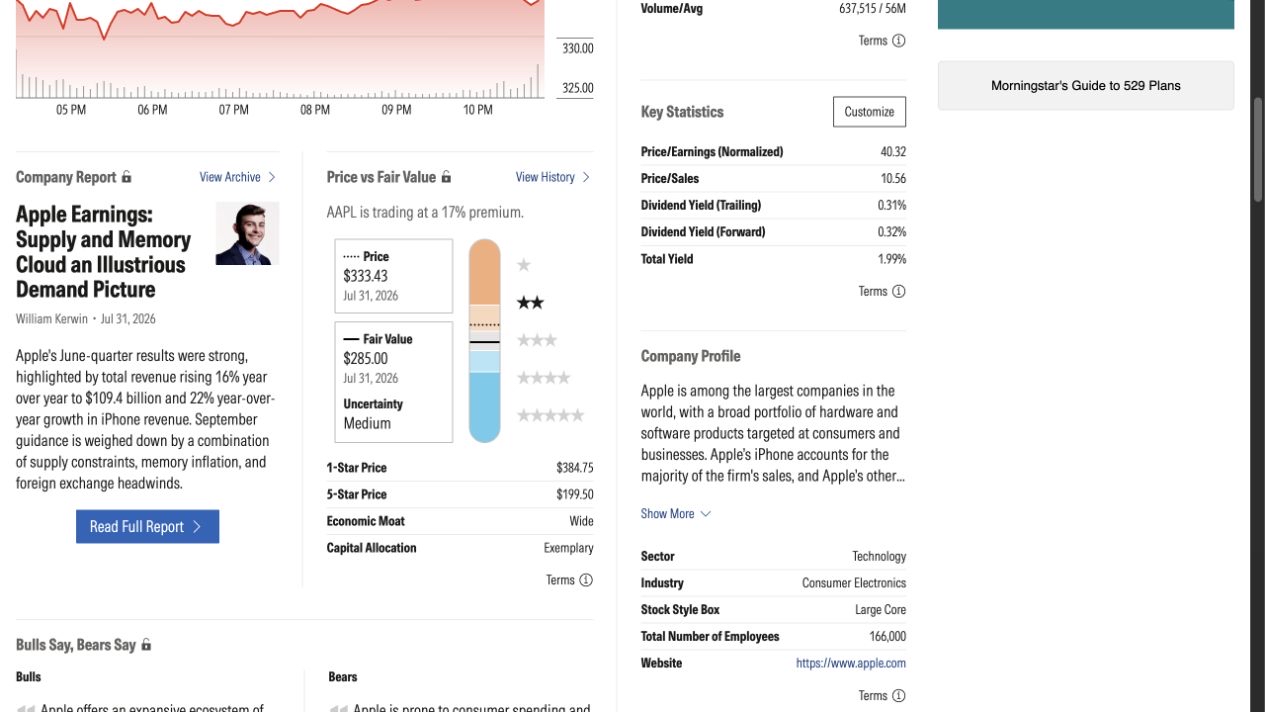
Paid stock pages carry the work that gives Morningstar its reputation. Where analyst coverage exists, a stock page can show a Morningstar Fair Value Estimate, the Morningstar Rating for stocks, an Economic Moat Rating, an Uncertainty Rating, a Capital Allocation Rating, Bulls Say and Bears Say summaries, analyst notes, and a full company report.
Fair Value Estimate and the star rating
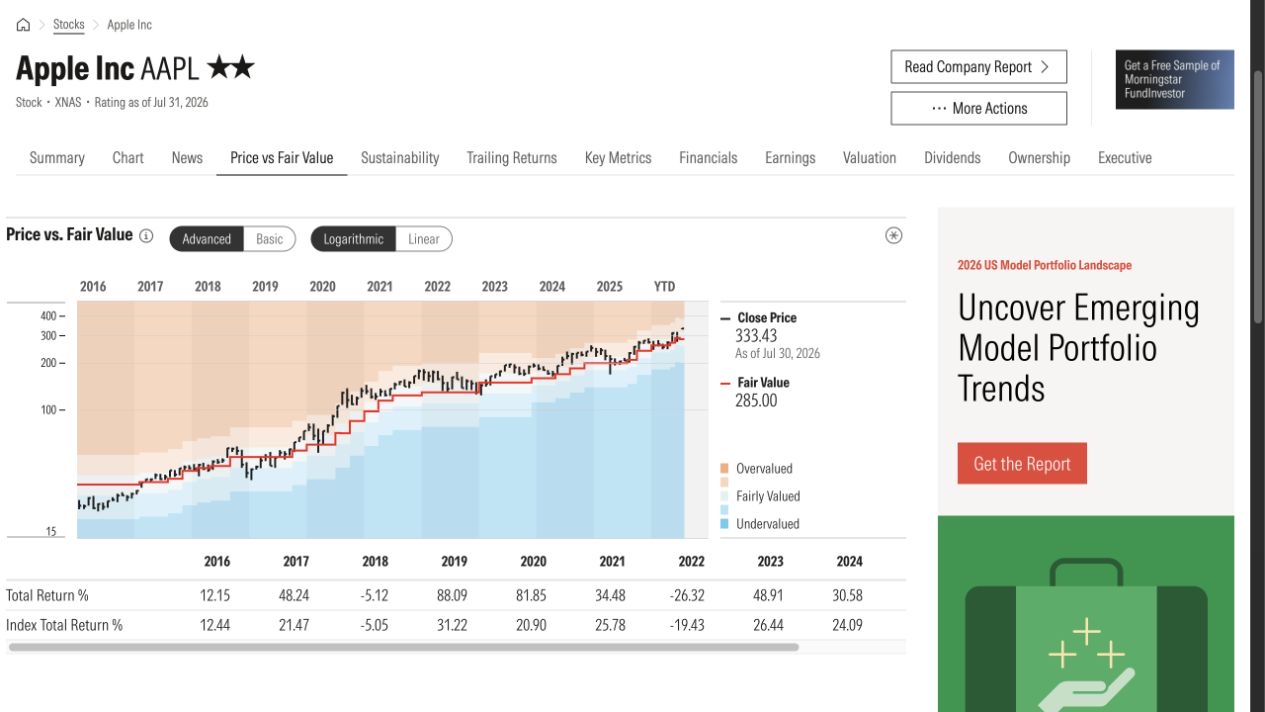
The star rating compares a stock's market price against the analyst's Fair Value Estimate and adjusts the comparison for uncertainty. Morningstar states plainly that the rating is neither a forecast nor a guarantee of investment returns, and we would repeat that. A Fair Value Estimate is the output of an analyst's assumptions about revenue, margins, capital needs, and discount rates. Change one assumption and the number moves.
We read these ratings as a starting point for a question. Morningstar plots the Fair Value Estimate against the market price on a Price versus Fair Value chart, and on Apple that chart shows the valuation bands the star rating works from. When the estimate sits far from the market price, the useful work involves identifying which assumption explains the gap and deciding whether the analyst or the market has the better case. Readers who want a structure for that process can use our guide on how to research a stock.
Moat, uncertainty, and capital allocation
The Economic Moat Rating expresses Morningstar's view on how durable a company's competitive advantage looks. The Uncertainty Rating feeds directly into how wide a discount or premium the star rating requires. The Capital Allocation Rating covers how management deploys the cash the business produces. Taken together, these three tell a subscriber how confident the analyst feels and where the argument could break.
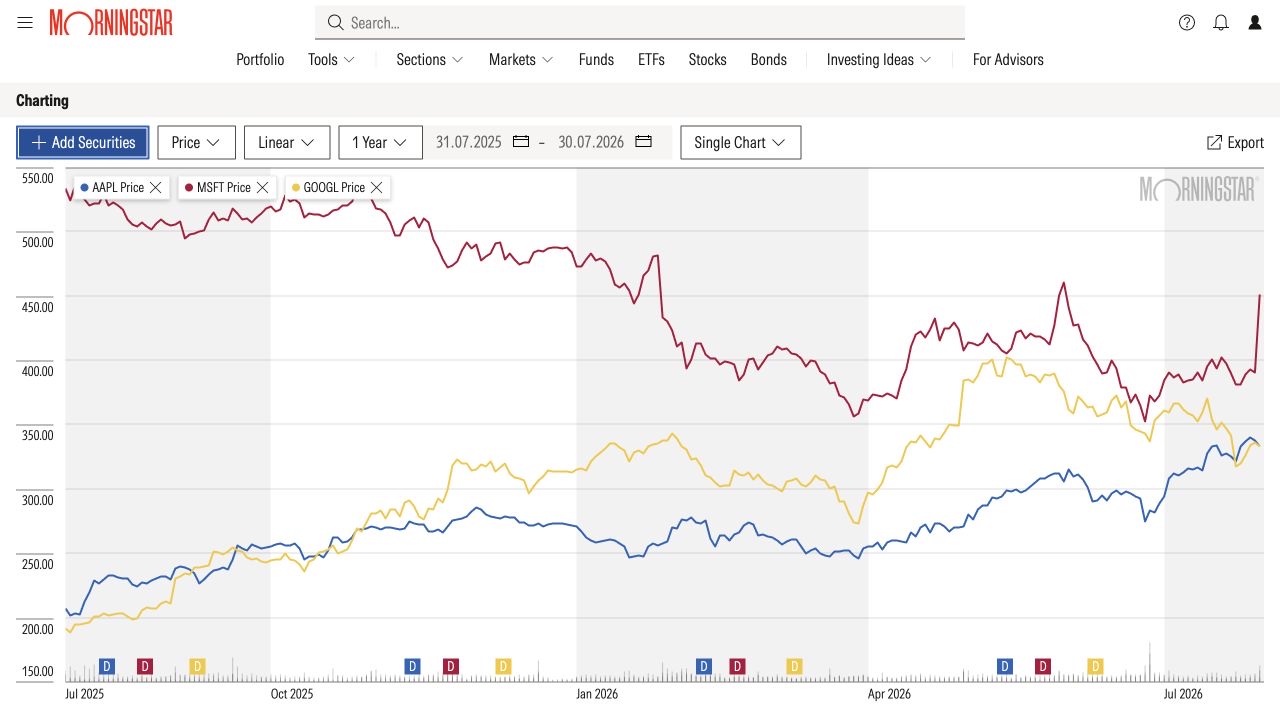
Bulls Say and Bears Say deserve particular attention, because they present the case against the analyst's own conclusion in compact form. Analyst notes then track how the view evolves after earnings, guidance changes, and corporate actions. The full company report gathers those elements in one document, and the signed-in version we reviewed on Apple opened without the previews and prompts that logged-out visitors meet. Setting Apple against GOOGL and 005930 then lines up Price/Earnings (Normalized), Price/Book Value, Price/Sales, and Price/Cash Flow in one view, with a historical Price/Earnings chart beside them, which shows whether a multiple looks stretched against peers or against the company's own recent range. Coverage does not extend to every listed company, so subscribers researching smaller or less-followed names will find pages with data and no analyst view attached.
Fund and ETF research
Fund and ETF research is, in our judgment, Morningstar Investor's clearest advantage over the two competitors named later in this review. The subscription includes full fund and ETF analyst reports wherever coverage exists, and those reports work through People, Process, Parent, Performance, and Price.
Two ratings sit alongside each other, and subscribers should keep them separate. The Morningstar Medalist Rating is forward-looking. It represents Morningstar's assessment of a fund or ETF's ability to outperform its category benchmark after fees. The Morningstar star rating for funds is backward-looking and risk-adjusted, describing what a fund has already delivered relative to peers. A fund can hold a strong star rating and a weaker Medalist Rating, and understanding why usually reveals something worth knowing about manager turnover, strategy drift, or cost.
Morningstar simplified the Medalist methodology in May 2026 with a clearer Price Score, which makes the fee component of the assessment easier to read. In the same month, Morningstar introduced downloadable full managed-investment reports, which suits readers who prefer to keep a record of the research behind a holding rather than revisiting a web page months later.
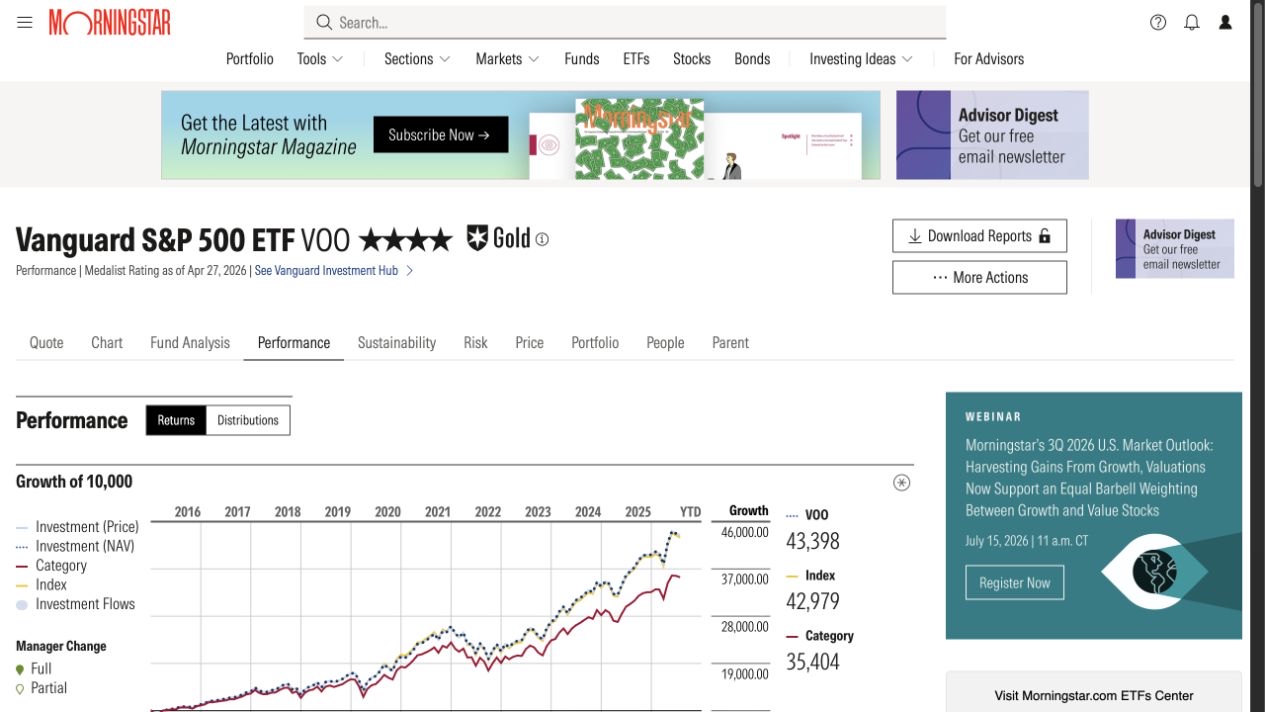
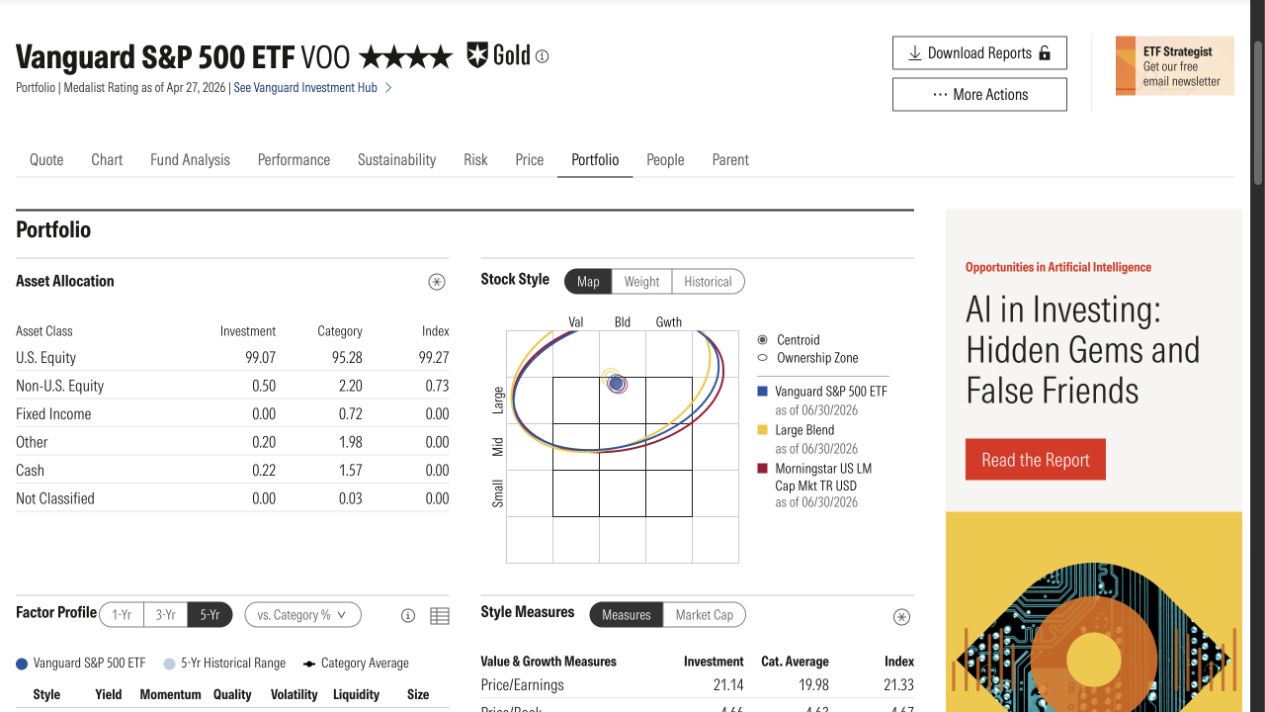
For an investor comparing two similar large-cap funds or deciding whether an actively managed fund earns its expense ratio, this is the part of the subscription that most often pays for itself. The Factor Profile makes that comparison concrete. On the Vanguard S&P 500 ETF we opened while reviewing the signed-in service, Morningstar plots Style, Yield, Momentum, Quality, Volatility, Liquidity, and Size against the fund's own five-year historical range and its category average, and a separate table sets valuation, dividend yield, earnings growth, sales growth, cash-flow growth, and book-value growth beside the category average and the index. That shows a subscriber where a fund sits against its peer group and its benchmark rather than trusting the category label.
Portfolio X-Ray and Stock Intersection
Portfolio X-Ray analyzes a portfolio as a single object. It breaks holdings down by asset allocation, stock sectors, world regions, fees, equity style, fixed-income style, and stock statistics, and it compares the result against a benchmark. Investors who accumulated funds across a 401(k), an IRA, and a taxable account over a decade often find that the combined exposure looks nothing like the intention behind any individual purchase.
Stock Intersection answers a related question by showing which underlying companies appear across the funds and individual stocks in a portfolio. Someone holding a total market fund, a technology sector fund, and a handful of large-cap stocks can see the concentration those three positions create together. We regard this pair of tools as the strongest practical reason for a multi-fund investor to pay for the subscription.
Two limits shape that work. Portfolio X-Ray accepts no more than 150 holdings in a single analysis, which will affect subscribers running very large or heavily fragmented portfolios, and splitting a portfolio across separate analyses costs the whole-portfolio view that makes the tool valuable in the first place. Capacity itself is rarely the constraint, because a subscription can hold up to 25 portfolios and 2,000 holdings in aggregate.
Morningstar Investor now gives investors three ways to move holdings into a portfolio: link an investment account, import a holdings file, or enter positions manually. Once the holdings are in place, they can feed Portfolio X-Ray, performance charting, and gain/loss analysis. The right setup method depends mainly on whether you prioritize convenience, historical accuracy, or direct control over the records.
Account linking is the simplest route for keeping current holdings and balances visible. It works well when your main goal is portfolio monitoring and X-Ray analysis. However, linked accounts do not provide Morningstar with cost basis or transaction history for performance charting. That limits how much confidence you can place in historical return and gain/loss figures.
Import Holdings removes much of the setup burden. You can add positions to a new or existing portfolio from XLSX, CSV, TXT, brokerage statement PDFs, or PNG, JPG, and JPEG images. Imports cover publicly traded stocks, mutual funds, ETFs, and money market funds on US exchanges, but not individual bonds. Morningstar recommends using a desktop for the best import results.
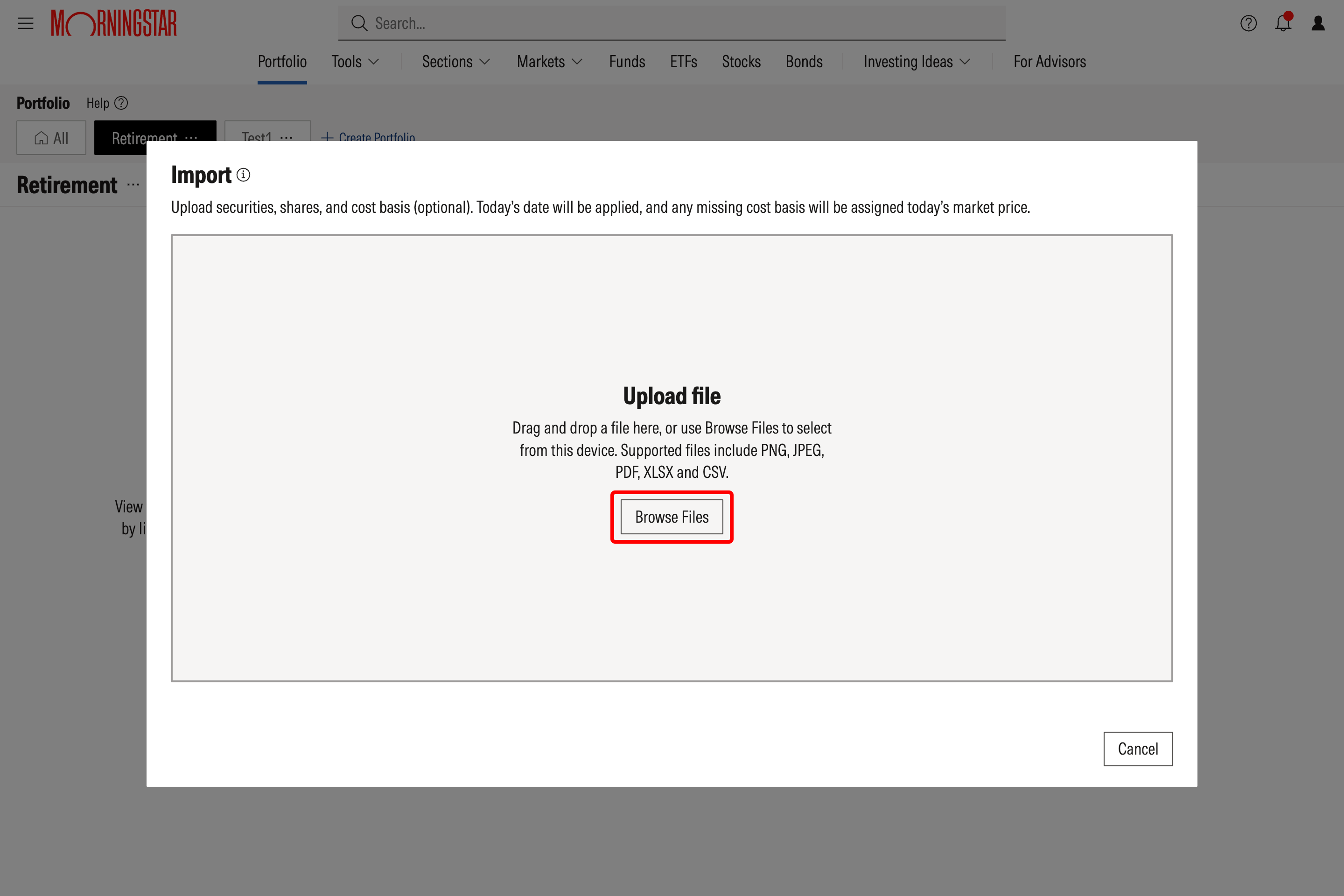
Files containing ticker symbols or security names, share quantities, and cost basis or purchase price should produce the most accurate records. Before completing an import, you can correct quantities and cost basis and exclude unwanted rows. This review step matters. If cost basis is missing, Morningstar uses the current market price as the purchase price, which can make performance results less accurate.
Every imported position also receives the import date as its initial purchase date, and you must correct that date afterward. Imports create separate positions rather than updating existing holdings, so reimporting an already represented security can create duplicates. We would use importing for a faster initial build, then check dates, cost basis, and duplicate positions before relying on performance figures. Manual entry remains the better choice when precise purchase dates, quantities, cost basis, and transaction records matter most.
Screener, AI Quick Filters, Watchlists, Compare, and notifications
The Screener carries more than 200 data points across supported investment types, and subscribers can save screens and build custom views. Saved screens matter more than the raw data point count for a long-term investor, because a screen that runs every quarter with consistent criteria produces a more useful shortlist than an ad hoc search.
AI Quick Filters
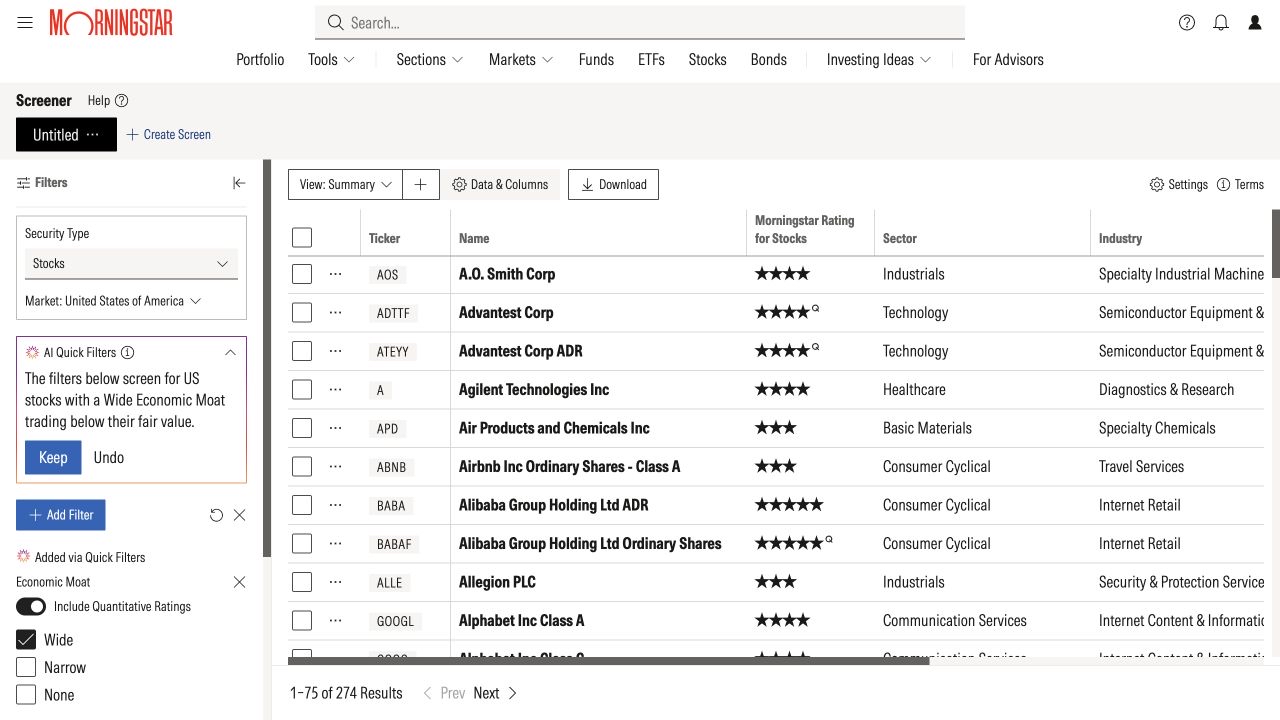
AI Quick Filters translate a plain-language screening request into filter criteria. Morningstar added natural-language Screener filters in March 2026, alongside AI-generated explanations of market movements for securities held in a subscriber's portfolio. When we ran a request through it, the Screener showed the filters it had built above the results table, which is the part that matters: Morningstar warns that AI output can contain errors and tells users to review the generated filters, and the interface makes that review possible. We would treat the feature as a faster route to a filter set that still needs checking before anyone acts on the results.
Readers weighing this against tools built around AI from the ground up should look at our roundup of the best stock analysis tools, which covers products taking a different approach.
Compare, Watchlists, and notifications
Compare handles up to five securities at once. Stocks can be compared only with other stocks, while mutual funds and ETFs can be mixed in the same comparison. Comparisons cannot be saved, which becomes irritating for anyone repeating the same analysis. Morningstar expanded Compare with 71 additional data points in June 2026, so the depth available in a single side-by-side view improved considerably during the year.
Watchlists hold securities for monitoring and feed both notifications and research updates. Notifications can cover changes to ratings, Fair Value, Economic Moat, earnings, analyst reports, dividends, Medalist Ratings, and distributions. For a long-term investor, a Fair Value revision or a Medalist downgrade on a held fund is exactly the kind of event worth an email. In July 2026, Morningstar expanded Watchlist import support, added money-market-fund screening, and introduced category grouping and dividend-payment-month fields.
What users say
Public sentiment splits along a consistent line: praise for the research, complaints about the software.
On Reddit, investors regularly single out Portfolio X-Ray, the fund and ETF analysis, and Morningstar's measured research voice as the reasons they keep paying. Threads in investing and value investing communities treat Fair Value Estimates as a reference point worth taking seriously, even among users who disagree with individual calls.
The complaints cluster around reliability and interface changes. Reddit users report website slowness, unexpected sign-outs, outages, portfolio behavior that does not work as expected, and frustration with the interface that replaced the Legacy experience. These reports come from self-selecting threads rather than a survey, though the consistency of the theme makes it worth flagging.
Trustpilot showed 1.8 out of 5 from 131 reviews when we checked in July 2026, with 22 of those reviews posted in the prior 12 months. That is a small, negatively selected global sample covering products beyond US Morningstar Investor, and we use it to identify failure modes rather than as any measure of overall satisfaction. The US iOS App Store showed 4.0 out of 5 from roughly 7,000 ratings at the same time, with recent reviews still pointing to functions available on the desktop site that are missing from the app, plus reliability concerns. We found no strong, recent, organic consensus about the product on X, so nothing in this section rests on that platform.
Pros and cons
We see a clear split in Morningstar Investor, and the summary below lays out both sides. The independent analyst research pairs with fund, ETF, and whole-portfolio diagnostics, and the screener carries more than 200 data points. Against that, Morningstar intends the service for US citizens or residents, linked accounts cannot chart performance, and public feedback keeps flagging reliability problems and mobile gaps.
Morningstar Investor versus Seeking Alpha Premium versus InvestingPro
These three products answer different questions, and the choice usually follows from research style and geography rather than price. The table reflects MatchMyBroker's judgment about specific use cases.
Seeking Alpha Premium suits a reader whose research centers on US stocks and who values contributor viewpoints, Quant ratings, earnings transcripts, and stock-oriented monitoring. Contributor articles represent the views of their authors, and the service does not provide personalized advice. Our Seeking Alpha Premium review covers the product in detail, and readers unsure which tier they need can read our guide with Seeking Alpha subscriptions compared.
InvestingPro suits a reader who wants broad global stock coverage, model-driven valuation, stock screeners, and a more explicit AI-assisted workflow. Its public pricing depends on term and location, so the headline monthly figures shift according to how a subscriber buys. Our InvestingPro review works through the product, and our page on InvestingPro pricing and discount sets out the current terms.

Final verdict: who should subscribe?
Morningstar Investor earns its price for a US-based long-term investor who researches mutual funds, ETFs, stocks, and portfolios spread across several accounts. The clearest case involves someone holding a dozen or more funds accumulated over years, who wants to know their real sector and regional exposure, which companies they own several times over, and whether their actively managed funds still deserve the fees they charge.
The research supports that use. Morningstar's analysts publish their reasoning, separate forward-looking judgments from backward-looking performance, and keep the tone measured. Portfolio X-Ray and Stock Intersection do work that most investors cannot easily do in a spreadsheet, and the 2026 releases across Screener, Compare, Watchlists, and downloadable reports show a product still receiving investment.
Several readers should skip it. Morningstar's US User Agreement states that the Investor service is intended only for US citizens or residents, which makes it unsuitable for most of MatchMyBroker's international readership. Active traders will find the 15-minute quote delay and the research-led design unsuitable. An investor holding one or two broad index funds already knows almost everything X-Ray would tell them, and $249 a year buys very little in that situation. Readers who want a stock-pick feed to follow, or an AI-first research assistant, will find that Morningstar was built on a different premise, and our roundup of the best stock analysis tools covers alternatives that fit those preferences better.
Subscribers should also plan around three limits. Linked accounts cannot produce performance charts, the mobile app trails the website, and reliability complaints run consistently through public feedback from 2026. None of that displaces the core judgment. For the reader described above, the analyst research and the portfolio diagnostics justify the cost, and our affiliate route prices the first annual term at $199 rather than $249 once the 7-day free trial ends.
Get $50 off Morningstar Investor
Frequently asked questions
Is there a Morningstar promo code?
Readers do not need to enter a MatchMyBroker promo code. Our affiliate link carries Morningstar's own offer code and applies the $50 reduction on Morningstar's side, so the first annual term should show $199 rather than $249 at checkout. Confirm that total before paying. The offer covers the first year of a yearly subscription only, cannot be combined with another offer, and cannot extend an existing subscription.
How much does Morningstar Investor cost?
Morningstar charges $249 for an annual subscription billed once per year, or $34.95 per month. Through MatchMyBroker's affiliate link, the first annual term costs $199. Verified US students pay $25 per year for two years, verified US teachers pay $99 per year for four years, and verified military users receive $75 off the first year.
Does Morningstar offer a free trial?
Yes. Eligible new users can receive a 7-day free trial, and a user who has already taken one is not eligible for another. The trial converts to the selected paid subscription when it ends unless the subscriber or Morningstar cancels during the trial. Morningstar does not offer a free Morningstar Investor tier beyond that, although selected editorial content, market pages, and free newsletters remain open on Morningstar.com.
Does Morningstar have a student discount?
Yes. Students pay $25 per year for two years. Teachers pay $99 per year for four years, and verified military users receive $75 off the first year. All three programs require verification and are open only to US users.
Is Morningstar worth it?
For a US-based long-term investor holding funds, ETFs, and stocks across several accounts, we think the analyst research and Portfolio X-Ray justify the price, and the first annual term costs $199 through MatchMyBroker's link. For an investor holding one or two broad index funds, or for an active trader who needs live quotes, the subscription is difficult to justify.
Can I cancel before the trial ends?
Morningstar's user agreement states that a trial converts to the selected paid subscription when the trial ends unless the subscriber or Morningstar cancels it during the trial. To cancel online, select the My Account icon, choose Subscription, then select Cancel Subscription. Subscriptions also renew automatically unless canceled, so set a reminder a day or two before the trial period closes.
Is Morningstar better than Seeking Alpha or InvestingPro?
Each product serves a different reader. In our judgment, Morningstar Investor is the strongest of the three for understanding an entire long-term portfolio, particularly one containing mutual funds and ETFs. Seeking Alpha Premium is stronger for US stock research through Quant ratings, earnings transcripts, and multiple viewpoints. InvestingPro offers broader global stock coverage, model-driven valuation, and a more explicit AI workflow. For a direct side-by-side decision, read our Morningstar vs Seeking Alpha comparison.
Kai is an investor who helps people choose the right broker and invest with confidence. He founded MatchMyBroker, a broker-comparison site for a global audience, and EU Investing Hub, his European-focused investing site. He also runs the Smart Money with Kai YouTube channel, where he breaks down investing, brokers and personal finance.