Best Stock Analysis Tools and Websites in 2026



There are dozens of stock research platforms, and most "best of" lists just rank whoever pays the most. We use these tools ourselves, so this is the honest version: which stock analysis tool is genuinely the best, and which one is right for you depending on how you actually invest.
We judged each platform on four things that matter for real research: the depth and accuracy of its data, how global its coverage is, how easy it is to use, and whether it earns its price. Some of the tools below pay us a commission if you subscribe through our links, which we disclose at the end. None of that changed the order. Seeking Alpha sits at the top because it is the only platform here that combines serious research, stock ratings and a track-recorded picks service in one place, not because of how it pays.
Below we break down each one: what it is best at, where it falls short, and who should use it. If you only have time for one, read the Seeking Alpha section first, then jump to whichever tool matches how you research.
How we tested these tools
We hold or have run active accounts on the platforms we recommend most, and we put each one through the same checks: pulling a financial deep-dive on a large-cap stock, stress-testing the screeners, checking how far the data reaches outside the US, and seeing how quickly a beginner could get a useful answer. Where a platform is strong we say so, and where it is weak or overpriced we say that too. The one we put real money behind is Seeking Alpha, where we track the Alpha Picks service in a live portfolio, and we link to our full hands-on reviews in each section so you can see the detail.

1. Seeking Alpha
Best for US investorsSeeking Alpha is the most complete platform on this list, and that is exactly why it wins. Most tools do one job well. Seeking Alpha does three: a deep research library with millions of analyses and earnings transcripts, the Quant Rating system that grades every stock from A to F across five factors (valuation, growth, profitability, momentum and earnings revisions), and Alpha Picks, a separate rules-based service that surfaces a track-recorded list of long-term stock ideas. No other platform here covers research, ratings and a picks service under one roof.
The Quant rating is the standout. It is a fast, unemotional read on whether a stock screens well right now, and it is the feature we lean on most for a first-pass sanity check. Alpha Picks has comfortably outpaced the S&P 500 since it launched in 2022, and because it carries a public, time-stamped record there is no backtest doing the heavy lifting. Past performance is no guarantee of future results, and we keep the latest verified figures in our Alpha Picks review.
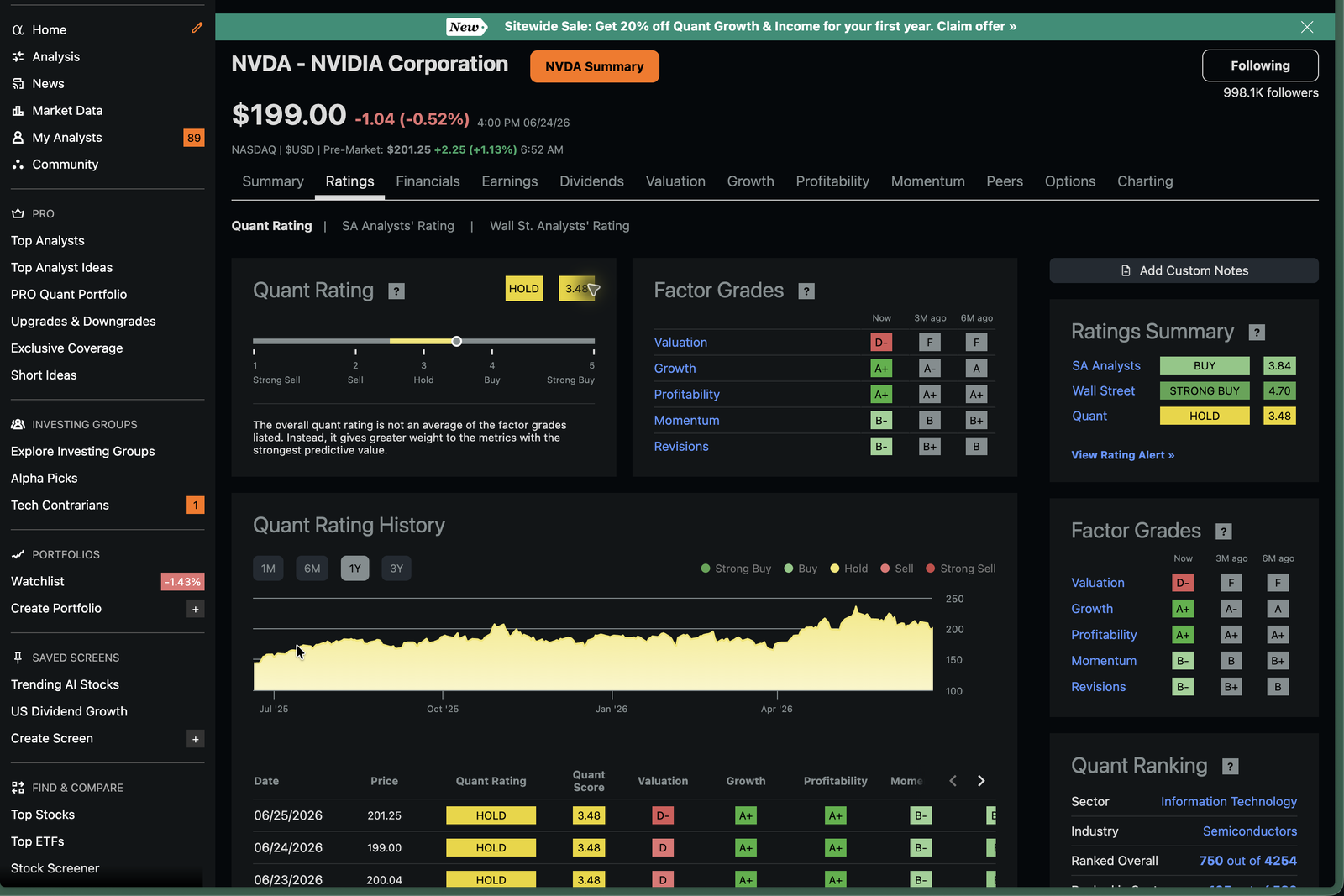
Seeking Alpha's Quant rating and A-to-F factor grades, shown here for NVIDIA.
- Quant ratings on virtually every US-listed stock
- Enormous depth of analysis and transcripts
- The Bundle pairs research with a proven picks service
- Coverage skews heavily US-listed
- The free version pushes a lot of upsells
Seeking Alpha keeps a free tier, while Premium lists at around $299 a year and Alpha Picks at around $499. The best-value route for most readers is the Premium plus Alpha Picks Bundle, which currently runs $639 a year, well below the $798 of buying both separately. If you only want the research and ratings, start with Seeking Alpha Premium, and you can see every current deal on our Seeking Alpha discount page. Best for serious self-directed investors who want one platform to research, rate and shortlist stocks.
Get the Bundle for $639 (save $159)
2. InvestingPro
Best for global investorsInvestingPro is the premium research layer built on top of Investing.com, one of the most-visited finance sites in the world. Its signature feature is Fair Value, an intrinsic-value estimate drawn from a stack of valuation models, paired with ProPicks AI stock lists, the WarrenAI natural-language assistant, and a screener that reaches across tens of thousands of global stocks. It is the cheapest all-in-one platform here, and unlike most US-built tools its coverage is truly international.
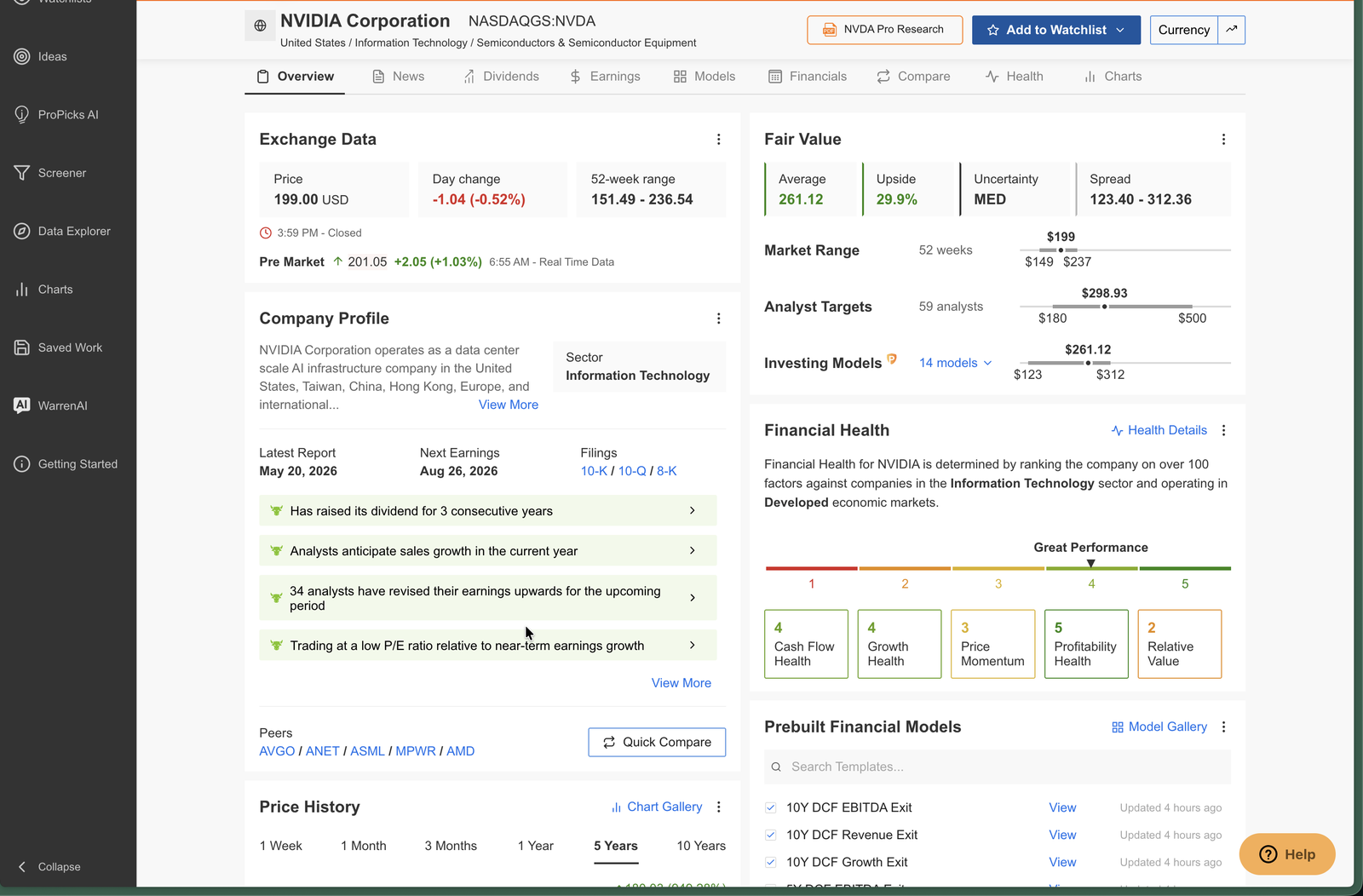
InvestingPro's Fair Value estimate and financial-health checks for NVIDIA.
- Strong global coverage, not US-only
- Fair Value plus AI picks in one place
- Lowest price of the all-in-one tools
- Pricing varies by country and is discount-heavy
- The parent site is ad-heavy
InvestingPro pricing is localised by region, so we do not quote a single global figure, but it is the cheapest of the genuine all-in-one tools here, and our readers get 15 percent off with code MMB, which stacks on any sale. We break down what it actually costs in your market in our full InvestingPro review and pricing guide. Best for cost-conscious investors with globally diversified portfolios who want fair-value estimates and AI ideas without paying terminal prices.
Get Up to 50% Off+ an Extra 15% With Code MMBCode MMB is applied automatically through this link. The extra 15% applies to the reduced price.
3. TipRanks
Best for analyst ratingsTipRanks does one thing better than anyone: it tracks Wall Street analysts and ranks them by how accurate they have actually been, so you can weight a price target by the forecaster's real hit rate rather than taking every "buy" at face value. Its Smart Score distils eight data factors into a single 1-to-10 number, which makes it a quick gut-check before you dig deeper. If your process leans on analyst sentiment and consensus, this is the tool.
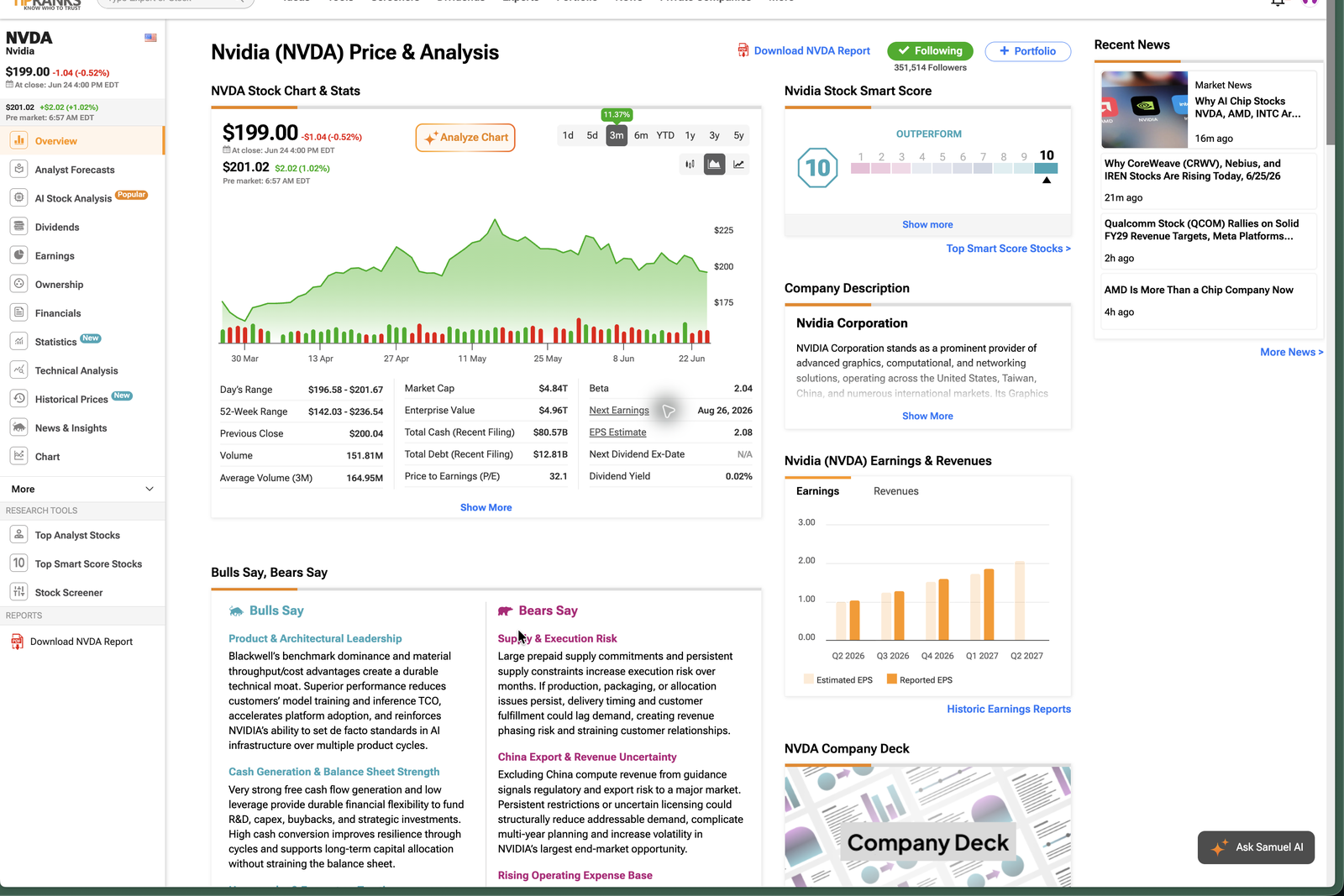
TipRanks scores NVIDIA with its 1-to-10 Smart Score and ranked analyst consensus.
- Analysts ranked by genuine track record
- Smart Score is fast and beginner-friendly
- Broad global stock coverage
- Lighter on deep fundamental modelling
- Billed annually, no true monthly plan
There is a free Basic tier to start, and Premium lists at around $360 a year billed annually, though our exclusive link takes 55 percent off that. We put it head to head with our top pick in Seeking Alpha vs TipRanks, and you can read the full writeup in our TipRanks Premium review. Best for investors who follow analyst ratings and want to know which analysts are worth listening to.
Get 55% off TipRanks Premium
4. Simply Wall St
Best for beginnersSimply Wall St turns a company's financials into a visual report anyone can read, anchored by its signature Snowflake diagram that scores a stock across value, future, past, health and dividend on a single five-point shape. If spreadsheets make your eyes glaze over, this is the friendliest way to understand whether a company is healthy and fairly priced. It also has one of the more usable free tiers here, with broad global coverage.
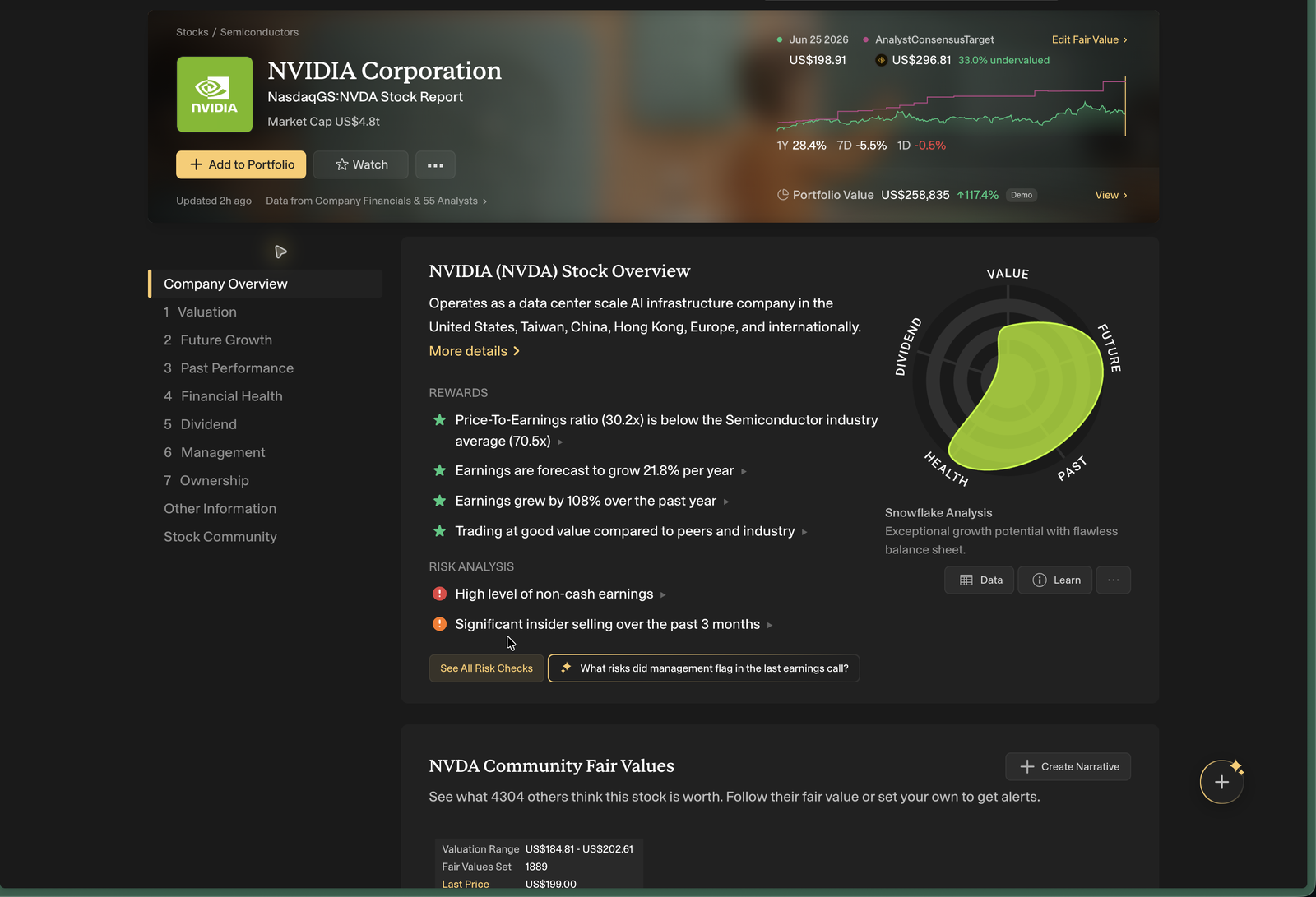
Simply Wall St's Snowflake turns NVIDIA's fundamentals into one readable shape.
- Best-in-class data visualisation
- Beginner-friendly, plain English
- Free tier plus broad global coverage
- Model-driven, can feel surface-level for pros
- No analyst-grade depth or earnings tooling
The free tier covers a handful of company reports a month, which is enough to get a feel for it, and paid plans start at around $131 a year, with a 14-day money-back guarantee. Best for beginner-to-intermediate, long-term investors who want fundamentals explained visually rather than in a wall of numbers. For the full breakdown, see our Simply Wall St review.
Try Simply Wall St free, paid from $131/yr
5. Fiscal.ai
Best for AI and dataFiscal.ai (formerly Finchat) is the AI-first research terminal on this list, and it is fast becoming a financial-data layer in its own right. Its Copilot is trained specifically on financial data, so you can ask something like "compare this company's gross margins to its peers over five years" and get a charted answer with citations back to the actual filing or earnings call. Beyond the terminal it now runs a Data Feed API and an official MCP (Model Context Protocol) server, so you can pipe its verified fundamentals, KPIs and filings straight into AI tools like Claude or ChatGPT, and the same data already powers platforms such as Perplexity and Stock Analysis. It carries unusually deep segment and KPI data too, which makes it our pick when we want to interrogate a business quickly rather than build a model by hand.
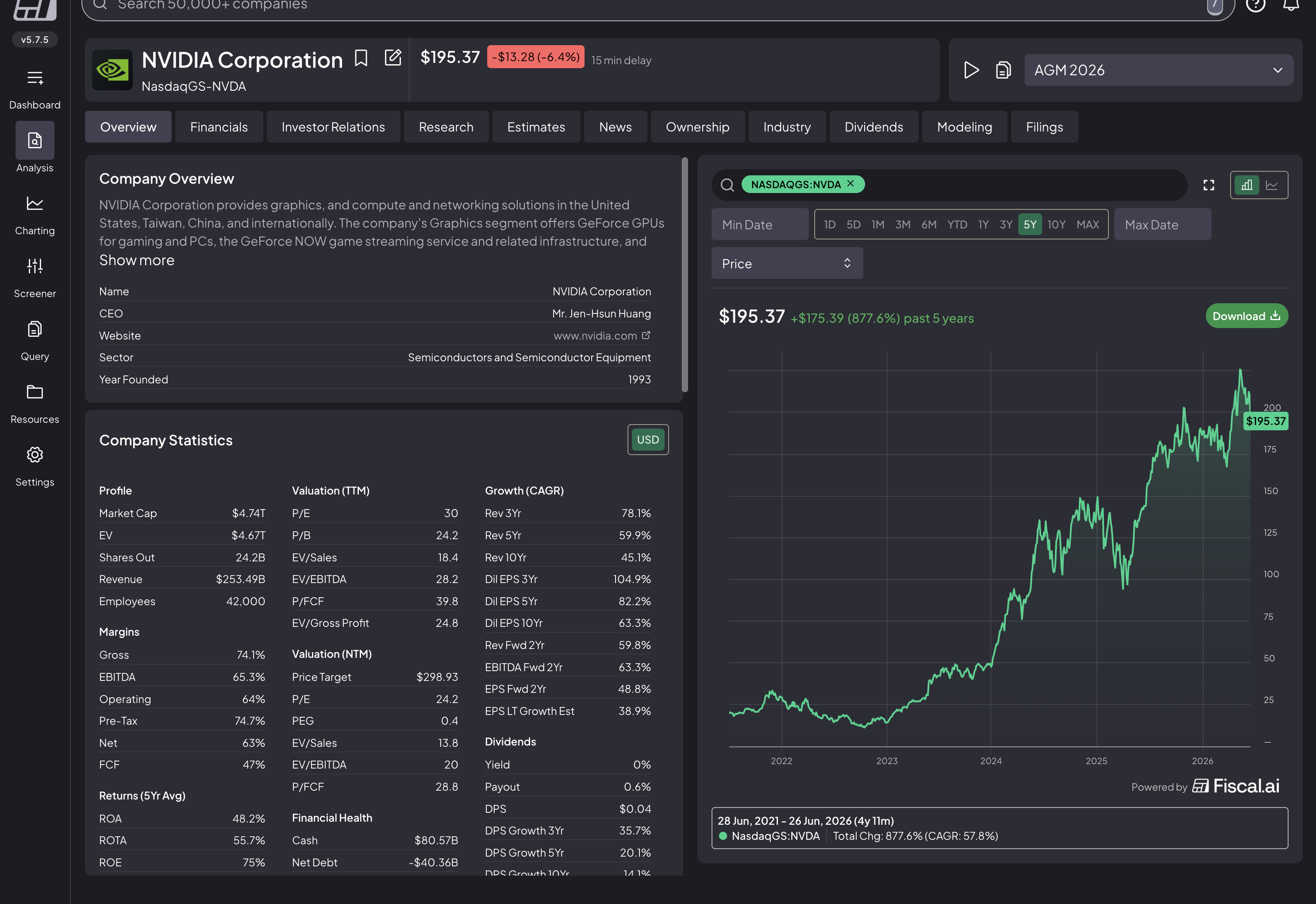
Fiscal.ai pairs deep financials and KPIs with an API and MCP feed into AI tools.
- AI Copilot that cites its sources
- Official MCP server and data API to feed AI tools
- Deep segment and KPI granularity
- Light on charting and technical analysis
- Full value sits behind the paywall
There is a free tier to test it, Pro runs about $39 a month billed annually, and our readers get 15 percent off the first 11 months with code MMB. Full writeup in our Fiscal.ai review. Best for fundamental, long-term investors and analysts who want to question filings and earnings calls fast.
Try Fiscal.ai (15% off with code MMB)
6. Morningstar
Best for funds and ETFsMorningstar is the trusted independent name in research, and it earns its place for one job in particular: funds and ETFs. Its star ratings, Economic Moat and Fair Value estimates are the industry reference, and the Portfolio X-Ray tool shows your true exposure and overlap across every holding, which is useful if you run a multi-fund portfolio. It is the most fund-focused tool here and the only one without a free tier.
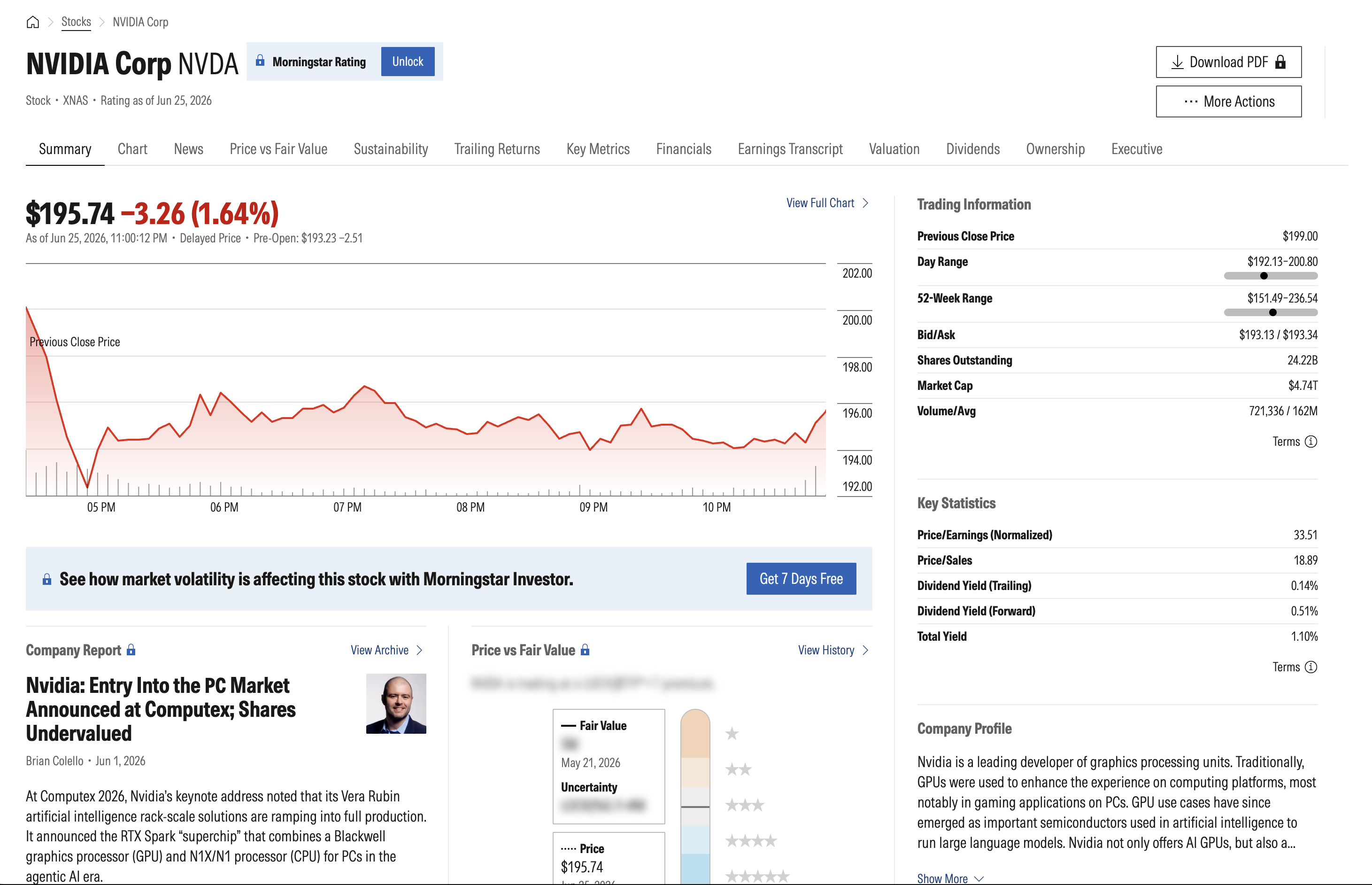
Morningstar's fair-value estimate and independent research view on NVIDIA.
- Trusted, independent ratings with real depth
- Unmatched mutual fund and ETF coverage
- Portfolio X-Ray for diversification checks
- Pricier, and no free tier (trial only)
- Feels fund-centric and less modern than newer tools
Morningstar Investor is around $249 a year with a 7-day trial, and there is no permanent free tier, though its star ratings and fair value still show free on public stock pages without an account. Best for long-term, fund-and-ETF-heavy investors who value independent ratings and want to stress-test how diversified they really are. To compare that fund-first workflow with a stock-first research service, read our Morningstar vs Seeking Alpha comparison.
Get $50 off Morningstar Investor
7. Koyfin
Most data, least polishKoyfin is the closest thing to a Bloomberg terminal a normal investor can afford, and its free tier alone holds more data than some paid tools here. You build your own dashboards combining macro, equities and fundamentals, with strong charting and years of financials and estimates. The trade-off, and the reason it sits last, is the interface: it is dense and busy, and a newcomer can feel buried under panels and numbers before finding the one figure they were after. If you love data and want to design your own cockpit it is superb. If you want something clean and visual, the tools above will suit you better.
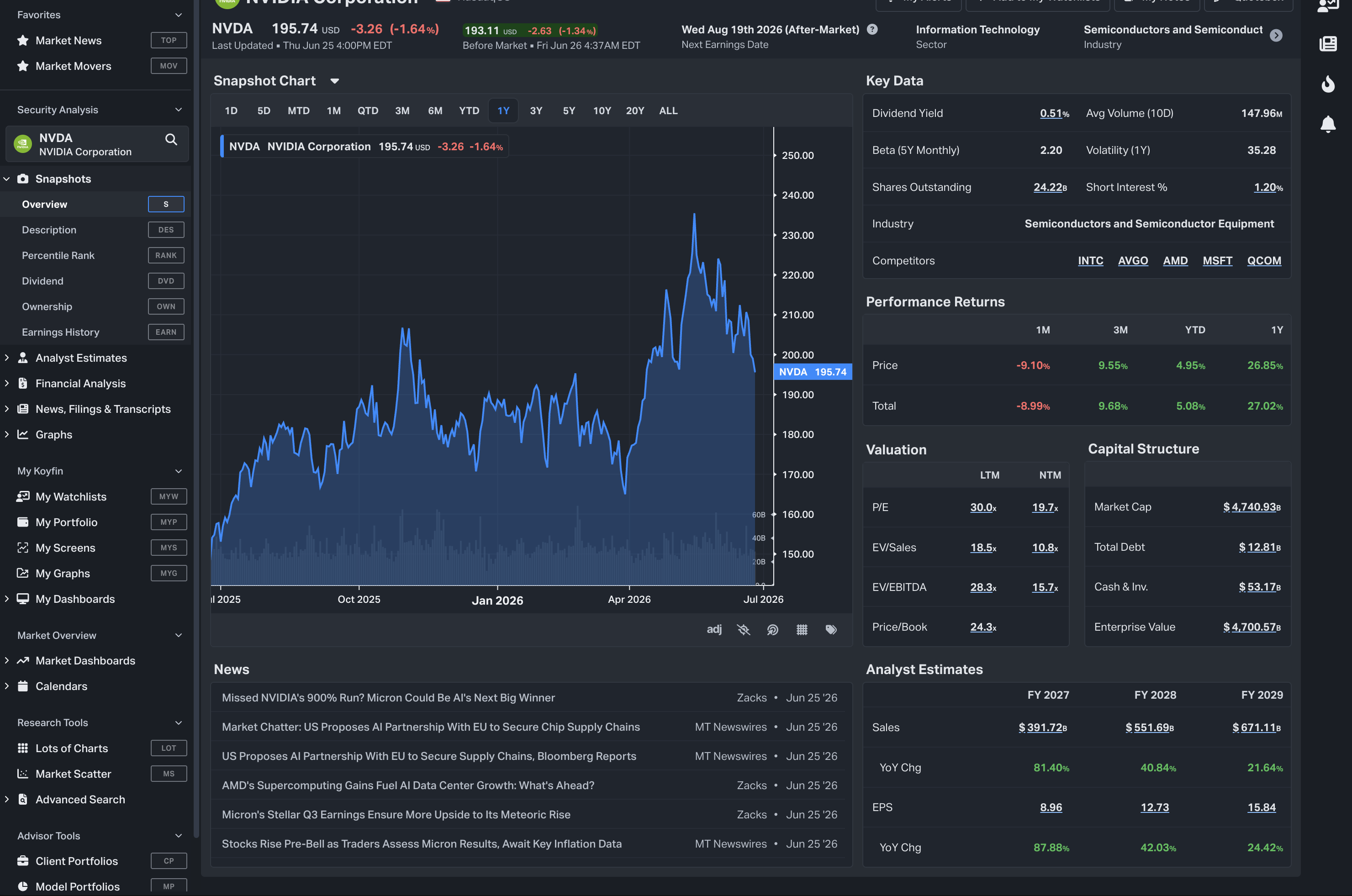
Koyfin packs an enormous amount onto one screen, its strength and, for some, its drawback.
- Near-institutional data at retail prices
- Powerful charting and custom dashboards
- One of the most capable free tiers anywhere
- Cluttered, overwhelming interface
- Steepest learning curve of the seven
Koyfin keeps a genuinely useful free plan, and paid Plus is about $39 a month billed annually, adding ten years of history and full screening. Best for data-hungry power users who want to build their own markets-and-macro dashboard and do not mind a busy screen.
Explore Koyfin free, Plus from $39/moStock analysis tools compared at a glance
The ranking above is our order of merit, but the right tool really depends on the job you need done. This table lines up all seven on the things that tend to decide it: what each is best at, how global its data is, whether there is a free tier, and where standard pricing starts. Prices are the regular annual rates, not seasonal sale prices, so treat them as the baseline and check the live page for the current offer.
| Tool | Best for | Coverage | Free tier | Standard price |
|---|---|---|---|---|
| Seeking Alpha | US: research, ratings and picks | US-focused | Yes | Premium ~$299/yr; Bundle = best value |
| InvestingPro | Global coverage and fair value | Global | Yes (Investing.com) | US annual: $91.29 after MMB |
| TipRanks | Analyst ratings and consensus | Global | Yes | Premium ~$360/yr |
| Simply Wall St | Visual, beginner-friendly analysis | Global | Yes | From ~$131/yr |
| Fiscal.ai | AI research, plus API and MCP | Global | Yes | Pro ~$39/mo billed yearly |
| Morningstar | Funds, ETFs and diversification | Global, fund-focused | Yes (limited) | Investor ~$249/yr |
| Koyfin | Custom dashboards, dense interface | Global | Yes (strong) | Plus ~$39/mo billed yearly |
Best free stock analysis tools
If you are not ready to pay, you still have strong options. Koyfin has the most capable free tier on this list, giving you advanced charting and custom dashboards at no cost. For a dedicated charting platform, see our TradingView review. Simply Wall St lets you analyse a handful of companies a month for free with its visual reports, and Fiscal.ai includes a free tier with limited Copilot access so you can test the AI before committing. Investing.com offers a free basic account alongside InvestingPro, and Morningstar shows its star ratings and fair value on public stock pages without an account. Seeking Alpha also has a free tier, though its Quant ratings and deeper analysis sit behind Premium.
Looking for a Seeking Alpha alternative?
Seeking Alpha is our top pick, but it is not for everyone, and the honest answer is that the best alternative depends on what you found lacking. If you want the same idea of stock scoring but cheaper and more global, InvestingPro is the closest match. If you mainly cared about analyst ratings, TipRanks does that one job better. If Seeking Alpha felt too dense, Simply Wall St is the gentler, more visual option, and if you wanted an AI that can read filings for you, Fiscal.ai is the modern alternative. We compare the research services directly in Seeking Alpha vs TipRanks and Seeking Alpha vs Motley Fool, and if you are weighing picks services specifically, our best stock newsletters roundup goes deeper.
Frequently asked questions
What is the best stock analysis tool in 2026?
For most investors it is Seeking Alpha, because it combines deep research, A-to-F Quant ratings and a track-recorded picks service in one platform. That said, the best tool depends on your style: InvestingPro for global fair-value analysis, TipRanks for analyst ratings, Simply Wall St for visual beginners, Fiscal.ai for AI research, and Koyfin for building your own dashboard.
Are there free stock analysis websites?
Yes. Koyfin has the strongest free tier for charting and dashboards, Simply Wall St offers free visual reports for a handful of companies a month, and Fiscal.ai includes a free tier with limited AI access. Morningstar shows star ratings and fair value on public stock pages without an account, and Investing.com has a free basic tier alongside InvestingPro.
What is the best free stock research tool?
Koyfin, by a clear margin. Its free plan gives you custom dashboards, strong charting and a global screener that outclasses some paid tools, which is why it earns a place here despite paying us nothing. Simply Wall St is the runner-up if you prefer visual, plain-English company reports.
Is Seeking Alpha worth it?
For self-directed investors who research individual stocks, yes, particularly the Bundle, which pairs the Premium research and Quant ratings with the Alpha Picks service for less than buying them separately. We cover this in depth in our Seeking Alpha review.
Which stock analysis tool is best for beginners?
Simply Wall St, because it turns financials into a visual report that is easy to read without a finance background. Morningstar is a strong second if you mostly hold funds and ETFs.
What do professional investors use?
Power users tend to favour Koyfin for its customisable, terminal-style dashboards and Fiscal.ai for fast, cited AI research on filings and earnings calls. Many also keep a Seeking Alpha subscription for the Quant ratings and analysis.
How did we choose these tools?
We ran the same research tasks on each platform from our own accounts, judging data depth and accuracy, global coverage, ease of use and value for money. Some links in this article earn us a commission, which we disclose below, but it did not affect the ranking.
The verdict
If you want one platform that does the most, Seeking Alpha is the pick, and the Bundle is the best-value way to use it. From there, choose by need: InvestingPro for global fair value, TipRanks for analyst ratings, Simply Wall St for a visual start, Fiscal.ai for AI-led research, Koyfin for a custom dashboard, and Morningstar for funds and long-term portfolios. The good news is that almost all of them have a free tier or trial, so you can test before you commit.
Kai is an investor who helps people choose the right broker and invest with confidence. He founded MatchMyBroker, a broker-comparison site for a global audience, and EU Investing Hub, his European-focused investing site. He also runs the Smart Money with Kai YouTube channel, where he breaks down investing, brokers and personal finance.
Advertising disclosure: we may earn a commission from Seeking Alpha, InvestingPro, TipRanks, Simply Wall St and Fiscal.ai if you subscribe through our links, at no extra cost to you. Prices and discounts are verified at the time of writing but change over time, so confirm the current figure on each provider's page before subscribing.
.png)

