Seeking Alpha vs Simply Wall St: 2026 Investor Guide



Seeking Alpha and Simply Wall St approach stock research from opposite directions. Seeking Alpha, founded in 2004, combines contributor analysis with quantitative ratings: you read authors argue opposing cases on a stock, then check those arguments against Quant Ratings and Factor Grades covering about 5,600 stocks. Simply Wall St turns raw financial data into standardized visual reports on more than 120,000 stocks across more than 90 markets, with a five-axis Snowflake summarizing each company at a glance.
Our position is direct. Active investors focused on US-listed stocks get more from Seeking Alpha because of its research depth, its quantitative ratings, and the Alpha Picks selection service. Globally diversified investors who prefer visual analysis and portfolio-level oversight get more from Simply Wall St. This guide compares pricing verified on 23 July 2026, feature differences, drawbacks, and one specific workflow where paying for both can make sense.

What Seeking Alpha does
Seeking Alpha is a research platform where contributors publish analysis on individual stocks, funds, and market themes. Its defining value is disagreement: on widely covered names you can read one author's bull case next to another author's bear case and weigh the evidence yourself. We examine the platform in depth in our full Seeking Alpha review, so this section stays with the essentials.
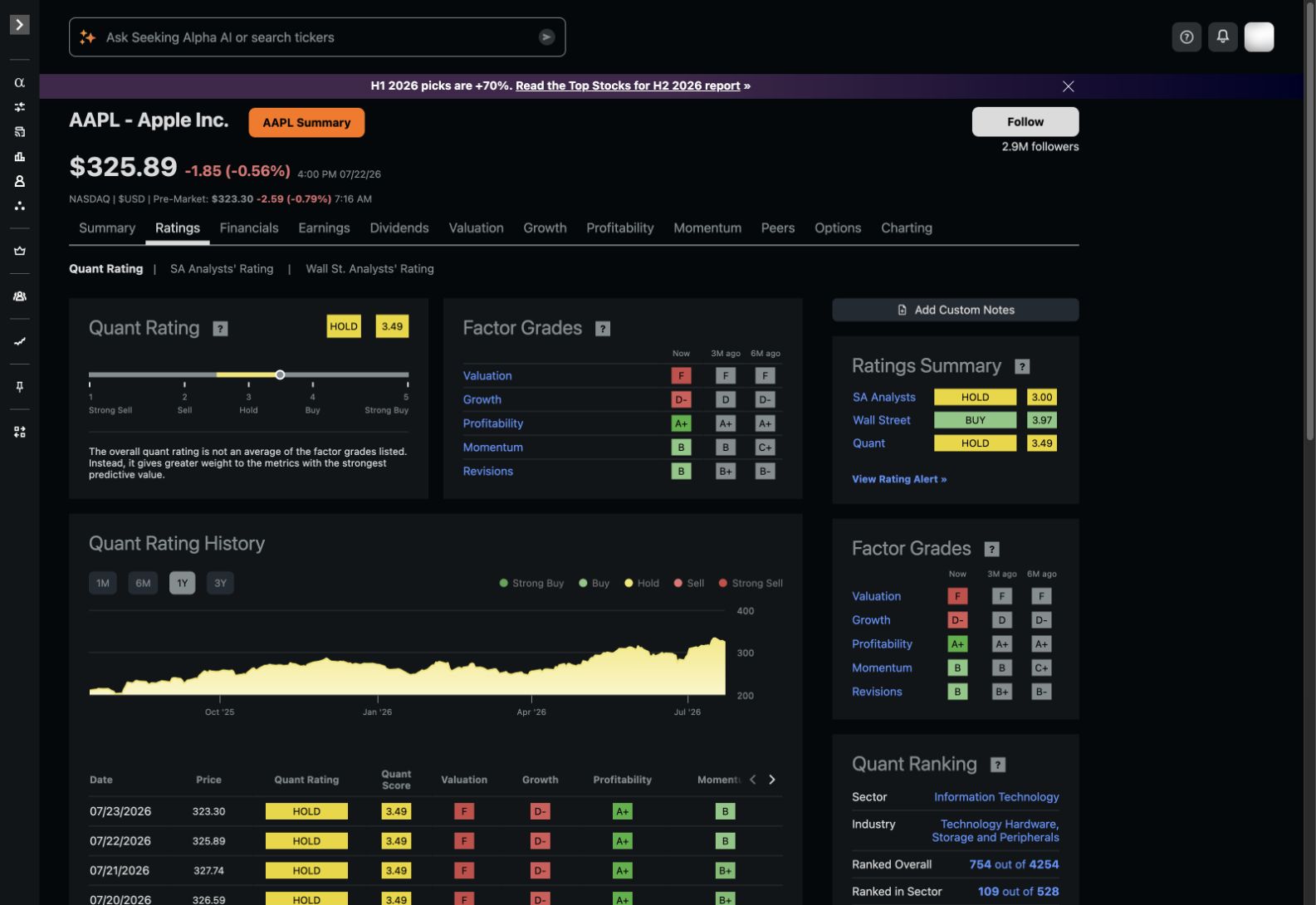
The quantitative layer balances the opinion layer. Quant Ratings and Factor Grades cover about 5,600 stocks and grade each one on five factors: Valuation, Growth, Profitability, Momentum, and EPS Revisions. The system does not cover stocks listed on foreign exchanges, a limitation that matters for internationally diversified readers and returns later in this comparison.
Premium is the core subscription. As verified on 23 July 2026, it costs $269 for the first year against a $299 list price and includes a 7-day trial for new subscribers. Premium unlocks full access to contributor articles, Quant Ratings and Factor Grades, earnings call transcripts, and Wall Street analyst information.
Alpha Picks is a separate product: a published stock-selection service driven by a quantitative process. It releases two new selections per month, normally on the first trading day of the month and on the 15th or the closest trading day. Its documented eligibility rules restrict the universe to US common stocks, exclude ADRs and REITs, and require a market capitalization above $500 million and a share price above $10. It costs $449 per year against a $499 list price. Our Alpha Picks review explains how the service runs in practice.
The Premium and Alpha Picks Bundle packages both products for $629 in the first year. The current separate list prices are $299 for Premium and $499 for Alpha Picks, or $798 combined, so the first-year Bundle saves $169 against those list prices. After the first year, the components renew separately at their then-current list prices, a detail worth knowing before you commit. Our Seeking Alpha Bundle review weighs whether the pairing fits your situation.
Seeking Alpha also sells Pro at $89 for the first month, then $2,149 for the first annual term. It subsequently renews at Seeking Alpha's then-current annual list price, currently $2,400, unless cancelled. Pro is a specialized, high-cost research product aimed at a narrow professional audience. It is not the natural next step after Premium, and we do not recommend it to beginners. Our Seeking Alpha Pro review covers who it serves.
What Simply Wall St does
Simply Wall St converts financial statements into standardized visual company reports. The platform reports 7 million investors and covers more than 120,000 stocks across more than 90 markets, using financial data from S&P Global Market Intelligence. That breadth is its defining feature: the same analytical framework applies whether a company trades in New York, Frankfurt, or Tokyo. Our Simply Wall St review examines the platform in full.
The centerpiece is the Snowflake, a visual summary scoring each company on five criteria: Valuation, Future Growth, Past Performance, Financial Health, and Dividend. Each criterion contains six individual checks, so a full report reflects 30 checks in total. Simply Wall St states that the Snowflake is not a buy or sell recommendation, and we agree with that framing: treat it as a fast visual summary of the fundamentals rather than a verdict.
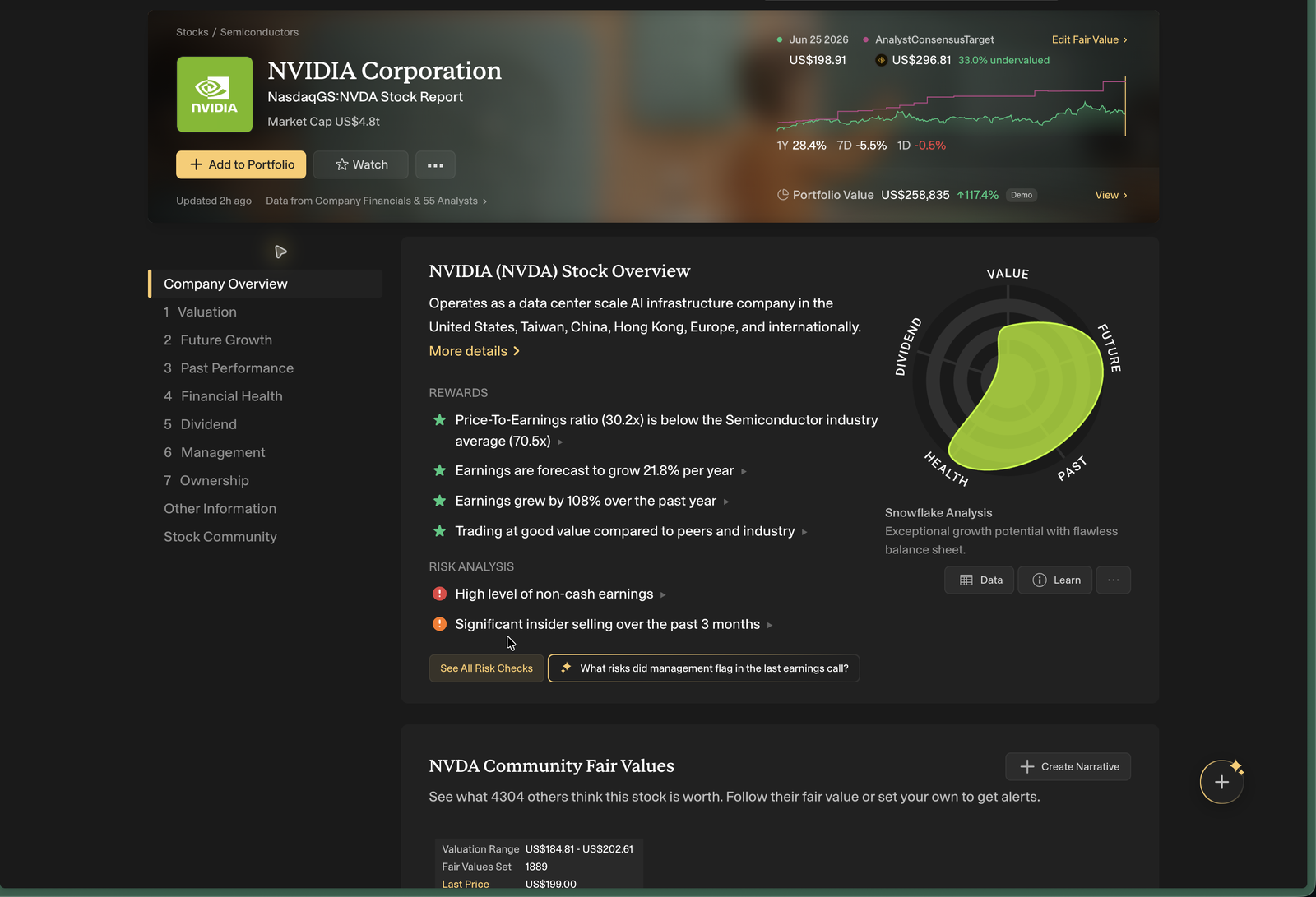
Beneath the Snowflake sits a valuation engine that uses both intrinsic and relative methods, with four model variations chosen to fit the company and the available data: a two-stage DCF, a Dividend Discount Model, an Excess Returns Model, and a two-stage AFFO DCF for REITs. We return to these models in the valuation section below.
Three plans exist. Free includes five company reports per month, one standard portfolio with ten holdings, five watchlists, and limited screener access, without broker synchronization, AI Chat, or Excel and PDF export. Premium raises the limits to 30 reports per month, three advanced portfolios with 30 holdings each, 20 watchlists, and ten saved screeners with alerts, and adds broker synchronization and AI Chat, though Excel and PDF export remain excluded. Unlimited removes the caps and adds the export features. You can try Simply Wall St on the Free plan before spending anything.
Seeking Alpha vs Simply Wall St at a glance
The two platforms overlap less than a surface comparison suggests. The main dimensions:
- Coverage: Simply Wall St analyzes more than 120,000 stocks across more than 90 markets. Seeking Alpha's Quant Ratings cover about 5,600 stocks and exclude foreign-exchange listings.
- Research style: Seeking Alpha pairs competing human analysis with quantitative grades. Simply Wall St applies one standardized visual model to every company.
- Valuation: Seeking Alpha grades Valuation as one of five Quant factors and lets contributors debate it. Simply Wall St builds explicit fair-value models whose assumptions you can inspect.
- Portfolio tools: Simply Wall St offers portfolio-level analysis, including returns, dividends, currency impact, and diversification. Seeking Alpha centers on researching individual stocks.
- Community and debate: Seeking Alpha's contributor base produces competing viewpoints. Simply Wall St produces consistent output with little editorial voice.
- Stock selections: Alpha Picks gives Seeking Alpha a published selection service. Simply Wall St has no equivalent.
- Pricing: Simply Wall St's paid tiers cost less at the offers verified on 23 July 2026. Full numbers appear in the pricing section.
Research depth and idea generation
Seeking Alpha's strongest asset is the ability to read different authors making bull and bear cases on the same company. That structure forces you to confront the counterargument to your own thesis, something a single-voice research tool cannot do. The Quant Ratings then serve as an unemotional cross-check: when the written analysis leans bullish but the Factor Grades flag weak Profitability or negative EPS Revisions, you know where to dig next.
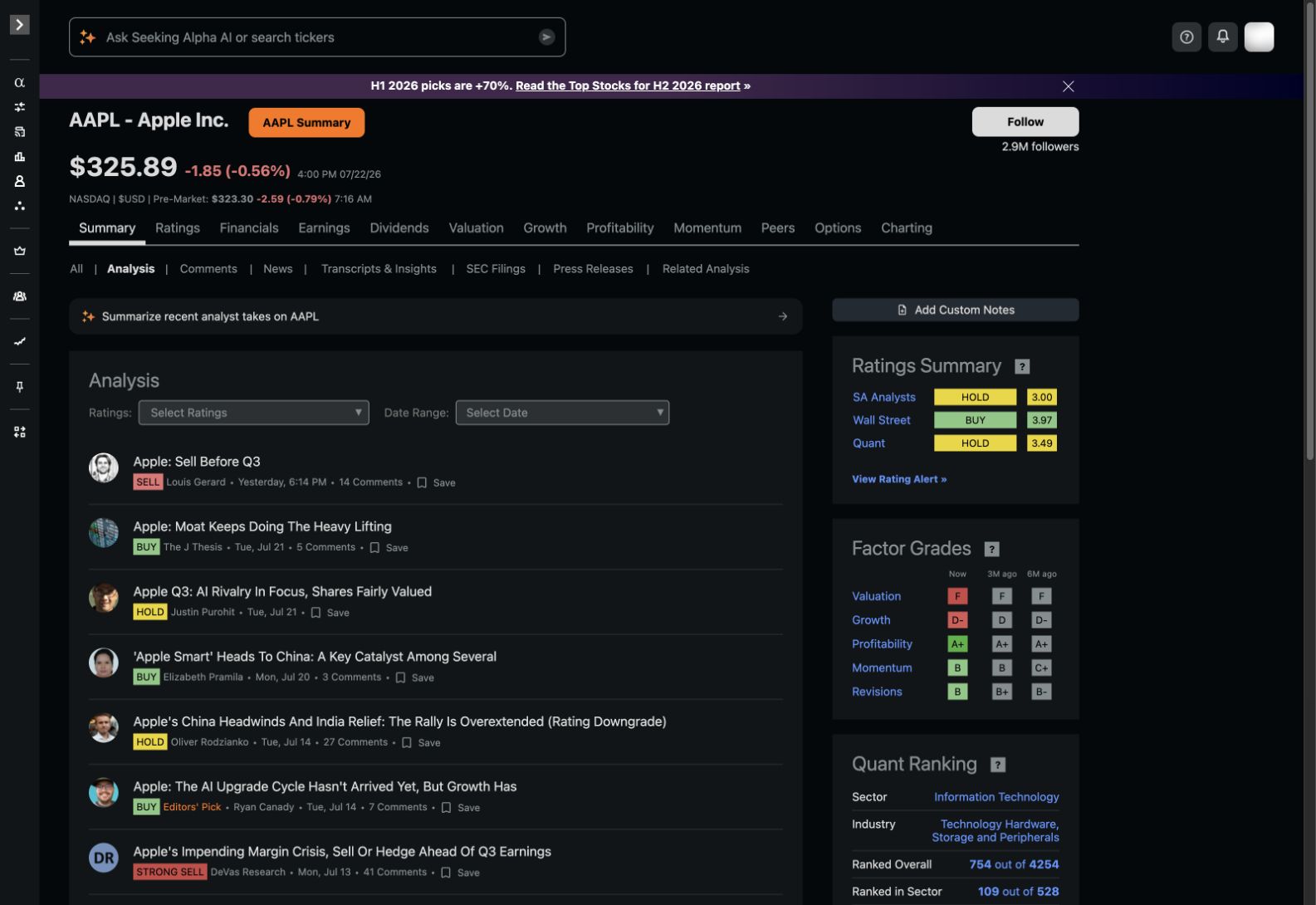
The volume cuts both ways. In a January 2026 community discussion, investors described Seeking Alpha as useful for investment analysis and opinion, while others in the same thread said the flow of opinions can feel noisy. Both observations ring true. The platform rewards readers who filter contributors deliberately and track whose reasoning holds up over time.
Simply Wall St generates ideas from the data side. Screeners and standardized reports make it fast to scan a market for companies passing specific fundamental checks, and a February 2026 community discussion described it as working well as a rapid quantitative check before deeper qualitative research. An April 2026 discussion drew the matching limitation: useful for quick fundamentals, less helpful for broader qualitative or macro context. Neither platform replaces reading company filings or checking the assumptions behind a valuation.
Stock selections and implementation
Alpha Picks is the clearest structural difference between the platforms. Simply Wall St helps you build your own shortlist. Alpha Picks publishes specific selections, chosen by a quantitative process, on a fixed schedule of two per month. Simply Wall St offers nothing comparable.
In the Since Inception view, starting 1 July 2022, the live Alpha Picks performance page showed a total return of 319.19% versus 102.18% for the S&P 500. Past performance does not guarantee future results, and this record should not be read as a likely future outcome.

Recent subscriber discussions show mixed individual outcomes. Some subscribers reported strong results, while others described weaker recent cohorts, uncomfortable volatility, and uncertainty about position sizing or whether to buy every selection. Individual results shared online are not representative of the service, and they surface a practical point: a published list still leaves implementation with you, including entry timing, position size, and exit discipline. Alpha Picks is a published selection service based on a quantitative process, not personalized advice, and you remain the decision maker. Our Alpha Picks review covers the mechanics in detail.
Global coverage
For investors holding stocks outside the United States, coverage often decides the choice on its own. Simply Wall St applies the same 30-check framework across more than 120,000 stocks in more than 90 markets, so a mid-cap in Frankfurt or Tokyo gets the same treatment as a US large cap.
Seeking Alpha's quantitative layer is far narrower. Quant Ratings and Factor Grades cover about 5,600 stocks and do not cover stocks listed on foreign exchanges, and Alpha Picks selects exclusively from US common stocks under its documented rules. If most of your portfolio trades outside the US, the features that justify Seeking Alpha's price will touch only a fraction of your holdings, and Simply Wall St becomes the more useful daily tool.
Portfolio analysis
Simply Wall St treats the portfolio, not just the single stock, as a unit of analysis. Its portfolio tools can show returns, realized and unrealized gains, dividends, currency impact, annualized returns, fundamental analysis, and diversification. For investors holding positions in several currencies, the currency-impact view answers a question most tools ignore: how much of the return came from the assets and how much from exchange rates. Broker linking is available on Premium and Unlimited, not on Free.
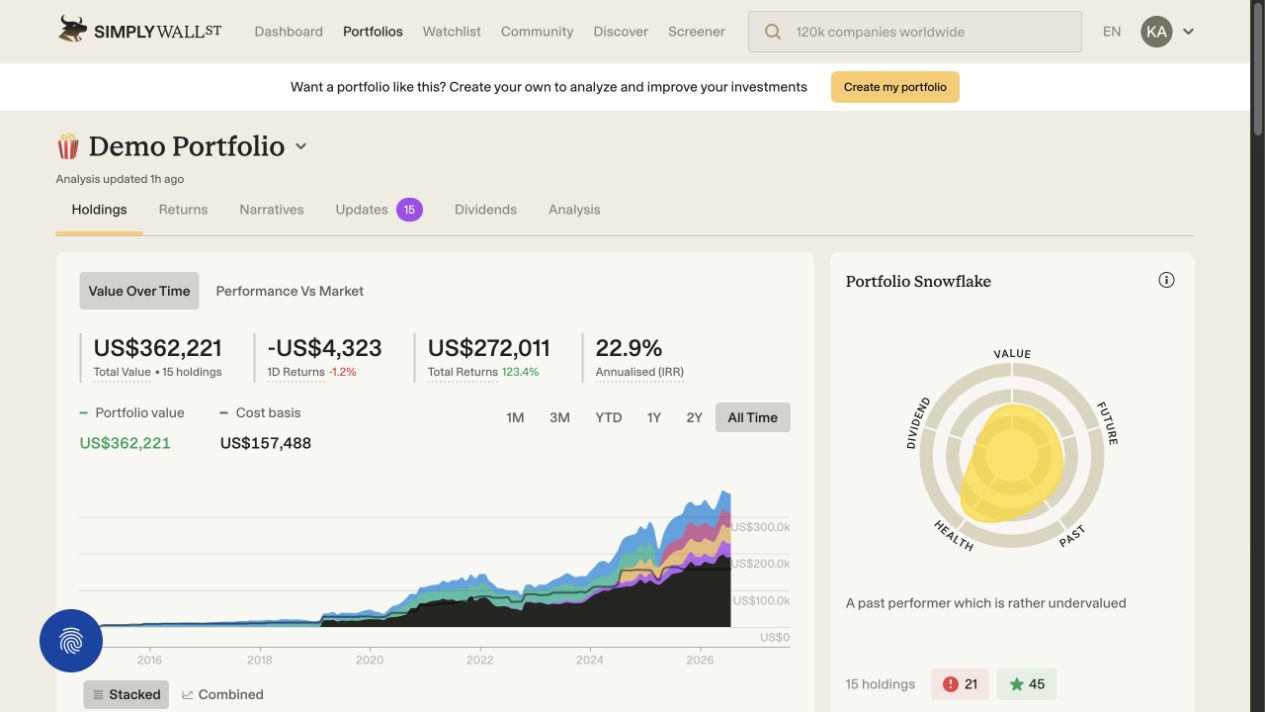
Seeking Alpha runs a research-first workflow. You investigate companies one at a time, maintain watchlists, and read analysis, but the platform is not built around portfolio-level visual analytics in the same way. For readers who want a recurring health check on the whole portfolio, this is Simply Wall St's clearest advantage.
Valuation methodology
Simply Wall St's fair-value work uses both intrinsic and relative valuation methods, with four model variations selected to fit the company and the available data: a two-stage DCF, a Dividend Discount Model, an Excess Returns Model, and a two-stage AFFO DCF for REITs. Matching the model to the business type produces more sensible output than forcing one generic DCF onto every company, and it is a reason to read the valuation section rather than dismiss it as automated.
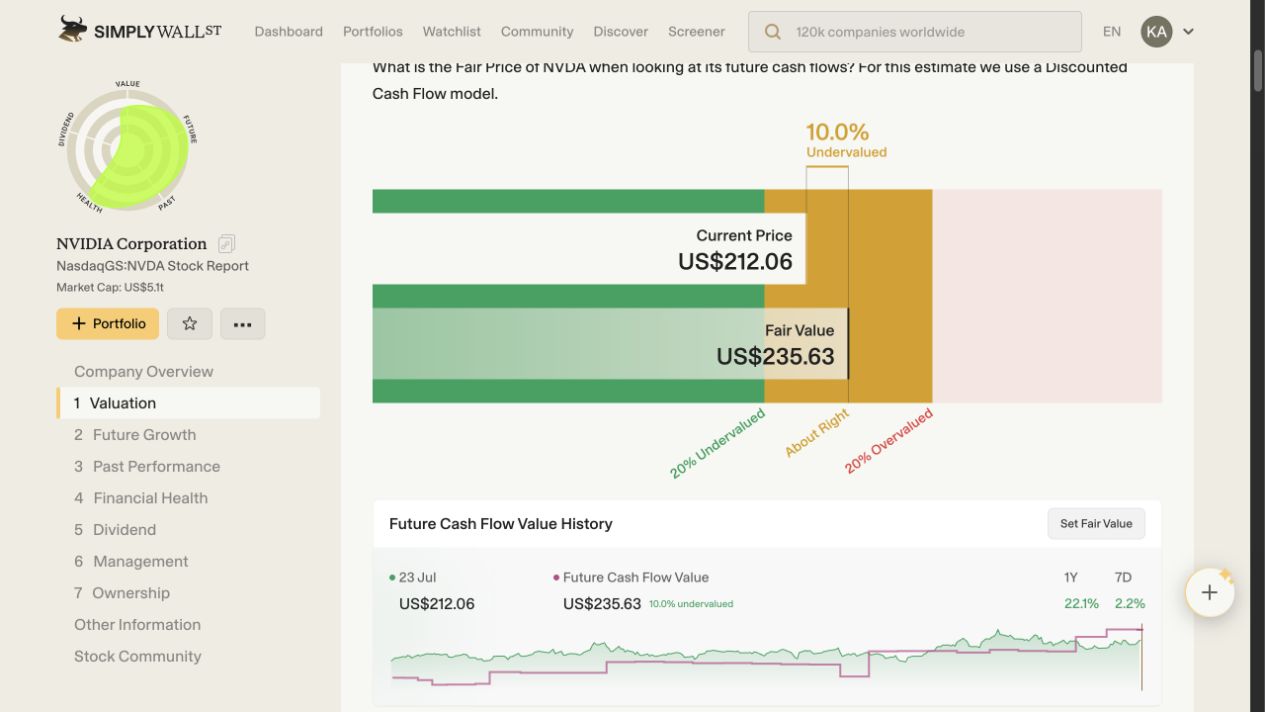
The standard caveat applies with full force: model output depends on model assumptions. Growth and discount-rate inputs move fair value materially, and a standardized system cannot know what you know about a company's competitive position. Check the assumptions before acting on a fair-value gap. On Seeking Alpha, valuation appears as one of the five Quant factors and as a recurring subject of contributor debate, which gives you interpretation and context rather than one standardized model.
Pricing and value
Every price below is a current offer we verified on 23 July 2026, and offers can change at any time. Both platforms use introductory first-year pricing, so a fair comparison needs two numbers: what you pay now and what the displayed regular rate implies later.
On the Seeking Alpha side, Premium costs $269 for the first year against a $299 list price, with a 7-day trial for new subscribers. Alpha Picks costs $449 for the first year against a $499 list price. The Bundle combines both for $629 in the first year, saving $169 against the current combined list prices of $798, and after year one the components renew separately at their then-current list prices. Our guide to Seeking Alpha plans compared walks through the tiers, and we track current Seeking Alpha pricing and discounts as offers move.
On the Simply Wall St side, Premium costs $65.70 for the first year, with a displayed regular rate of $10.95 per month billed annually, equivalent to $131.40 per year. Unlimited costs $129 for the first year, with a displayed regular rate of $21.50 per month billed annually, equivalent to $258 per year. Two billing details deserve attention: Simply Wall St sells annual subscriptions only, and new subscribers get a 14-day money-back guarantee with no refunds beyond that window. A canceled subscription stays active until the end of the paid billing period.
At both the first-year offers and the displayed later rates, Simply Wall St's paid tiers sit well below Seeking Alpha's. That gap only matters if the cheaper tool does the job you need. A US-focused active researcher saves nothing by buying the tool built for global screening, and a globally diversified investor gains little from paying more for US-centric research depth.
Drawbacks of each platform
Seeking Alpha's drawbacks follow from its design. The contributor volume that creates choice also demands filtering, and some readers find the flow of opinions noisy rather than useful. The quantitative layer excludes foreign-exchange listings, which limits its value for internationally diversified portfolios. The annual cost is meaningful, and for a small portfolio the subscription is hard to justify regardless of research quality.
Simply Wall St's main limitation is depth. The standardized model improves consistency, but it can feel shallow when you need industry context, management analysis, or competing interpretations of the same numbers. Its outputs also depend on assumptions you should verify yourself. Two smaller frustrations: Premium excludes Excel and PDF export, which is reserved for Unlimited, and annual-only billing means you commit for a year once the 14-day refund window closes.
Who should choose Seeking Alpha
Choose Seeking Alpha if most of these describe you:
- You invest mainly in US-listed stocks.
- You research actively and prefer reading full analysis over skimming dashboards.
- You want bull and bear cases on the same stock before committing capital.
- You want Quant Ratings as a systematic cross-check on your own judgment.
- You are considering Alpha Picks and want research and selections in one place.
Skip it if your portfolio holds mainly non-US listings, if high article volume sounds draining, if you prefer a visual-first workflow, or if your portfolio is too small to justify the annual cost.
Who should choose Simply Wall St
Choose Simply Wall St if these fit:
- You hold stocks across several markets and want one consistent analytical view.
- You process information visually and want fundamentals summarized at a glance.
- You want a rapid first-pass screen before committing time to deeper research.
- You manage positions in more than one currency and care about currency impact.
- You value portfolio-level analysis, diversification views, and broker synchronization.
Look elsewhere if you need deep qualitative debate, detailed US earnings commentary, or a curated selection service. Simply Wall St is a screening and monitoring tool, and it works best when you treat it as one.
Is paying for both reasonable?
Sometimes, in one specific setup: Seeking Alpha for US research and Simply Wall St for international screening and portfolio review. In that workflow you read competing analysis and Quant Ratings on your US positions, follow Alpha Picks if you subscribe to it, and use Simply Wall St to screen non-US markets and monitor the whole portfolio, including currency impact and diversification.
The cost is concrete. At these first-year prices, the Seeking Alpha Bundle at $629 plus Simply Wall St Premium at $65.70 totals $694.70. At today's displayed later rates, the Bundle components would total $798 and Simply Wall St Premium $131.40, or $929.40 combined, and future renewal prices can change. We treat the two-tool setup as an optional workflow for investors who have both jobs to do, not as the default choice. If your portfolio lives mostly in one region, one subscription is enough.
Alternatives worth considering
If the Seeking Alpha model appeals to you but you want to compare it against other research services before deciding, we have written detailed comparisons of Seeking Alpha versus TipRanks and Seeking Alpha versus Motley Fool. Each weighs a different style of research service against the platform covered here.
Frequently asked questions
Is Seeking Alpha or Simply Wall St better for beginners?
Simply Wall St is the gentler entry point. The visual reports summarize fundamentals without requiring you to evaluate competing written arguments, and the Free plan lets you learn the format at no cost. Seeking Alpha rewards experience, because the contributor debate is most useful once you can judge the quality of an argument. Beginners should also weigh either annual fee against the size of their portfolio.
Does Simply Wall St provide stock picks?
No. Simply Wall St has no curated selection service. Its screeners and company reports help you build your own shortlist, and the Snowflake is a visual summary of fundamentals, not a buy or sell recommendation. Investors who want published selections would need something like Alpha Picks on the Seeking Alpha side.
Does Seeking Alpha Premium include Alpha Picks?
No, they are separate subscriptions. As verified on 23 July 2026, Premium costs $269 for the first year, Alpha Picks costs $449 for the first year, and the Bundle combines both for $629 in the first year, with components renewing separately at then-current list prices after year one.
Which platform covers international stocks better?
Simply Wall St, by a wide margin. It covers more than 120,000 stocks across more than 90 markets. Seeking Alpha's Quant Ratings cover about 5,600 stocks and do not cover foreign-exchange listings, and Alpha Picks selects only US common stocks.
Can you use Simply Wall St for free?
Yes. The Free plan includes five company reports per month, one standard portfolio with ten holdings, five watchlists, and limited screener access. It excludes broker synchronization, AI Chat, and Excel and PDF export, which sit in the paid tiers.
Is the Simply Wall St Snowflake a buy or sell recommendation?
No, and Simply Wall St says so itself. The Snowflake is a visual summary of five criteria (Valuation, Future Growth, Past Performance, Financial Health, and Dividend), each built from six underlying checks. Use it to decide where to look closer, then verify the assumptions behind the scores.
Is it worth paying for both Seeking Alpha and Simply Wall St?
Only when you have two distinct jobs: deep US research on one side and international screening plus portfolio monitoring on the other. At these first-year prices, the combination costs $694.70 in the first year and $929.40 at today's displayed later rates, and renewal prices can change. For a single-region portfolio, pick one.
Conclusion
Neither product wins outright, because they solve different problems. Seeking Alpha is the stronger fit for active, US-focused investors who want competing human research, Quant Ratings, and the option of a published selection service through Alpha Picks. At the current offer, the Bundle at $629 for the first year is the natural entry point for that profile, and our Seeking Alpha Bundle review covers the package in detail.
Simply Wall St is the stronger fit for global investors who prefer visual quantitative analysis, transparent valuation models, and portfolio oversight across markets and currencies. The Free plan costs nothing to test, so you can try Simply Wall St and upgrade only if the workflow earns its place.
And if the bigger open question is where to hold your investments in the first place, our BrokerMatch tool helps you shortlist brokers that fit your country and investing profile.
Kai is an investor who helps people choose the right broker and invest with confidence. He founded MatchMyBroker, a broker-comparison site for a global audience, and EU Investing Hub, his European-focused investing site. He also runs the Smart Money with Kai YouTube channel, where he breaks down investing, brokers and personal finance.