
How to Research a Stock Before You Buy It



Most bad investments start the same way: someone buys a stock because it is going up, or because a video told them to, and they have no idea what to do when it drops. The fix is a research process you run every time, so that when you buy, you know exactly why. This is the checklist I use before I put real money into any stock, written so you can copy it.
Start with the business, not the chart
I am a long-term investor, so I am not trying to time entries or read candlestick patterns. Plenty of people sell courses on that. If it worked as well as they claim, they would be trading, not selling courses. What matters is the company underneath the ticker. Are revenues growing? Are profits growing? Does the business have a moat, something that makes it hard to copy? ASML is the textbook example: it is the only company in the world making the machines that print the most advanced chips. A new milk brand is not hard to compete with. A company like that is.
So the first question is never "what is the price doing" but "is this a good business that is getting better."
Where to find the data
Your broker app is a fine place to start, and a free tool like Yahoo Finance covers the basics. You can even ask an AI like ChatGPT or Claude, and I do use AI later in my process, but on its own it is clunky when you want to compare twenty companies the same way every time, and it cannot give you proper analysis on demand. What you want is one dashboard that pulls the numbers, the ratings and the analyst views into the same view for every company.
I have used TipRanks, Simply Wall Street and Investing.com, and they are all decent. The one I keep coming back to for US stocks is Seeking Alpha. The table below is roughly how I think about free tools versus a paid research platform.
The three checks I run on every stock
Once I have a company in front of me, the decision comes down to three questions. This is the core of the whole process.
1. The rating: is the data on its side?
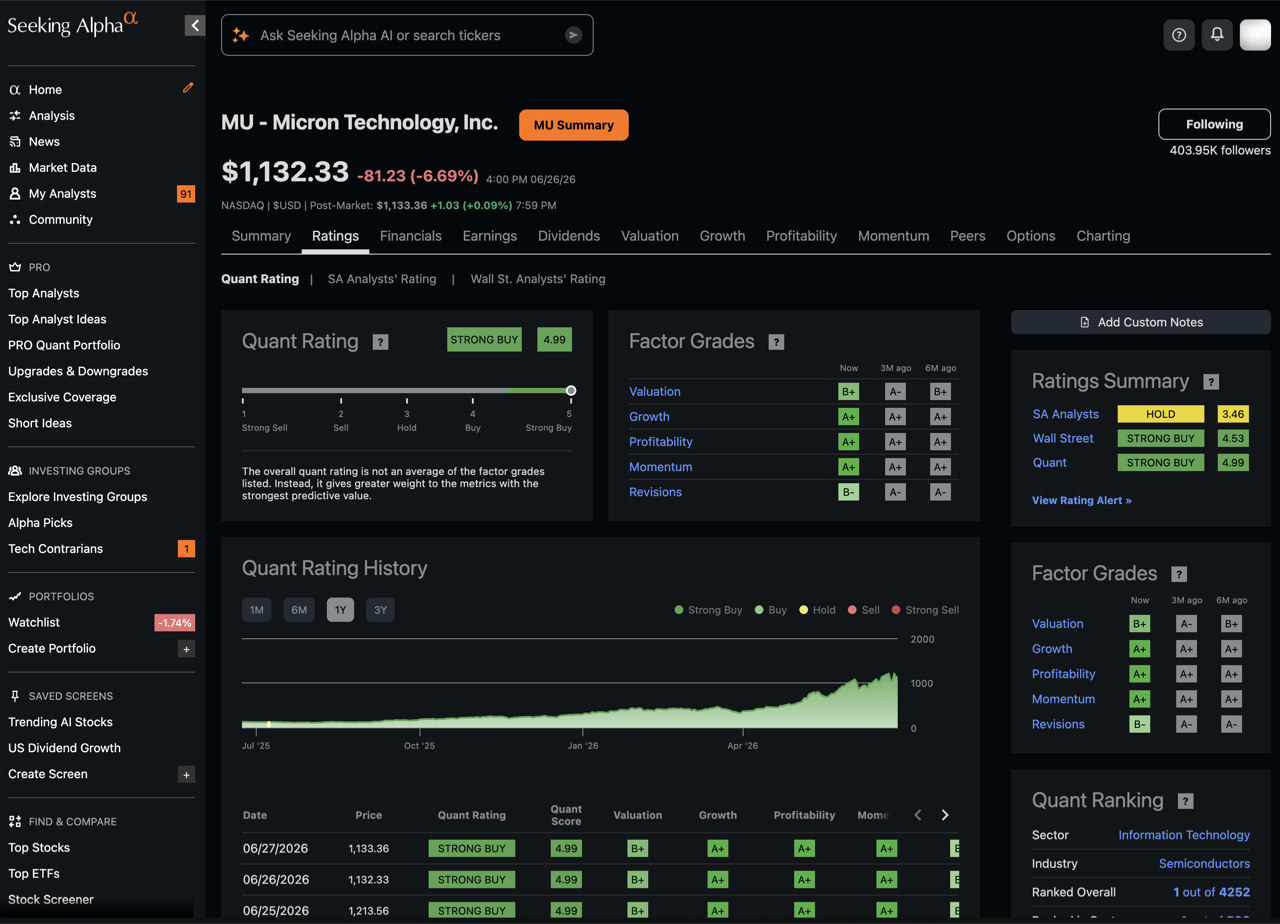
Seeking Alpha pulls three views into one summary: its own analysts, Wall Street, and the Quant rating. The Quant rating is a data-driven score across valuation, growth, profitability and momentum, and it is the one I lean on most because it is rules-based rather than opinion. I also set an alert so I am notified if the rating changes after I buy.
2. The price: am I overpaying?
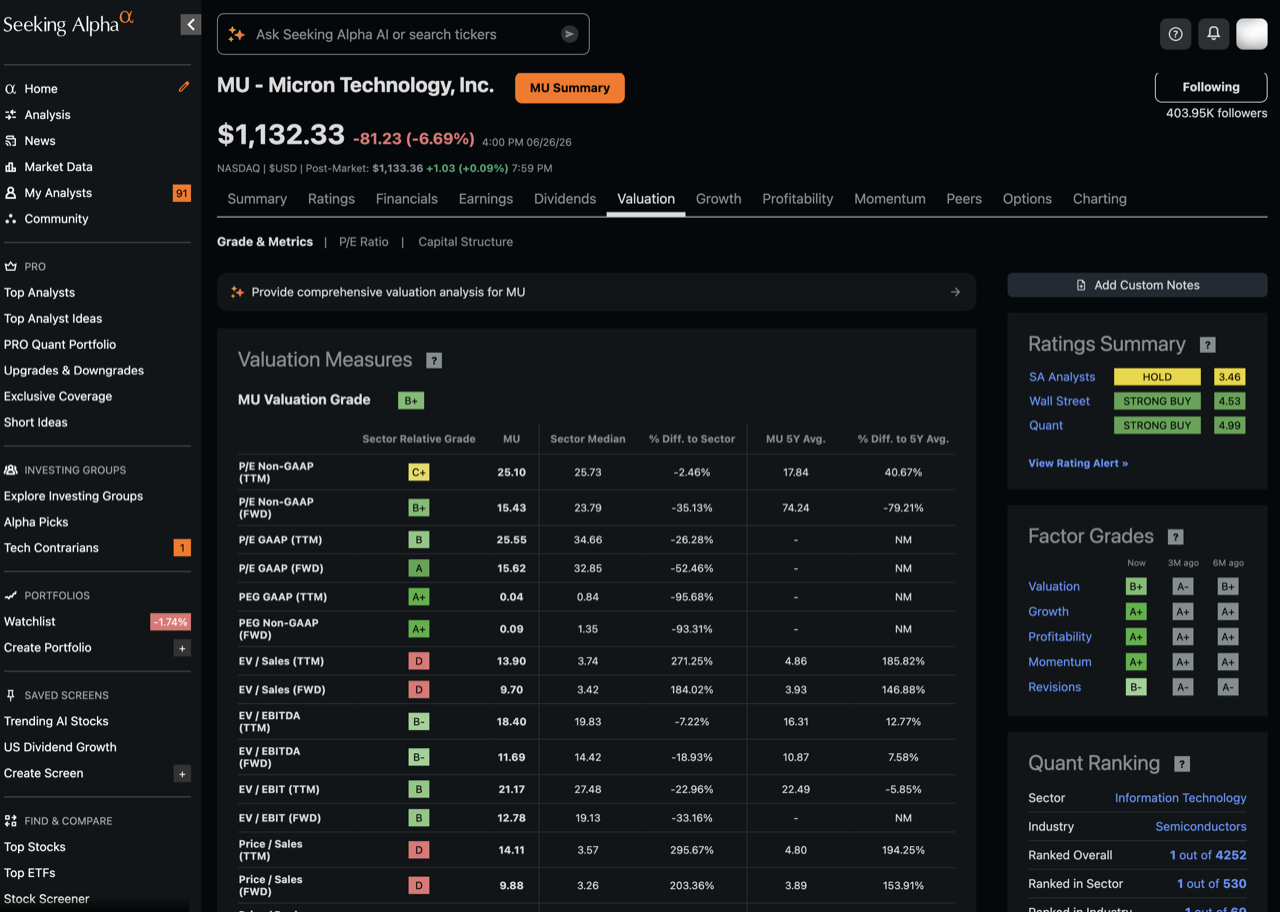
A great company can still be a poor investment if you pay too much. I look at the forward P/E to judge how much I am paying for the earnings, then compare it to the sector so the number has context. The factor grades for valuation, growth and profitability give a quick read here, colour-coded so you do not have to dig through the financial statements line by line.
3. The other side: what does the bear case say?
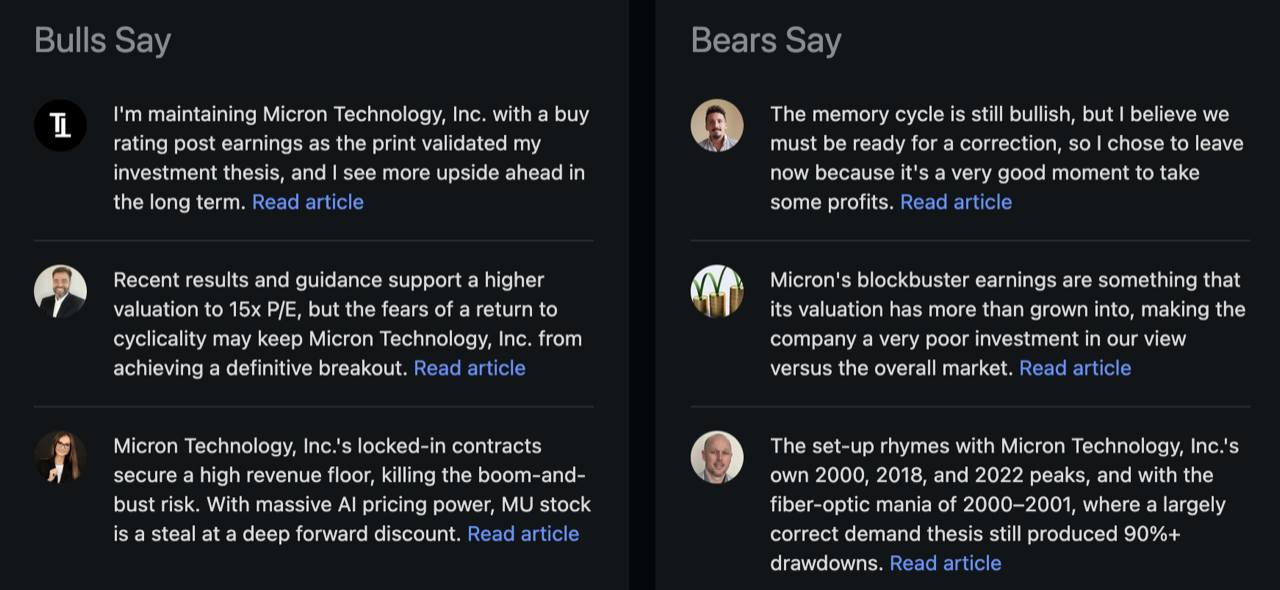
This is the step most people skip. I deliberately read the most bearish articles on a stock, not just the bullish ones. A useful detail on Seeking Alpha is that you can see each author's track record, so you can tell whether a writer calling sell has actually been right or has been calling sell the whole way up.
A worked example: how I looked at Micron
Micron has been one of my better holdings, so it is a good one to run through the checklist. Treat the figures below as a snapshot from when I researched it, since ratings and valuations move.
I start with the price chart, but only to zoom out. I want to see a long-term uptrend over five and ten years, not a hot month. Then the ratings: Micron's Quant rating was a near-perfect Strong Buy, with strong factor grades for growth and profitability, which matters because I want a company that is both growing and making money, not one without the other. A few numbers I always pull: the market cap, to gauge how big the company is; the short interest, where anything above 10 percent is a warning sign and Micron sat around 3 percent; the dividend, which I mostly ignore as a total-return investor; and the forward P/E, which even after a big run was still reasonable for the growth on offer. Finally the analysis, where I read both the bull and the bear case.
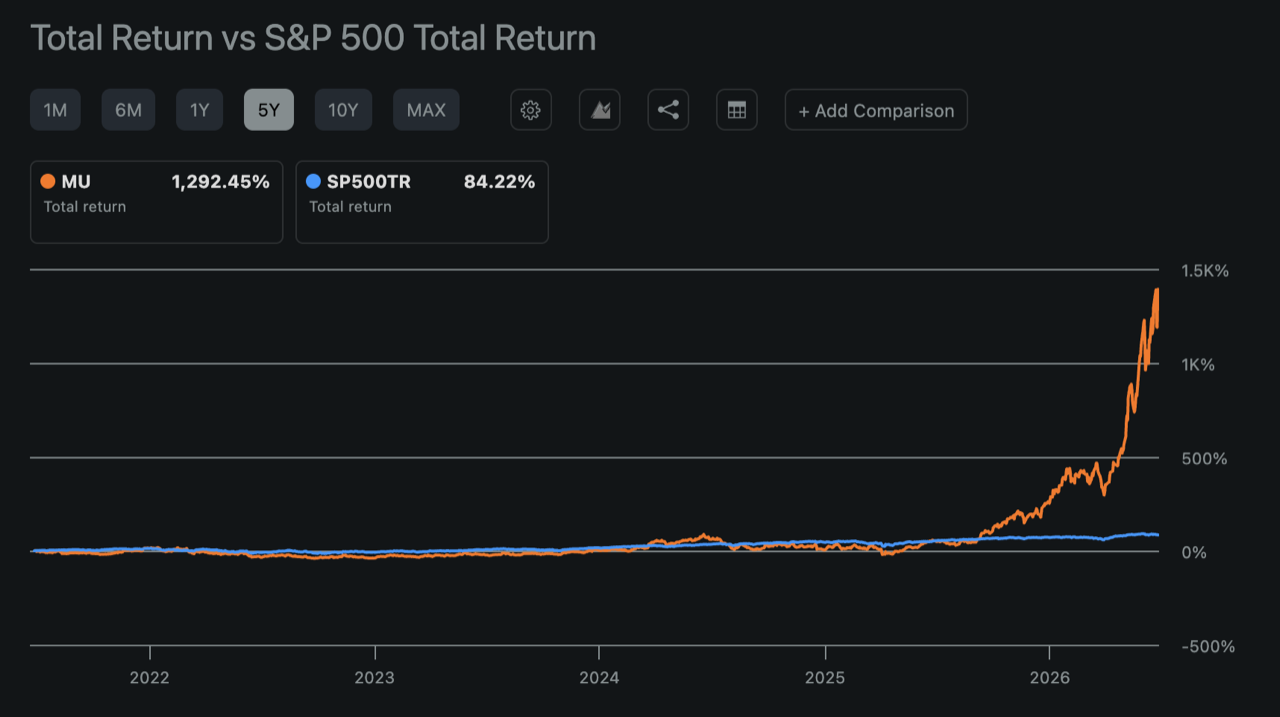
Pulling it together, this is the pattern I am looking for, and the warning signs that make me walk away.
Use AI as a second opinion, after your own homework
Once I have formed a view, I bring it to an AI like Claude as a sparring partner. I paste in what I found, or screenshot a few things, and ask it to challenge my thesis or tell me where I might be wrong. The order matters. Asking a chatbot "is Micron a good buy" gives you a useless answer. Giving it your own reasoning and context gets you something worth reading. AI is the last step, not the first.
If you want to bring your own portfolio context into that process, see our guide to connecting your broker to AI.
The tool I use, and how to try it
You can run this whole checklist with free tools and patience. I pay for Seeking Alpha because it puts the rating, the valuation grades and the bull-versus-bear analysis in one place, which saves me hours. The best value is the Bundle, which pairs Premium with Alpha Picks, their data-driven, buy-and-hold stock picks. Right now the Bundle runs $639 for the first year, down from the usual $798, a saving of $159. For reference, Premium on its own lists at $299 a year and Alpha Picks at $499.
Frequently asked questions
How do I research a stock as a beginner?
Start with the business: is revenue growing, are profits growing, and does it have a moat. Then run three checks before you buy, the rating, the price, and the bear case. A research platform speeds this up, but you can begin with your broker app and a free tool like Yahoo Finance.
What is the Seeking Alpha Quant rating?
It is a data-driven score from 1 to 5 that grades a stock on valuation, growth, profitability and momentum. It is rules-based rather than opinion, which is why many investors use it as a first filter. You can set an alert for when a holding's rating changes.
Do I need a paid tool to research stocks?
No. Your broker app and a free tool like Yahoo Finance will get you started. A paid platform mainly saves time and adds the rating and bear-case layer in one place, which is why I use one for US stocks.
What should I check before buying a stock?
At a minimum: revenue and profit growth, the valuation versus the sector, the rating, the short interest, and the strongest argument against the stock. If you cannot explain why the bear case is wrong, you are not ready to buy.
Is Seeking Alpha worth it?
For US stocks it is the tool I keep coming back to, mainly for the Quant rating and the balanced analysis. It is weaker on international names. The Bundle, which combines Premium and Alpha Picks, is the best-value option.
Kai is an investor who helps people choose the right broker and invest with confidence. He founded MatchMyBroker, a broker-comparison site for a global audience, and EU Investing Hub, his European-focused investing site. He also runs the Smart Money with Kai YouTube channel, where he breaks down investing, brokers and personal finance.
.png)

