A stock screener turns thousands of listed companies into a short list you can actually research: you set the rules (size, valuation, growth, dividends, debt) and it shows only the stocks that pass. Almost every research site has one now, but they differ a lot in which markets they cover, which filters are free and which scores you can screen by.
Short answer: For most investors, InvestingPro is the best stock screener: it screens stocks far beyond the US and lets you filter by its own Fair Value and Financial Health scores, so a value screen shows you how far each stock sits from an estimate of what it is worth. If you buy mainly US stocks, Seeking Alpha Premium's screener built on its Quant Ratings is the strongest. If you want to pay nothing, TradingView has the best free stock screener, with Finviz the fastest free option for US stocks.
I ranked the nine screeners we have reviewed by their MatchMyBroker review scores, the same scores as in our full reviews. Finviz is listed further down with its key facts but without a score or a rank, because we have not reviewed it. Every screener fact below was read on the provider's own pages on 26 November 2026, and the screenshots come from my own accounts.
Stock screeners at a glance
| Screener | Free to use | What you can screen by | Markets | Paid plan |
|---|---|---|---|---|
 InvestingPro | Yes, basic screener on Investing.com | Fair Value, Financial Health and 1,200+ metrics on Pro+ | Global | Pro $227.40 a year at the regular price |
 Seeking Alpha Premium | No, subscribers only | Quant Rating, factor grades, SA analyst and Wall Street ratings | US stocks and ETFs | $299 a year |
 Fiscal.ai | 7-day trial | Hundreds of financial metrics plus an AI filter in plain English | Global | Pro $39 a month billed yearly |
 TradingView | Yes, stock screener on the free plan | Price, valuation, growth, dividends, analyst ratings, technicals | Global | From $12.95 a month billed yearly |
 TipRanks | Yes, basic filters | Smart Score, top analysts, insiders and hedge funds (Premium) | US and more | Premium $360 a year list price |
 Simply Wall St | Yes, top 4 results per screen | The five Snowflake scores, keywords and advanced filters | 90+ markets | Premium $131.40 a year |
 Morningstar Investor | No, part of Investor | Star rating, Fair Value, economic moat and 200+ data points | Stocks, funds and ETFs | $249 a year |
 Koyfin | Yes, 2 saved screens | Over 5,900 filter criteria | Over 100,000 global equities | Plus $39 a month |
 Zacks | Yes, custom screens | Zacks Rank, Style Scores and 45+ ready made Premium screens | US stocks | Premium $249 a year |
Checked on 26 November 2026 on each provider's own pages. Regular prices in US dollars; most of these tools run sales around Black Friday, shown in the ranking at the top while they last.
What makes a good stock screener
- The markets you buy in. A screener that only covers US stocks is no help for a UK, German or Australian portfolio. Check that your exchange is in it before you pay.
- Filters you cannot build yourself. Price, market cap and P/E are everywhere. What you pay for is a score that does the work: a fair value estimate, a quality or health score, an analyst consensus or a quant rating.
- Saved screens and alerts. A screen you run once is a curiosity. A screen you save and get alerts on when a new stock passes is a process.
- Ready made screens. Good starting points such as undervalued large caps, dividend growers or top rated stocks save time while you learn which rules matter to you.
- Fresh data. Free plans often show delayed prices. That is fine for long-term investing, less so if you trade the same day.
The nine stock screeners we rank
Ranked by our review scores out of 5. InvestingPro and Seeking Alpha share the top score; InvestingPro comes first here because its screener covers far more markets.
1. InvestingPro: The best stock screener for value investors anywhere in the world
Investing.com's screener is free to use. InvestingPro adds its own scores to it, so you can screen for stocks trading below Investing.com's Fair Value estimate and with a solid Financial Health score, in the US and in markets around the world.
- What you screen by
- Price, valuation, financials, dividends, growth, returns, risk, technical and profile filters, spread over 11 tabs. Pro covers 100+ metrics, Pro+ more than 1,200.
- InvestingPro scores
- Fair Value, Fair Value upside, analyst price targets and the Financial Health score show as columns you can screen on. On the free screener they are locked.
- Ready made screens
- More than 20, such as Insider Favorites, Momentum Masters and Financial Fortresses. Save your own under My Screeners and download the results.
- Markets
- Stocks in about 70 markets, filtered by country, currency, sector and industry.
- Price
- Pro renews at $227.40 a year and Pro+ at $534.48 a year at the regular price; sales and code MMB lower the first year.
What we like
- Screen by Fair Value and Financial Health, not just ratios
- Strong coverage outside the US, so it works for UK, European and Asian stocks
- The free screener is a real tool, not a teaser
What to watch
- The deepest metrics are on Pro+, not Pro
- Fair Value is a model estimate: a big upside can also mean the market sees a problem
- Busy interface with a lot of upsell on the free site
How I turn a screen into a decision, step by step with real screens, is in our guide to finding undervalued stocks with InvestingPro. Plans and current prices are in our InvestingPro pricing guide, and everything else in our InvestingPro review. Sources: Investing.com stock screener and how to use it.
2. Seeking Alpha Premium: The best screener for US stocks, built on Quant Ratings
Seeking Alpha's screener uses its Quant Ratings and factor grades plus the ratings of Seeking Alpha authors and Wall Street analysts, so you can ask for stocks that every one of those sources rates Buy or better and that also grade well on valuation and growth.
- What you screen by
- Quant Rating, SA analyst and Wall Street ratings, factor grades for valuation, growth, profitability, momentum and EPS revisions, dividend grades, earnings, sector, industry and country.
- Ready made screens
- Top Rated Stocks, Top Growth Stocks, Top Value Stocks, Top Small Cap Stocks, Top Dividend Stocks and more, plus an ETF screener.
- Saving
- Save and name your own screens; they appear in your menu.
- Access
- The ratings screener is for Premium subscribers.
- Price
- Premium costs $299 a year at the list price.
What we like
- Quant Ratings have a long public track record
- One screen combines the quant model, Seeking Alpha authors and Wall Street
- Ready made screens are genuinely useful starting points
What to watch
- Built around US-listed stocks
- No free screener with the ratings
- The best filters only make sense once you know the grading system

Seeking Alpha's ready made lists are explained in our guide to Seeking Alpha Top Rated Stocks, and Premium as a whole in our Seeking Alpha Premium review. Source: Seeking Alpha help centre on screeners.
3. Fiscal.ai: A global fundamentals screener with an AI filter
Fiscal.ai (formerly FinChat) is a research platform for people who read financial statements. Its screener sets minimum and maximum values on hundreds of metrics, and the AI filter lets you describe a screen in plain English instead.
- What you screen by
- Hundreds of financial metrics such as net debt to EBITDA, payout ratio and 10-year dividend growth, with countries, exchanges and industries to include or exclude.
- AI
- The screener on the Pro and Max plans includes AI filters.
- Ready made screens
- Examples such as US High Quality and Global Small-Cap Growth.
- Markets
- Global, with country and exchange filters.
- Price
- Pro $39 a month billed yearly or $49 monthly, after a 7-day free trial.
What we like
- Clean, fast interface with deep company data behind each result
- AI filter for idea generation
- Global coverage with exchange filters
What to watch
- No free screener once the trial ends
- Fewer ready made screens than InvestingPro or Seeking Alpha
- Export and download only on Max
More in our Fiscal.ai review. Sources: Fiscal.ai screener and Fiscal.ai guide.
4. TradingView: The best free stock screener
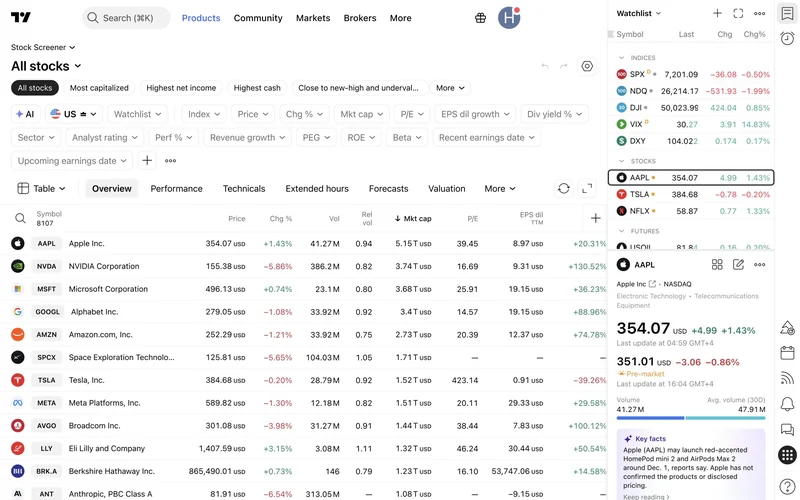
TradingView is best known for its charts, but its stock screener is the most complete one you can use for free. You pick a market, add filters and switch between column sets for performance, valuation, dividends and financial statements.
- What you screen by
- Security info, market data, technicals, financials, dividends, valuation, growth, margins and ratios, with dozens of technical indicators.
- Other screeners
- ETF, bond and crypto screeners in the same layout. The Pine Screener runs your own indicator scripts across a watchlist or index on any paid plan.
- AI
- The AI screener turns a sentence into filters for all paid users (in beta).
- Saving and export
- Save several custom screens and download results as a CSV file.
- Price
- The stock screener works on the free plan. Paid plans start at $12.95 a month billed yearly.
What we like
- A real free screener across markets well beyond the US
- Click a result and you are in the best charts on the web
- Technical and fundamental filters in one place
What to watch
- Fewer fundamental scores than the research tools above
- Pine and AI screeners need a paid plan
- Ads on the free plan
What each TradingView plan adds is in our TradingView review, and other charting and screening sites in our TradingView alternatives guide. Sources: TradingView Stock Screener, screeners walkthrough, Pine Screener and AI Screener.
5. TipRanks: Screen by what analysts, insiders and hedge funds do
TipRanks tracks the calls of analysts, insiders, hedge funds and financial bloggers, and its screener lets you filter on that crowd. The free version covers the basics; Premium adds the filters that make TipRanks different.
- Free filters
- Market cap, price target upside, dividend yield, sector, analyst consensus, investor sentiment, blogger consensus, news sentiment and media buzz.
- Premium filters
- Smart Score (a 1 to 10 score from 8 factors), insider signal, hedge fund signal, and the consensus and price targets of the top analysts only.
- Other screeners
- ETF, penny stock and technical analysis screeners, plus lists such as Top Smart Score Stocks.
- Price
- Premium $360 a year at the list price.
What we like
- Filters on analyst and insider activity you will not find elsewhere
- Smart Score condenses many signals into one number
- Useful free version
What to watch
- The best filters need Premium
- Up to 14 filters in one search, fewer than the data-heavy tools
- Strongest on US stocks
More in our TipRanks Premium review. Sources: how to use the TipRanks stock screener and TipRanks screeners.
6. Simply Wall St: The easiest screener for beginners
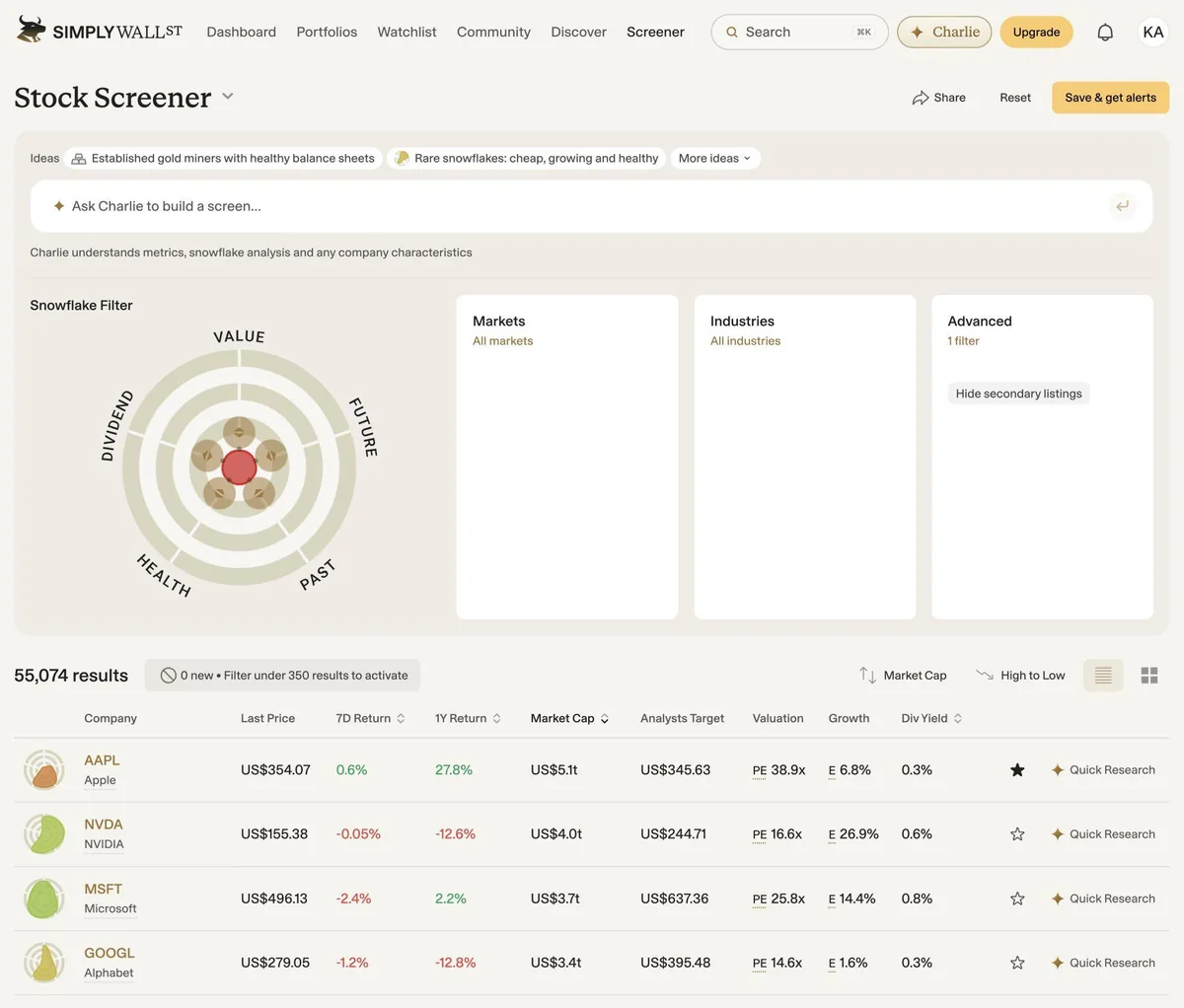
Simply Wall St scores every stock on five points (value, future growth, past performance, financial health and dividends) and draws them as a Snowflake. In the screener you drag those five scores instead of setting ratios, then narrow by market and industry.
- What you screen by
- The Snowflake score and shape, market and industry, keywords (in beta) and advanced filters such as returns, valuation multiples, growth forecasts, margins, dividends and insider buying.
- Ready made screens
- More than 100 curated screens.
- Markets
- More than 120,000 stocks in 90+ markets.
- Alerts
- Save a screen and you get a weekly notification when new companies match.
- Price
- Free shows the top 4 results of each screen. Premium $131.40 a year shows all results.
What we like
- No ratio knowledge needed to build a sensible screen
- Wide global coverage
- Charlie, the AI assistant, can build a screen from plain words
What to watch
- Free accounts see only the first 4 results
- Scores are a simplification, so check the numbers behind them
- Fewer raw metrics than InvestingPro or Koyfin
More in our Simply Wall St review. Sources: Simply Wall St screener help and Simply Wall St plans.
7. Morningstar Investor: Screen by star rating, fair value and moat
Morningstar's analysts publish a fair value estimate, a star rating and an economic moat rating (wide, narrow or none) for the stocks they cover. Morningstar Investor lets you screen on those ratings together with performance and valuation data.
- What you screen by
- More than 200 data points across stocks, funds and ETFs, with Morningstar's own ratings alongside.
- AI
- AI Quick Filters turn a plain-language request into screener filters.
- Ready made lists
- Pre-filtered stock lists to start from.
- Price
- $249 a year or $34.95 a month, after a 7-day trial.
What we like
- Analyst fair values and moat ratings you can screen on
- Screens stocks, funds and ETFs in one place
- Saved screens and rating change alerts
What to watch
- Analyst ratings cover thousands of stocks, not the whole market
- Less useful for short-term or technical screening
- No free screener with the ratings
More in our Morningstar Investor review. Source: Morningstar Investor stock research.
8. Koyfin: The deepest free global screener for data lovers
Koyfin looks like a professional terminal and has a screener to match. Even the free plan screens stocks across global markets.
- What you screen by
- Over 5,900 filter criteria.
- Markets
- Over 100,000 global equities.
- Free plan
- 2 saved screens, stocks only.
- Paid plans
- Plus ($39 a month billed yearly) adds unlimited screens, ETF screening and Check Ticker, which shows why a stock passes or fails a screen.
What we like
- Huge filter list and global coverage, even free
- Dashboards and charts to dig into each result
- 30-day money back guarantee on paid plans
What to watch
- Only 2 saved screens on the free plan
- Dense screens take time to learn
- No ready made scores like Fair Value or Quant Ratings
Sources: Koyfin stock screener and Koyfin plans.
9. Zacks: Screen by Zacks Rank and Style Scores
Zacks is known for the Zacks Rank, which sorts stocks from 1 (Strong Buy) to 5 (Strong Sell) mainly on earnings estimate revisions. Its screener lets you combine the Rank with its Value, Growth, Momentum and Income Style Scores and almost any other data point.
- What you screen by
- Zacks Rank, Style Scores and a long list of fundamental and price criteria.
- Ready made screens
- Zacks Premium has more than 45 predefined screens, grouped into value, growth, momentum, income and more.
- Zacks #1 Rank
- The top 5% of the stocks Zacks ranks.
- Price
- Premium $249 a year after a 30-day free trial.
What we like
- A ranking system with a long history behind it
- Many ready made screens to learn from
- Free trial to test it
What to watch
- US stocks only in practice
- Dated interface
- Many features sit behind Premium
Sources: Zacks stock screening and Zacks Premium Screens.
Other stock screeners
Finviz is one of the most used free screeners in the world, so it belongs on this page, but we have not reviewed it, so it has no score and no rank. Facts read on its own pages on 26 November 2026.
 Finviz
 is a fast screener with market heat maps and charts, built for US-listed stocks.
- Markets
- US only: NASDAQ, NYSE and AMEX.
- Free
- Basic filters, 50 saved presets, 20 rows per page, delayed data, no export and no alerts.
- Elite
- Advanced filters (20+ more), unlimited presets, real-time data, export to Excel and CSV, and alerts.
- Price
- Elite $299.50 a year or $39.50 a month, with a 30-day refund period.
Source: Finviz Elite.
The best free stock screeners
You do not have to pay to screen stocks. These are the free options worth using, and what you give up on each:
| Free screener | Best for | The catch |
|---|---|---|
| TradingView | Global stocks with technical and fundamental filters | Pine and AI screeners need a paid plan; ads |
| Finviz | Fast screening of US stocks | US only, delayed data, no export or alerts |
| Koyfin | Deep global data | Only 2 saved screens, stocks only |
| Investing.com | Global stocks, ready made screens | Fair Value and health scores locked |
| Simply Wall St | Beginners, visual scores | Only the top 4 results of each screen |
| TipRanks | Analyst consensus and sentiment | Smart Score and top analyst filters need Premium |
How to build a useful screen in five steps
- Start from your market. Choose the countries or exchanges you can actually buy on your broker.
- Set a size floor. A minimum market cap removes thinly traded shares that are hard to buy and sell.
- Add one quality rule. For example positive free cash flow, a healthy balance sheet score, or debt below a level you are comfortable with.
- Add one value or growth rule, not five. Too many filters leave you with nothing, or with companies that only pass by accident.
- Save it and read the results. A screen is a shortlist, not a buy list. Read the latest results and filings of each company before you buy.
Once you have a shortlist, you need a broker that reaches those markets at a low cost. Our best UK brokers, best brokers in Europe and best brokers in the US lists compare them. For research beyond screening, see our best stock analysis tools.
How we compared these screeners
We included screeners that a private investor in the UK, Europe, the UAE or the US can sign up to, and that publish what their screener does. For each one we read its own screener pages, help centre and plans on 26 November 2026 and noted what you can filter on, which markets it covers, what is free and what a paid plan costs. Where a page did not say something, we say so rather than guess. The nine reviewed tools are ranked by the scores from our full reviews; Finviz has no score because we have not reviewed it, so it is listed without a rank. The screenshots are from my own accounts; names on Seeking Alpha's subscriber lists are blurred. We may earn a commission from some providers on this page, at no extra cost to you. It never affects our ranking.
FAQ
What is the best stock screener?
Of the screeners we have reviewed, InvestingPro scores highest for screening: its Pro+ plan lets you filter on more than 1,200 metrics, including its own Fair Value and Financial Health scores, across stocks in many markets. Seeking Alpha Premium is the best fit if you mainly buy US stocks and want to screen by Quant Rating and factor grades. If you want a free screener, start with TradingView.
What is the best free stock screener?
TradingView's stock screener is the most complete free option we use: it covers stocks well beyond the US, filters on price, valuation, growth, dividends and analyst ratings, and lets you save screens and export results. Finviz is the fastest free screener for US stocks, Koyfin's free plan gives you two saved screens across more than 100,000 global equities, and Investing.com has a free screener too, with the valuation scores kept for InvestingPro.
Is a paid stock screener worth it?
Only if you use what the free ones lack. Paid screeners add their own scores (Fair Value at InvestingPro, Quant Ratings at Seeking Alpha, the Smart Score at TipRanks, star ratings and moats at Morningstar), longer financial history, saved screens with alerts and real-time data. If you mostly filter by price, market cap, P/E and dividend yield, a free screener does the job.
Which stock screener is best for beginners?
Simply Wall St is the easiest to start with: you drag five Snowflake scores (value, future growth, past performance, financial health and dividends) instead of setting ratios, and you can type what you want in plain words. TradingView is a good free choice once you know which ratios matter to you.
Which stock screener covers UK and European stocks?
InvestingPro, TradingView, Koyfin, Fiscal.ai and Simply Wall St all screen stocks outside the US. Finviz covers only US-listed stocks (NASDAQ, NYSE and AMEX), and Seeking Alpha and Zacks are built around US stocks.
Can I screen stocks with AI?
Yes. TradingView, Fiscal.ai, Simply Wall St and Morningstar Investor can turn a sentence such as "profitable small caps with low debt" into filters. Always check the filters it built before you trust the list, because the AI can misread what you meant.
Disclaimer. A stock screener lists companies that match your filters; it does not tell you whether to buy them. Scores such as Fair Value, Quant Ratings or the Smart Score are model outputs and can be wrong. Prices and features change; check the provider's page before you subscribe. This article is for information only and is not financial advice. It contains affiliate links: we may earn a commission if you sign up through them, at no extra cost to you.